
Security
EU Tightens Smoke Detector Standby Power Checks
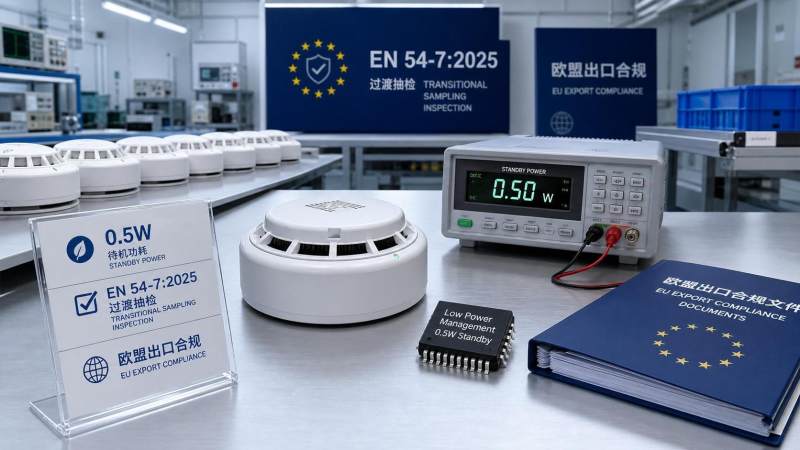
On June 19, 2026, the European Commission signaled a stricter enforcement phase for imported smoke detectors by tightening the standby power limit from 1.0W to 0.5W and beginning transition-period spot checks tied to EN 54-7:2025. For exporters, component buyers, manufacturers, testing-related parties, and delivery teams, the development deserves attention because it connects product design, customs inspection exposure, and compliance readiness in a single execution signal rather than a routine standards update.
What Has Changed in the Current Enforcement Notice
The confirmed facts are limited but clear. The European Commission announced on June 19 that market surveillance for imported Smoke Detectors is being strengthened with immediate effect. The standby power ceiling is tightened from the current 1.0W to 0.5W, and spot checks during the transition to EN 54-7:2025 have been launched.
Shenzhen customs data cited for the third week of June shows the export inspection rate for this product category rising to 22% in a single week. The stated reason is that some domestically made battery-powered detectors had not been adapted to the new low-power management IC requirement. The rule change directly affects the energy-efficiency design and BOM selection of Smoke Detectors and related emergency lighting systems.
Where the Pressure Is Likely to Appear First
Export shipments now face a narrower compliance margin
From an industry perspective, exporters are likely to feel the first impact at shipment preparation and customs-facing documentation stages. When inspection rates rise, the practical issue is not only whether a product is broadly marketable, but whether technical files, test evidence, and product configuration can consistently support the lower standby power threshold during review.
Design and sourcing teams may need to revisit component choices
Analysis shows that the stated issue around battery-powered detectors and low-power management IC adaptation points directly to upstream design and procurement decisions. For manufacturing and sourcing teams, the change is less about a generic regulatory update and more about whether existing component selections still support the lower power target without creating mismatch risks in BOM control, model variants, or ongoing orders.
Testing and certification-related work may become more time-sensitive
For certification-related companies and testing service providers, the start of transition-period spot checks under EN 54-7:2025 suggests that timing and interpretation now matter more in project handling. What deserves closer attention is whether existing reports, technical descriptions, and product declarations remain aligned with the stricter power requirement and with any customer-side compliance expectations tied to the new standard transition.
Buyers and channel participants may need tighter delivery coordination
Procurement teams, distributors, and supply-chain service providers may be affected through delivery scheduling, model approval, and replacement planning. If inspection frequency remains elevated, even compliant products may require closer coordination on specification confirmation, document completeness, and shipment sequencing, especially where smoke detectors are supplied together with related emergency lighting systems.
What Companies Should Watch Closely Now
Check whether product files match the lower standby limit
Companies should first review whether product specifications, internal test records, and external compliance materials consistently reflect the 0.5W standby threshold. Where documents still correspond to the previous 1.0W baseline, the gap may become a practical risk point during inspection or customer review.
Review BOM exposure in battery-powered models
Observably, the reported mismatch involving low-power management ICs makes battery-powered detector models a priority area for review. Manufacturers and sourcing teams should focus on whether current BOM structures, approved alternatives, and in-production configurations remain technically aligned with the tighter requirement.
Track how EN 54-7:2025 is referenced in transactions
Because the input only confirms that transition-period spot checks have started, it is more appropriate to understand the current stage as an enforcement signal rather than a fully detailed execution framework. Companies should therefore pay attention to how EN 54-7:2025 begins to appear in customer specifications, tender documents, technical appendices, and compliance review requests.
Prepare for possible delivery and after-sales questions
Exporters and after-sales teams should also watch for practical issues around shipment timing, model traceability, and post-delivery technical clarification. If products shipped under earlier assumptions are questioned against the tighter power threshold, responsive documentation and version tracking may become important in reducing trade friction.
Why This Looks More Like an Execution Signal Than a Routine Update
Analysis shows that this development is significant less because it introduces a broad new policy narrative and more because it combines a stricter numerical limit, a named standard transition, and an immediately visible inspection response. The rise in Shenzhen export inspections indicates that enforcement attention is already interacting with product configuration realities.
At the same time, it would be premature to treat every downstream consequence as settled. The input does not provide fuller details on official implementation wording, certification handling, or transaction-level acceptance practice. For that reason, this is better understood as a rule change with clear operational impact already appearing, while the exact execution rhythm still warrants continued observation.
How the Market May Need to Read This Development
From an industry perspective, the immediate message is that standby power performance has moved from a technical optimization issue into a more direct compliance and shipment-readiness issue for smoke detector exports linked to the EU market. The effect is especially relevant where product design, BOM decisions, inspection exposure, and standard-transition review intersect.
A neutral reading is therefore the most appropriate one: this is not merely a background standards update, but it is also not yet a fully transparent end-state for market practice. At present, companies should read it as an implemented enforcement change with practical trade and design implications, while continuing to monitor how compliance interpretation and execution develop.
Basis of This Article
This article is generated based on the user-provided news title, event date, and event summary. For events of this type, commonly relevant source categories may include official notices, regulatory releases, customs or trade authority information, industry association updates, standards organization documents, and reporting by authoritative media.
No specific official source link was provided in the input, so the exact source documentation still requires further verification. What remains worth tracking includes later policy detail, certification interpretation, tender document updates, market feedback, and how companies implement the requirement in actual export, procurement, and delivery workflows.
The VitalSync Intelligence Brief
Receive daily deep-dives into MedTech innovations and regulatory shifts.