
Security
Security Innovation Trends Changing Smoke Detector Design
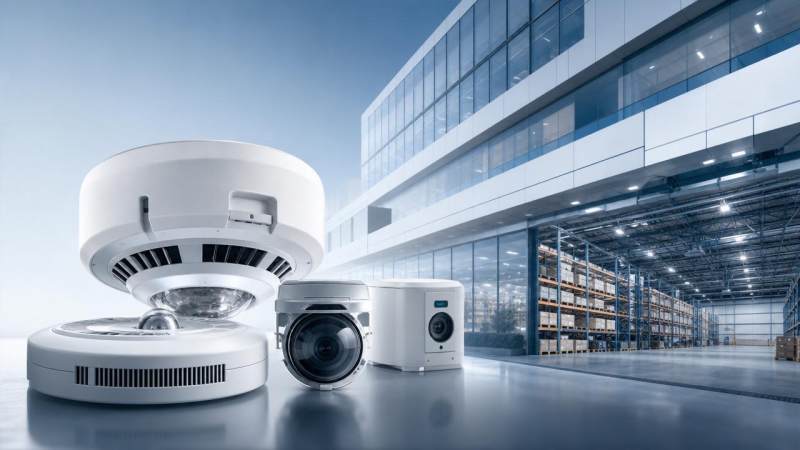
Security innovation is rapidly reshaping how smoke detectors are designed, specified, and integrated into modern safety systems. For researchers tracking global security upgrades, this topic reveals how AI sensing, compliance standards, connectivity, and optical technologies are driving smarter fire detection. Understanding these trends helps decision-makers evaluate future-ready solutions that align with evolving urban safety, infrastructure, and risk management demands.
Why scenario differences matter when evaluating security innovation in smoke detector design
Not all smoke detectors face the same risks, operating environments, or compliance pressures. A device that performs well in a residential tower may be poorly matched to a logistics warehouse, a hospital ward, or a smart construction site. That is why security innovation in this field should not be viewed only as a technology story. It is also a scenario-fit question involving occupancy density, false alarm tolerance, maintenance access, network architecture, response workflows, and regulatory accountability.
For information researchers and decision-support teams, the most useful lens is to ask how current design trends change performance under specific business conditions. Modern smoke detector development increasingly combines multi-sensor analysis, edge intelligence, cloud reporting, optical signal refinement, and lifecycle diagnostics. These upgrades can create measurable advantages, but only when they match the practical realities of the site.
This scenario-based view is especially relevant in the 2026 environment of digital infrastructure expansion and urban safety upgrades. Across public facilities, industrial operations, and mixed-use buildings, buyers are not just looking for code-compliant hardware. They want systems that support faster detection, better signal discrimination, lower maintenance burden, and more reliable integration with broader security assurance platforms. In that context, security innovation becomes a design filter for selecting the right detector architecture for the right environment.
Where these design trends are showing up first
The strongest shifts in smoke detector design are appearing in environments where traditional alarm logic no longer meets operational expectations. Common high-interest scenarios include:
- Smart commercial buildings that need integrated fire, access, surveillance, and building automation workflows
- Healthcare and education facilities where nuisance alarms can disrupt sensitive populations
- Warehouses and industrial facilities with dust, heat variation, airflow complexity, or high ceilings
- Hospitality and residential towers where occupant safety and remote maintenance are both critical
- Construction and temporary project sites that need flexible, connected, and fast-deploy protection
- Urban public infrastructure where resilience, compliance traceability, and centralized monitoring are major priorities
In all of these cases, smoke detector design is being influenced by broader security innovation trends: smarter sensing, interoperable communications, stronger cybersecurity expectations, and better use of optical and environmental data. The result is a shift away from one-size-fits-all selection toward more context-aware fire detection planning.
A practical comparison of major application scenarios
The table below highlights how scenario demands change the way researchers and buyers should assess design priorities.
How security innovation is changing detector design in commercial and smart building scenarios
In smart office towers, retail complexes, and mixed-use properties, smoke detectors are no longer isolated alert devices. They are becoming data nodes within larger security and facility management ecosystems. Here, security innovation has three major implications.
First, integration matters as much as detection. Building operators increasingly want smoke alarms to trigger linked actions such as door release logic, elevator control, video verification, and mass notification. This means detector design must support reliable communication protocols, event prioritization, and clean interoperability with centralized platforms.
Second, false alarm reduction has become a business requirement. In high-traffic properties, unnecessary evacuations damage tenant confidence and disrupt operations. Multi-criteria detectors that combine smoke sensing with heat, particulate patterning, or intelligent analytics are gaining preference because they improve discrimination between real incidents and environmental noise.
Third, operators now value maintenance intelligence. Devices that can report contamination levels, device health, battery status, and signal degradation support more efficient building-wide servicing. For researchers evaluating product direction, this is a clear sign that security innovation is moving detector design toward continuous operational visibility, not just emergency response.
Why healthcare, education, and public facilities need a different judgment standard
Hospitals, schools, transit hubs, and civic buildings present a different challenge. In these environments, the impact of a poor-quality alarm event can be as important as the speed of detection. A hospital cannot tolerate frequent nuisance alarms in critical care areas. A school needs simple response coordination and high reliability across multiple wings. A transport terminal needs centralized oversight across changing occupancy patterns.
That is why detector design in these scenarios is increasingly shaped by alarm intelligence rather than raw sensitivity alone. Advanced optical chambers, adaptive thresholds, and context-aware analysis help distinguish smoke signatures from steam, dust, or temporary airborne disturbances. This is one of the most practical examples of security innovation translating into operational value.
Another decision factor is traceability. Public institutions often face stronger documentation, inspection, and policy review requirements. Devices and systems that support event logs, remote status checks, standards-based reporting, and easier audit preparation can provide a major lifecycle advantage. For information researchers, this means product comparisons should include compliance workflow support, not only detector specifications.
Industrial, warehouse, and logistics scenarios: where environment shapes design choice
Industrial and logistics sites are among the clearest examples of why application context should drive detector selection. Warehouses may have high ceilings, rapid airflow, forklifts, temperature fluctuations, and suspended particulates. Manufacturing sites may introduce vapor, dust, or intermittent emissions that confuse basic sensing methods. In these spaces, smoke detector design must cope with environmental complexity before it can deliver dependable safety performance.
Current security innovation trends address these issues in several ways. Enhanced optical sensing improves particle interpretation. Intelligent compensation algorithms help maintain stability under changing conditions. Remote diagnostics reduce the need for disruptive physical inspection across large sites. In some cases, hybrid architectures combining smoke, heat, or aspirating detection are more appropriate than standard point detectors.
For decision-makers, the key lesson is simple: a detector that is technologically advanced on paper may still be a poor fit if its sensing logic was not designed for the site’s environmental profile. Researchers should therefore examine airflow mapping, contamination exposure, maintenance accessibility, and communication infrastructure alongside product claims.
Temporary projects, smart construction sites, and rapidly changing layouts
Construction zones and temporary facilities have become a major watchpoint in global safety upgrades. These sites are dynamic, often fragmented, and difficult to protect with fixed legacy systems. Layouts change quickly, power availability may be uneven, and project teams need visibility across multiple subcontractors and risk zones.
In this setting, security innovation is pushing smoke detector design toward flexibility. Wireless connectivity, temporary network enrollment, location awareness, and portable supervisory dashboards are increasingly relevant. The value proposition is not only faster installation but also more adaptive risk coverage as work phases change.
Researchers assessing this category should look beyond the headline feature of “wireless.” Important questions include signal resilience around metal structures, battery management, tamper alerts, redeployment speed, and the ability to synchronize with broader site security controls. In temporary settings, practical deployment reliability often matters more than advanced analytics alone.
How to match smoke detector design trends to your specific scenario
A useful selection framework is to evaluate every project through five filters:
- Environment: Is the air clean, dusty, humid, high-flow, or temperature-variable?
- Occupancy impact: What happens if an alarm is delayed, missed, or falsely triggered?
- Integration needs: Must the detector connect with surveillance, access, building automation, or remote command systems?
- Maintenance model: Can staff physically inspect devices often, or is remote diagnostics essential?
- Compliance exposure: How important are logs, standards alignment, and audit readiness?
When these filters are applied consistently, security innovation becomes easier to evaluate in practical terms. Instead of asking which product is most advanced, teams can ask which design approach best supports their environment, workflow, and risk accountability.
Common misjudgments that weaken scenario fit
Several recurring mistakes appear across procurement research and project planning. One is assuming that higher sensitivity always means better safety. In many settings, poorly managed sensitivity increases nuisance alarms and reduces operator trust. Another is focusing on acquisition cost without modeling maintenance, testing frequency, and downtime impact over the product lifecycle.
A third mistake is treating connectivity as optional. As security innovation continues to align fire detection with digital infrastructure, disconnected devices can create visibility gaps in large or distributed properties. Finally, some teams overvalue feature lists while ignoring standards, local code compatibility, and actual site conditions. Good detector design is not simply feature-rich; it is context-appropriate, maintainable, and operationally credible.
FAQ: scenario-based questions researchers often ask
Which scenarios benefit most from AI-enabled smoke detection?
AI-enabled or analytics-assisted designs are especially valuable in busy commercial buildings, healthcare spaces, and large public facilities where distinguishing real incidents from environmental interference is crucial. The stronger the need to reduce false alarms without losing response speed, the more relevant this form of security innovation becomes.
Are advanced detectors always necessary for smaller properties?
Not always. Smaller or simpler properties may not need the same degree of analytics or integration. However, remote diagnostics, easier compliance reporting, and dependable optical sensing can still deliver value. The right choice depends on maintenance capacity, occupancy risk, and future expansion plans.
What should researchers compare besides technical specifications?
Compare scenario fit, interoperability, environmental tolerance, total lifecycle servicing, cybersecurity posture for connected systems, and support for inspection or audit workflows. These factors often determine whether security innovation translates into practical performance.
A focused way to move from trend tracking to better specification
For research-led organizations, the next step is to connect trend analysis with site-specific decision criteria. Smoke detector design is changing because the environments around it are changing: buildings are more connected, projects move faster, compliance scrutiny is deeper, and operators expect more actionable data from every safety device. The most relevant security innovation is therefore not the newest feature in isolation, but the design direction that improves fit for a defined scenario.
GSIM’s perspective is especially useful in this context because the value of fire detection technology increasingly depends on how global standards, intelligent security systems, and optical performance trends intersect. Researchers, specifiers, and project planners should begin by mapping their operating environment, risk profile, and integration needs. From there, they can identify whether the priority is false alarm control, industrial durability, public accountability, smart building interoperability, or flexible temporary deployment.
If your team is evaluating future-ready detection strategies, use scenario-based comparison as the first filter. That approach will help transform broad market signals into practical specification guidance, stronger investment decisions, and smoke detection systems that truly support safer, more intelligent infrastructure.
The VitalSync Intelligence Brief
Receive daily deep-dives into MedTech innovations and regulatory shifts.