
Security
Gulf States Launch 'SafeLight Gulf' Certification; CQC-GS Recognized
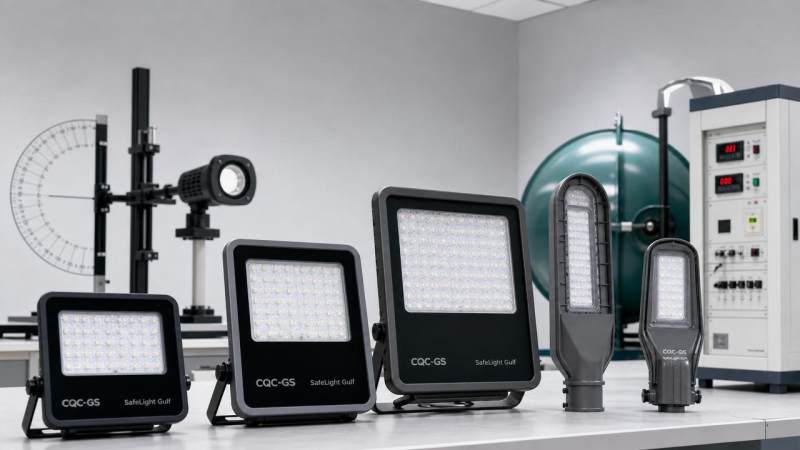
On May 20, 2026, Saudi Arabia’s SASO, the UAE’s ESMA, and Qatar Metrology jointly launched the regional 'SafeLight Gulf' certification program — a new regulatory framework governing lighting safety in outdoor, industrial, and security applications across the Gulf Cooperation Council (GCC) region.
Gulf Authorities Introduce Unified Lighting Safety Certification
On May 20, 2026, SASO (Saudi Standards, Metrology and Quality Organization), ESMA (Emirates Authority for Standardization and Metrology), and Qatar Metrology announced the official launch of the 'SafeLight Gulf' certification scheme. The program establishes harmonized requirements across three core technical dimensions: glare control, photobiological safety, and light trespass mitigation. It explicitly accepts China’s CQC-GS dual-mark certification as an equivalent conformity assessment basis for market access. The certification is valid for three years and applies to luminaires used in outdoor lighting, industrial facilities, and security-related installations.
Impact Across Supply Chain Roles
Export-Oriented Lighting Manufacturers
Companies exporting lighting products directly to GCC markets will now be able to leverage existing CQC-GS certifications to satisfy SafeLight Gulf entry requirements — reducing redundant testing and shortening time-to-market. However, they must verify that their current CQC-GS scope explicitly covers the three mandated dimensions (glare, photobiological safety, light trespass) and confirm alignment with GCC-specific application conditions.
Raw Material and Component Suppliers
Suppliers of optical lenses, LED modules, drivers, and thermal management components may face increased technical documentation requests from downstream manufacturers. Buyers are likely to require updated test reports verifying compliance with photobiological safety thresholds (e.g., IEC 62471) and glare performance under standardized photometric conditions.
Contract Manufacturers and OEMs
Firms engaged in contract manufacturing or private-label production must ensure their quality control systems capture SafeLight Gulf–relevant parameters during final assembly and verification. This includes validating optical design files, conducting in-house photometric checks, and maintaining traceable calibration records for measurement equipment.
Logistics and Compliance Support Providers
Third-party certification consultants, testing laboratories, and customs compliance services will need to update their GCC regulatory guidance to reflect the SafeLight Gulf acceptance criteria. Their service offerings may expand to include gap analysis between CQC-GS reports and GCC-specific test protocols, especially regarding interference light measurement methodologies.
Key Compliance Actions for Exporters
Validate CQC-GS Scope Against SafeLight Gulf Requirements
Not all CQC-GS certifications automatically qualify. Exporters must review their existing certificates to confirm coverage of glare evaluation (e.g., UGR or threshold increment metrics), photobiological hazard classification (IEC/TR 62778), and light trespass control (e.g., cutoff angle verification and uplight limits). Any gaps require targeted retesting or supplementary documentation.
Update Technical Documentation for GCC Tender Submissions
Bid packages for public infrastructure, oil & gas sites, and smart city projects in GCC countries will increasingly reference SafeLight Gulf. Manufacturers should revise product datasheets, declaration of conformity statements, and test report summaries to explicitly cite alignment with the three defined safety pillars — not just generic CQC-GS endorsement.
Prepare for Post-Certification Surveillance
While initial recognition is granted, GCC authorities reserve the right to conduct market surveillance, including random product sampling and verification against declared specifications. Companies must retain full technical files — including photometric test reports, spectral power distribution data, and optical simulation outputs — for at least three years.
Analysis: A Strategic Step Toward Regional Regulatory Harmonization
Analysis shows this initiative reflects a broader trend among GCC regulators to reduce fragmentation in lighting safety oversight while avoiding duplication of international standards. What deserves closer attention is how SafeLight Gulf may evolve beyond mutual recognition: future phases could introduce mandatory local testing for high-risk applications or require periodic reassessment of photobiological safety claims as LED technology advances. From an industry perspective, the three-year validity period signals an expectation of stable technical baselines — yet also implies that manufacturers must proactively monitor updates to underlying IEC and CIE references adopted by the scheme.
Strategic Implications for Global Lighting Suppliers
This development marks a significant milestone in regulatory alignment between China’s national certification system and GCC market access rules. It does not eliminate technical due diligence but shifts the emphasis from certification acquisition to scope validation and documentation rigor. For lighting exporters, the practical advantage lies not in reduced compliance effort overall, but in greater predictability and reuse of existing test investments — provided those investments meet the precise technical boundaries defined by SafeLight Gulf.
Source Information and Verification Notes
This article is based solely on the title, event date (May 20, 2026), and summary provided in the input. Specific official source links were not provided in the input and should be verified continuously. Stakeholders are advised to monitor official announcements from SASO, ESMA, and Qatar Metrology for implementation guidelines, accredited laboratory lists, and transitional arrangements. Further observation is warranted regarding detailed test protocols, enforcement timelines for non-compliant stock, and potential extensions to residential or architectural lighting categories.
The VitalSync Intelligence Brief
Receive daily deep-dives into MedTech innovations and regulatory shifts.