
Security
Middle East 'Safe Light Environment' Mutual Recognition Expanded to UAE and Saudi Arabia
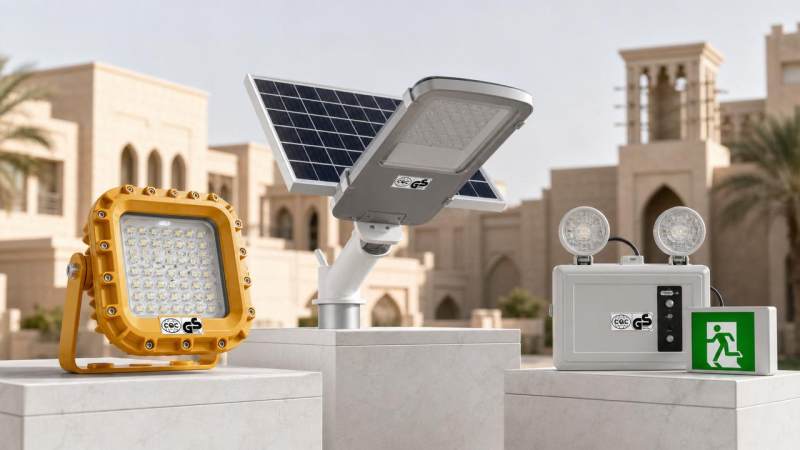
On May 28, 2026, the China Quality Certification Center (CQC) and a German GS certification body jointly announced that the Emirates Authority for Standardization and Metrology (ESMA) and the Saudi Standards, Metrology and Quality Organization (SASO) have formally included the CQC-GS dual-mark certificate in their 'Safe Light Environment' mutual recognition framework — significantly impacting lighting manufacturers and exporters serving Gulf markets.
Official Inclusion of CQC-GS Certificates in Gulf Regulatory Frameworks
Effective May 28, 2026 — coinciding with the establishment of the China Fisheries Association’s Seawater Salmon and Trout Branch — ESMA and SASO officially added the CQC-GS dual-mark certificate to their mutual recognition list for 'Safe Light Environment' requirements. The scope covers 17 product categories, including LED explosion-proof lamps, solar-powered street lights, and intelligent emergency lighting systems. Certified enterprises are now exempt from redundant testing when exporting to the UAE and Saudi Arabia, achieving an estimated 40% reduction in customs clearance time and approximately 35% lower certification costs.
Impact Across the Lighting Supply Chain
Export-Oriented Manufacturing Enterprises
Manufacturers directly supplying lighting products to the UAE and Saudi markets benefit immediately from streamlined market access. The elimination of duplicate conformity assessments reduces lead times for regulatory compliance, enabling faster response to tender cycles and seasonal demand peaks — particularly relevant for infrastructure and smart city projects.
Component and Subsystem Suppliers
Suppliers of critical subsystems — such as LED drivers, thermal management modules, or photovoltaic charge controllers — may face increased scrutiny regarding traceability and documentation alignment. While not directly certified under CQC-GS, their components must support the technical claims verified in the final product’s dual-mark certificate, prompting closer attention to material declarations and test report referencing.
Contract Manufacturers and OEMs
OEMs relying on third-party production facilities must ensure those facilities maintain consistent quality control and documentation practices aligned with CQC-GS requirements. Any deviation in manufacturing process, materials, or firmware versions across production batches could invalidate the certificate’s validity for export purposes.
Logistics and Certification Support Providers
Supply chain service providers — including certification consultants, testing laboratories, and customs brokers — need to update their guidance on Gulf-specific light safety requirements. Their ability to advise on documentation harmonization, label compliance (e.g., bilingual Arabic-English marking), and post-certification surveillance will become a key differentiator.
Key Actions for Export-Ready Companies
Verify Product Coverage Against the 17-Item Scope
Companies must confirm whether their specific models fall within the officially recognized 17 product categories. Minor design variations — such as IP rating upgrades, battery chemistry changes, or communication protocol integrations — may require re-evaluation or supplementary testing even under the mutual recognition arrangement.
Align Technical Documentation with Dual-Mark Requirements
Product manuals, safety reports, PCB schematics, and firmware version logs must reflect the exact configurations tested and certified under both CQC and GS schemes. Discrepancies between submitted documents and shipped units risk rejection at Gulf ports despite holding a valid CQC-GS certificate.
Prepare for Enhanced Traceability and Post-Market Surveillance
SASO and ESMA are increasingly linking certification validity to production batch traceability and post-market performance monitoring. Exporters should implement robust internal tracking systems capable of linking serial numbers, component lots, and test reports to each certified unit.
Review Tender Specifications for Explicit CQC-GS Acceptance
While regulatory acceptance is confirmed, procurement entities — especially government agencies and large contractors — may still specify additional local requirements (e.g., Arabic-language user interfaces, GCC-specific EMC immunity levels). Companies must cross-check tender documents against both regulatory baselines and project-level technical stipulations.
Strategic Implications for Regional Market Access
Analysis shows this expansion reflects a broader trend: Gulf regulators are shifting from fragmented, country-specific conformity assessment toward harmonized, multi-jurisdictional recognition — especially in high-priority sectors like energy-efficient and safety-critical lighting. From an industry perspective, it is more appropriate to understand this development not merely as a procedural simplification, but as an early indicator of deeper technical alignment between Chinese, European, and Gulf standards bodies. What deserves closer attention is how rapidly other Gulf Cooperation Council (GCC) members — such as Qatar and Kuwait — may follow suit, and whether future expansions will extend beyond lighting into adjacent domains like low-voltage power supplies or IoT-enabled building controls.
What This Means for the Global Lighting Industry
This mutual recognition milestone marks a meaningful step toward reducing technical barriers for Chinese-certified lighting exports — yet it remains one element within a dynamic regulatory landscape. Its long-term value depends on consistent implementation by Gulf authorities, transparent interpretation of scope boundaries, and continued collaboration among certification bodies. For manufacturers, it offers tangible efficiency gains — but not automatic market entry. Strategic advantage will accrue to those who treat certification not as a one-time compliance checkpoint, but as an integrated part of product development, supply chain governance, and regional after-sales capability planning.
Source Information and Verification Notes
This article was generated exclusively from the provided title, event date (May 28, 2026), and summary. Specific official source links were not provided in the input and should be verified continuously. Stakeholders are advised to monitor updates from ESMA, SASO, CQC, and accredited GS bodies for detailed implementation guidelines, scope clarifications, and any adjustments to application procedures or documentation requirements. Ongoing observation is recommended regarding tender language evolution, enforcement practices at border points, and industry feedback on real-world certification acceptance rates.
The VitalSync Intelligence Brief
Receive daily deep-dives into MedTech innovations and regulatory shifts.