
Security
Vietnam Requires Dual Certificates for Imported PPE Helmets
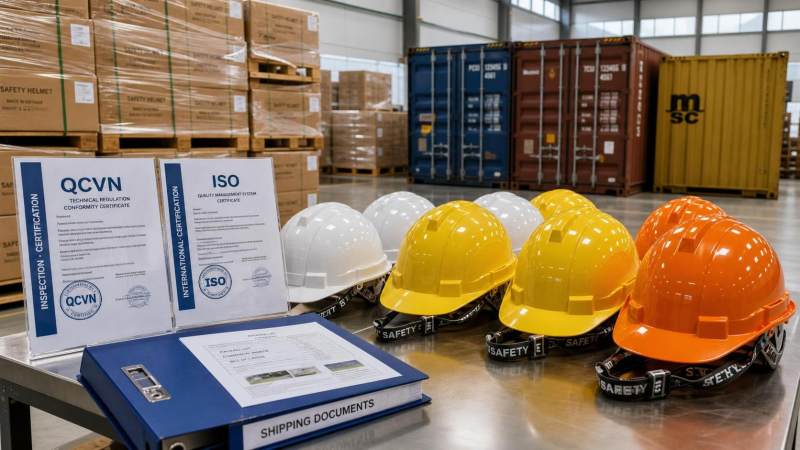
On June 25, 2026, Vietnam’s General Department of Customs under the Ministry of Industry and Trade circulated an urgent instruction to ports nationwide tightening import control over PPE safety helmets. From the date of notice, imported safety helmets, including industrial and construction models made of ABS or PC, must be cleared with both a QCVN 3:2026 conformity certificate and an ISO 3873:2025 impact absorption test report. For importers, manufacturers supplying Vietnam, testing and compliance teams, and logistics service providers, the immediate point of concern is that the earlier period in which QCVN documentation alone was accepted has now ended.
What the June 25 customs notice confirms
The confirmed change is document-based and immediate. According to the information provided, Vietnam’s customs authority issued an urgent guidance document on June 25, 2026 to strengthen supervision of imported personal protective equipment. Within that instruction, all imported safety helmets are required to present two documents at the same time: a conformity certificate to Vietnam’s mandatory national standard QCVN 3:2026 and an ISO 3873:2025 test report covering impact absorption performance.
The scope expressly includes imported industrial and construction safety helmets made from ABS and PC materials. The requirement is described as mandatory from the effective date of the notice, and the previously looser period under which only QCVN documentation had been recognized is stated to have formally ended.
Where the operational impact is likely to appear first
Import transactions face a stricter document threshold
From an industry perspective, direct trading companies and importers are the first group likely to feel the impact because customs clearance now depends on a dual-document submission rather than a single compliance file. The main pressure point is likely to sit in pre-shipment document readiness, internal compliance review, and customs filing coordination.
Manufacturing suppliers may need tighter certification alignment
For manufacturers shipping safety helmets into Vietnam, the change matters because product compliance is no longer only a matter of meeting the local mandatory standard on paper. Analysis shows that suppliers now need to ensure that the QCVN 3:2026 conformity certificate and the ISO 3873:2025 impact absorption test report can be presented together in a way that matches the shipment and product category being declared.
Testing, compliance, and supply chain service teams gain a larger role
Observably, testing support providers, compliance managers, customs brokers, and supply chain coordinators may see a more time-sensitive role in transaction execution. The issue is not only whether a product is saleable in principle, but whether the file set is complete at the point of customs clearance. What deserves closer attention is the handoff between certification, testing, shipping documentation, and filing timelines.
Downstream buyers may need to watch delivery certainty
For procurement teams and end-use businesses sourcing industrial or construction helmets into Vietnam, the practical effect may emerge through delivery scheduling and supplier communication. Where supply depends on imported helmets, attention is likely to shift toward whether suppliers can provide both required documents without delay.
What companies should review now
Check whether current helmet SKUs are covered by both documents
Companies involved in Vietnam-bound shipments should first verify whether the specific imported helmet models in scope already have both the QCVN 3:2026 conformity certificate and the ISO 3873:2025 impact absorption test report available for customs use. The immediate risk in practice is not abstract regulatory exposure, but shipment interruption caused by incomplete files.
Separate policy wording from shipment execution
What deserves closer attention is the difference between a formal rule statement and actual clearance execution. Even where companies understand the new requirement in principle, they still need to confirm how internal teams, brokers, and suppliers will organize document matching, submission timing, and shipment-level traceability.
Reassess supplier and service-provider readiness
For businesses buying from third-party manufacturers or using external customs and logistics support, this notice makes supplier readiness more important. The key issue is whether upstream partners can provide compliant documentation in a synchronized way, rather than only confirming that a product generally meets market requirements.
Prepare for customer and delivery communication
Companies serving contractors, industrial buyers, or distributors in Vietnam may also need to review how they communicate about lead times and documentation status. Analysis shows that this is especially relevant where purchase commitments or delivery schedules were built around the earlier, looser documentation practice.
Why this should be read as more than a routine filing update
Observably, this development is not merely a technical customs reminder. It indicates that Vietnam customs is treating PPE helmet imports with a stricter documentation standard at the clearance stage, and that the earlier flexibility around single-certificate treatment has been withdrawn. It is more appropriate to understand this as an implemented compliance shift rather than a tentative signal, because the notice states that the requirement applies immediately.
At the same time, this should still be treated as a dynamic item for continued observation. Analysis shows that the market will need to watch how the requirement is applied in day-to-day operations, especially in document review, shipment handling, and coordination between testing and conformity certification.
How the market may best interpret this notice for now
The clearest industry meaning of the June 25 notice is that imported PPE safety helmets entering Vietnam now face a narrower customs documentation path. The confirmed fact is straightforward: both QCVN 3:2026 and ISO 3873:2025 documentation are required, and the period of accepting only QCVN has ended. From a practical standpoint, it is more appropriate to understand this as an immediate compliance and execution issue with broader supply chain implications, rather than as a distant policy trend.
For the market, the rational reading is neither to overstate the impact nor to dismiss it as a minor procedural change. The more grounded conclusion is that this is a live operational requirement with direct relevance to import planning, supplier coordination, and clearance preparedness.
Basis of this article and points for follow-up verification
This article is based on the user-provided news title, event date, and event summary concerning Vietnam customs’ June 25, 2026 notice on dual-certificate requirements for imported PPE safety helmets. In this type of industry update, relevant source categories typically include official notices, customs guidance, enterprise compliance announcements, industry association updates, authoritative media reports, and standard-setting documents.
No specific official source link was provided in the input, so the exact official publication path remains subject to further verification. Follow-up attention should remain on any subsequent official wording, implementation clarification, and practical customs handling guidance related to QCVN 3:2026 and ISO 3873:2025 document submission.
The VitalSync Intelligence Brief
Receive daily deep-dives into MedTech innovations and regulatory shifts.