
Security
Vietnam Rule Tightens PPE Import Labeling From Aug. 2026
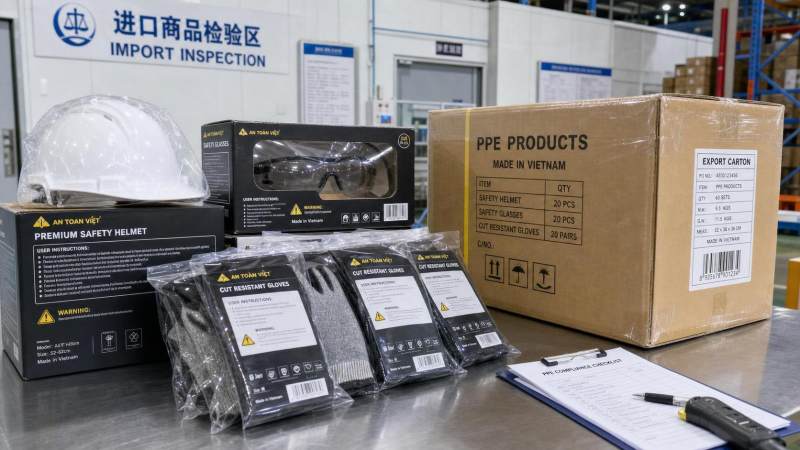
Starting on August 1, 2026, imported PPE entering Vietnam faces a more explicit labeling requirement: the minimum sales unit must carry complete safety warnings and instructions for use in both Chinese and English. Based on the notice identified as 28/2026/TT-BCT from Vietnam’s Ministry of Industry and Trade (MOIT), this is a rule change with direct implications for import compliance, packaging preparation, customs clearance, and delivery planning for suppliers, traders, buyers, and logistics participants handling products such as safety helmets, goggles, and cut-resistant gloves.
What the new requirement states
The confirmed information provided indicates that MOIT Notice 28/2026/TT-BCT took effect on July 7, 2026. It requires that, from August 1, 2026, all PPE imported into Vietnam, including products such as safety helmets, protective eyewear, and cut-resistant gloves, must bear complete safety warnings and instructions for use in both Chinese and English on the minimum sales unit. Products without this bilingual labeling will be refused by Ho Chi Minh City customs.
Where the rule change may be felt first
Import and trading workflows move from product availability to label readiness
From an industry perspective, importers and trading companies are likely to feel the change first because labeling is no longer a secondary packaging issue. It becomes part of import readiness at the unit level. What deserves closer attention is whether stock prepared under earlier packaging arrangements can still move smoothly if the required bilingual label is missing at the minimum sales unit stage.
Manufacturing and packaging teams face a compliance checkpoint before shipment
For manufacturers and export-oriented suppliers, the practical effect is likely to appear in packaging review, artwork approval, and shipment release steps. Analysis shows that even when the product itself is ready, incomplete label content could still affect shipment timing if the packaging does not match the stated requirement for full safety warnings and instructions for use in Chinese and English.
Procurement and delivery coordination may need earlier document checks
Buyers, sourcing teams, and supply chain service providers may need to pay closer attention to the handoff between purchase orders, packaging confirmation, and delivery scheduling. Observably, the issue is not limited to product selection; it also touches whether the ordered goods can be delivered with labeling that aligns with the import rule and avoids customs rejection in Ho Chi Minh City.
Compliance and technical support functions may see more review work
Certification-related service providers, inspection support teams, and after-sales functions may also be affected at the document and traceability level. From an industry angle, safety warnings and usage instructions are part of how product information is communicated into the market, so companies may need to review how labels, technical materials, and product support records correspond to one another.
What companies should review now
Check whether packaging approval already covers the minimum sales unit
Analysis shows that the immediate point of attention is not only the outer carton or shipping mark, but the minimum sales unit specifically named in the provided summary. Companies involved in exports to Vietnam should therefore review whether existing packaging approval processes actually verify the smallest commercial unit that reaches customs and distribution channels.
Review the completeness of warning and instruction content
The provided information refers to complete safety warnings and instructions for use, which makes content scope a key compliance point. Since no further execution detail is provided in the input, it is more appropriate to understand this as a requirement that merits careful internal review rather than assume a settled market practice on wording, layout, or content depth.
Recheck shipment timing around the August 1, 2026 implementation date
For orders shipping close to the implementation date, companies may need to pay attention to whether packaging prepared earlier still aligns with the rule once the effective date arrives. This is especially relevant for export traders, procurement teams, and delivery planners managing goods already in production or awaiting dispatch.
Watch for follow-up enforcement language and buyer-side document changes
Because the input does not provide further official interpretation, companies should continue watching for practical signals in customs handling, buyer requirements, tender documents, and internal supplier qualification checks. At this stage, those points should be treated as monitoring items rather than confirmed outcomes.
How this should be read at this stage
Observably, this development is more than a general policy statement because the provided information includes an effective date, a product scope tied to imported PPE, a labeling requirement at the minimum sales unit, and a stated customs consequence in Ho Chi Minh City for non-compliant goods. At the same time, analysis shows it should still be read with some caution on execution detail, because the input does not include fuller guidance on label format, review procedure, or broader enforcement practice beyond the stated rejection outcome.
A compliance signal with immediate trade relevance
In practical terms, this update is best understood as an implemented compliance signal affecting import preparation rather than a distant policy direction. The most rational reading for the industry is that labeling has become a shipment-critical checkpoint for PPE entering Vietnam from August 1, 2026, while the finer points of implementation and market response still require ongoing observation.
Basis of this article
This article is generated from the user-provided news title, event date, and event summary. The analysis is based on the supplied information that MOIT Notice 28/2026/TT-BCT took effect on July 7, 2026, and that from August 1, 2026, imported PPE must carry complete Chinese-and-English safety warnings and instructions for use on the minimum sales unit, with non-compliant products refused by Ho Chi Minh City customs. For events of this type, commonly relevant source categories may include official notices, releases from regulatory authorities, customs or trade administration information, industry association updates, standard-setting documents, and reporting by authoritative media. A specific official source link was not provided in the input, so further verification remains necessary. What still warrants continued attention includes any follow-up policy detail, enforcement interpretation, changes in buyer or tender documentation, industry feedback, and how companies implement the requirement in actual trade flows.
The VitalSync Intelligence Brief
Receive daily deep-dives into MedTech innovations and regulatory shifts.