
Security
OSHA Updates PPE Respiratory Protection Guidelines, New ANSI/ISEA Z88.2-2026 Certification Required for US Market
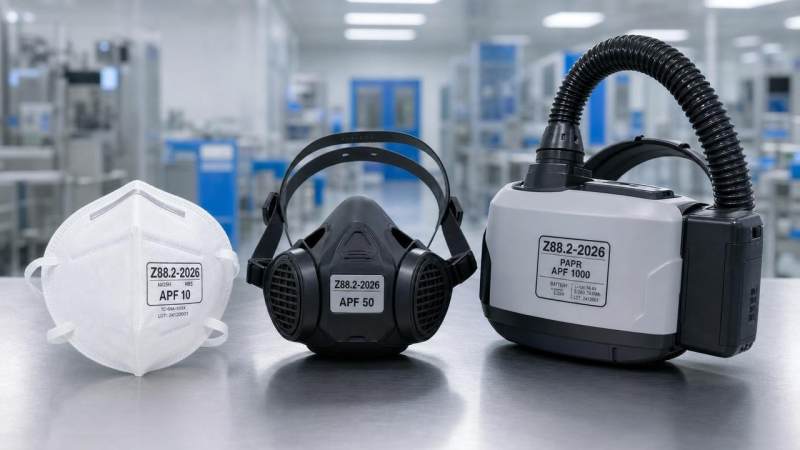
On May 7, 2026, the U.S. Occupational Safety and Health Administration (OSHA) issued an updated Respiratory Protection Standard Guidance, mandating that all respiratory protective equipment—including N95 filtering facepiece respirators, half-mask elastomeric respirators, and powered air-purifying respirators—used in U.S. workplaces must comply with the newly published ANSI/ISEA Z88.2-2026 standard effective October 2026. Exporters of dust masks and respirators from China must obtain this certification to maintain eligibility for U.S. federal procurement, infrastructure projects, and manufacturing supply chains. This development directly affects manufacturers, exporters, and distributors engaged in occupational PPE trade with the United States.
Event Overview
On May 7, 2026, OSHA released its revised Respiratory Protection Standard Guidance. The update specifies that, starting October 2026, all respiratory protection devices deployed in U.S. workplaces must be certified to ANSI/ISEA Z88.2-2026. The standard requires full labeling of performance parameters, including Assigned Protection Factor (APF) values and filtration efficiency decay curves. The guidance applies to all classes of respirators covered under the existing OSHA 1910.134 regulation, including disposable filtering facepieces (e.g., N95), reusable elastomeric half-masks, and motorized air-purifying respirators. No transitional grace period beyond October 2026 is indicated in the publicly released guidance.
Industries and Roles Affected
Export-oriented manufacturing enterprises: These companies produce respirators or dust masks for U.S. end markets. They are directly affected because compliance with ANSI/ISEA Z88.2-2026—not just FDA or NIOSH pre-market authorization—is now a mandatory condition for market access. Non-compliant products will be excluded from U.S. government contracts and private-sector safety procurement programs tied to OSHA-regulated workplaces.
Supply chain and distribution intermediaries: Entities acting as importers, brand licensees, or logistics partners handling respiratory PPE destined for U.S. employers must verify certification status before shipment. Under the updated guidance, downstream liability may extend to parties involved in placing non-certified products into U.S. workplaces—even if the manufacturer holds older Z88.2-2015 certification.
Raw material and component suppliers: Firms supplying filter media, head straps, valve assemblies, or battery systems for respirators may face revised technical specifications. ANSI/ISEA Z88.2-2026 introduces new test protocols for fit testing repeatability, exhalation resistance under humid conditions, and long-term filtration stability—potentially requiring material-level validation by upstream vendors.
Third-party testing and certification service providers: Laboratories accredited to conduct ANSI/ISEA Z88.2-2026 evaluations—including APF determination via human subject fit testing and filtration decay profiling—are now in higher demand. Chinese testing labs seeking recognition for Z88.2-2026 must demonstrate alignment with ISEA’s updated accreditation requirements, which differ from prior versions.
Key Focus Areas and Recommended Actions
Monitor official implementation timelines and enforcement clarifications
While the guidance takes effect in October 2026, OSHA has not yet published formal rulemaking or regulatory amendments. Companies should track updates from both OSHA and the American National Standards Institute (ANSI), particularly regarding whether Z88.2-2026 will be incorporated by reference into 29 CFR 1910.134—and whether any phased enforcement or documentation allowances apply.
Verify certification scope and labeling requirements for specific product categories
ANSI/ISEA Z88.2-2026 introduces differentiated performance reporting for different respirator types. For example, APF assignment for elastomeric half-masks now depends on tested fit variability across facial dimensions, while N95-type filtering facepieces require documented filtration efficiency retention after simulated workplace exposure cycles. Exporters must confirm whether their current certifications cover these new test criteria—and whether legacy Z88.2-2015 certificates remain valid for any subset of products.
Distinguish between regulatory signal and operational readiness
The May 7, 2026 guidance is a policy directive—not a final rule—but signals imminent enforceability. Companies should treat it as a binding operational milestone: inventory planning, packaging redesign, and quality system updates must align with Z88.2-2026 labeling and documentation expectations well ahead of October 2026. Delaying internal alignment until formal rulemaking is published may result in shipment delays or rejection at U.S. ports.
Initiate coordination with U.S.-accredited testing bodies and notified bodies
Not all labs authorized for Z88.2-2015 are automatically qualified for Z88.2-2026. Exporters should proactively engage laboratories recognized by ISEA for the 2026 edition—including those with active participation in the Z88.2 committee—to schedule testing slots and review protocol alignment. Early engagement helps avoid bottlenecks, especially for products requiring human-fit studies, which have longer lead times.
Editorial Perspective / Industry Observation
Observably, this update reflects a tightening convergence between U.S. occupational safety enforcement and standardized performance verification—not just product approval. While NIOSH certification remains the baseline for respirator approval, ANSI/ISEA Z88.2-2026 shifts emphasis toward real-world usage parameters: how protection degrades over time, how fit varies across user populations, and how environmental stressors affect performance. Analysis shows this is less a sudden regulatory shock and more a calibrated escalation of existing expectations—building upon the 2015 version’s foundation but adding quantifiable, auditable metrics. From an industry perspective, the requirement functions primarily as a gatekeeping mechanism for high-value, regulated procurement channels rather than a broad consumer-market restriction. Current relevance lies not in immediate product recalls, but in forward-looking qualification and documentation discipline.
Concluding, this guidance establishes a new threshold for respiratory PPE entering U.S. occupational settings—not merely as compliant hardware, but as traceably characterized protective systems. It does not invalidate existing NIOSH-approved products per se, but renders them ineligible for use in OSHA-enforced workplaces unless re-validated against Z88.2-2026. More accurately, it represents a procedural and evidentiary upgrade: one that prioritizes verifiable performance transparency over binary pass/fail certification. For stakeholders, the most constructive interpretation is not as a barrier, but as a specification shift demanding earlier integration of test planning, labeling compliance, and supply chain documentation into product development and export workflows.
Source: U.S. Occupational Safety and Health Administration (OSHA), Respiratory Protection Standard Guidance, issued May 7, 2026. ANSI/ISEA Z88.2-2026 standard, published by the American National Standards Institute and the International Safety Equipment Association. Note: Formal incorporation into 29 CFR 1910.134 and associated enforcement procedures remain pending; these aspects are under ongoing observation.
The VitalSync Intelligence Brief
Receive daily deep-dives into MedTech innovations and regulatory shifts.