
Security
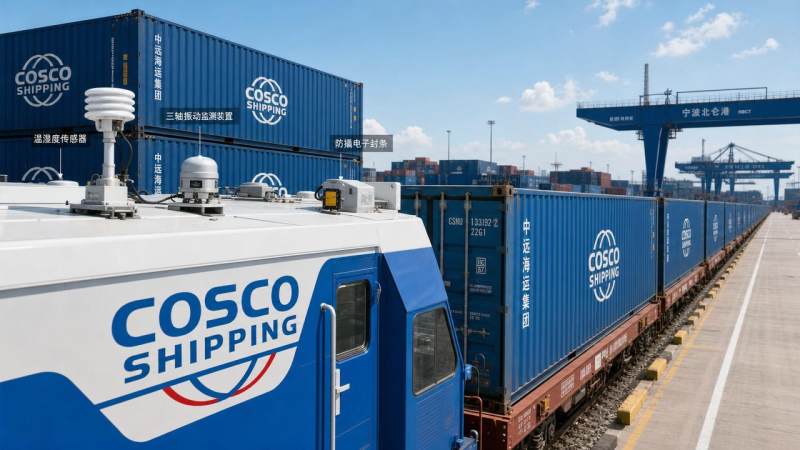
COSCO Shipping Launches Ningbo-Rotterdam Smart Security Train
Lead
On May 20, 2026, COSCO Shipping Logistics launched its first dedicated ‘Smart Security Equipment Express Train’ between Ningbo Beilun Port and Rotterdam Port. This initiative marks a significant operational shift in cross-border logistics for high-sensitivity electronic security devices—and reflects growing regulatory and market-driven demand for verifiable, tamper-evident, and condition-monitored transport solutions in global supply chains.
Event Overview
COSCO Shipping Logistics officially commenced operations of the ‘Smart Security Equipment Express Train’ on May 20, 2026, connecting Ningbo Beilun Port (China) and Rotterdam Port (Netherlands). The train is equipped end-to-end with IoT sensors monitoring temperature, humidity, triaxial vibration, and unauthorized container opening. Sensor data feeds directly into the Global Supply Intelligence Management (GSIM) platform. The service prioritizes exports of video surveillance systems, access control controllers, and fire alarm host units. Transit time is reduced to 18 days—four days faster than conventional maritime shipping—and includes a digitally signed, audit-ready compliance certificate covering environmental integrity and physical security throughout transit.
Industries Affected
Direct Exporting Enterprises
Companies exporting intelligent security hardware—including OEMs and branded solution providers—are directly impacted due to tightened contractual obligations around delivery reliability and device integrity. The shortened lead time enables tighter alignment with European project timelines (e.g., smart city tenders or critical infrastructure upgrades), while the GSIM-certified compliance record supports adherence to EU’s Cybersecurity Act (CSA) and EN 50131-1 requirements for alarm system transport documentation.
Raw Material Procurement Firms
Suppliers of precision components—such as MEMS accelerometers, optical lenses, and low-power edge processors—face indirect but material pressure. As original equipment manufacturers (OEMs) increasingly specify ‘transport-condition-guaranteed’ sourcing clauses, procurement teams must now verify not only component specifications but also downstream logistics traceability capabilities of their contract manufacturers or tier-1 assemblers.
Contract Manufacturing & Electronics Assembly Firms
EMS and JDM providers handling final integration of security subsystems are affected operationally: they must align production scheduling with the fixed weekly departure windows of the dedicated train and adapt packaging protocols to ensure compatibility with IoT sensor placement and vibration thresholds. Failure to meet these constraints may disqualify shipments from priority loading or invalidate the GSIM compliance certificate.
Logistics & Compliance Service Providers
Third-party logistics (3PL) firms, customs brokers, and certification consultants face new service demands—including real-time interpretation of GSIM telemetry dashboards, preparation of EU-compliant transport affidavits, and validation of sensor calibration logs per IEC 60068-2 standards. Their role is shifting from documentation facilitators to technical assurance partners.
Key Considerations and Recommended Actions
Evaluate Eligibility Against GSIM Certification Criteria
Exporters should confirm whether their product categories, packaging configurations, and declared shipment weights fall within the current scope approved for GSIM certification. Devices exceeding 15 kg/unit or requiring active cooling remain excluded from this initial rollout.
Integrate GSIM Data Feeds Into Internal QA Workflows
Manufacturers are advised to connect GSIM telemetry outputs (e.g., peak g-force events, humidity excursions) to internal nonconformance tracking systems. This enables root-cause analysis linking in-transit anomalies to field failure rates—a capability increasingly requested by EU notified bodies during post-market surveillance audits.
Align Export Documentation With EN 50131-7 Annex D Requirements
The provided compliance certificate must be cross-referenced against EN 50131-7:2021 Annex D, which specifies evidence needed for ‘transport-related environmental stress validation’. Legal and compliance teams should verify that the certificate explicitly references vibration spectra (not just pass/fail status) and temperature/humidity exposure duration.
Editorial Perspective / Industry Observation
Observably, this initiative is less about incremental freight optimization and more about preemptive standard-setting: COSCO is embedding transport integrity into the product lifecycle definition for security electronics. Analysis shows that similar IoT-integrated rail corridors are under discussion between Shenzhen and Duisburg, and between Ho Chi Minh City and Warsaw—suggesting a broader trend toward ‘certified logistics lanes’ as de facto compliance infrastructure. From an industry perspective, this represents a quiet but consequential transfer of verification responsibility—from end-user installers and certifiers—to upstream logistics operators.
Conclusion
This service does not merely accelerate delivery; it redefines evidentiary expectations across the security electronics value chain. For stakeholders, the longer-term implication lies not in speed gains, but in the normalization of transport-as-a-verifiable quality attribute—making logistics performance a measurable input to product certification, rather than an assumed background condition.
Source Attribution
Official announcement issued by COSCO Shipping Logistics Co., Ltd., May 20, 2026. GSIM platform specifications referenced from COSCO’s 2026 Digital Logistics White Paper (v2.1, publicly available via coscoshipping.com/logistics/whitepapers). Regulatory alignment verified against EN 50131-7:2021 and EU Commission Notice 2023/C 241/01. Note: GSIM certification scope expansion, sensor calibration frequency updates, and potential inclusion of battery-powered devices remain under evaluation—subject to quarterly review by COSCO’s Technical Advisory Board.
The VitalSync Intelligence Brief
Receive daily deep-dives into MedTech innovations and regulatory shifts.