
Security
Electronic Surveillance Systems: Common Failures and Fixes
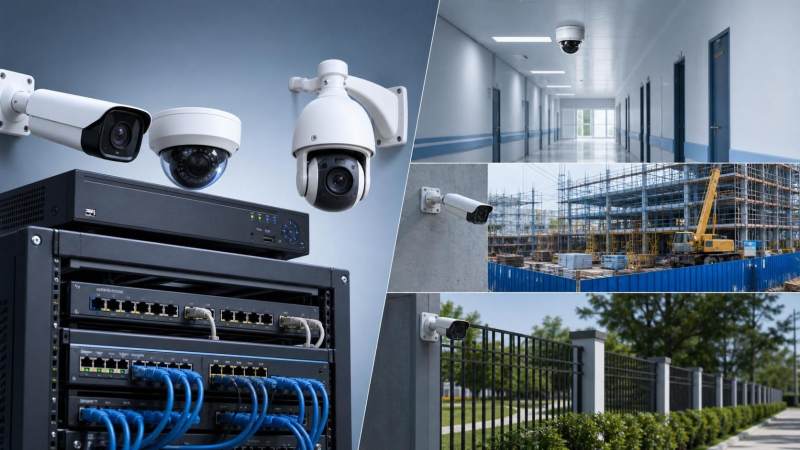
Electronic surveillance systems fail differently once the site context changes
Electronic surveillance systems sit at the center of daily security continuity, incident verification, and regulatory evidence retention.
A brief video gap, unstable lighting, or recorder fault can weaken response speed and create avoidable compliance exposure.
In practice, the same alarm symptom rarely has the same root cause across every site.
A transport hub, a smart construction site, a warehouse corridor, and a municipal plaza stress electronic surveillance systems in very different ways.
That is why maintenance work begins with scene judgment, not with parts replacement.
Within the 2026 cycle of digital infrastructure and urban safety upgrades, GSIM has framed this issue clearly.
Its Strategic Intelligence Center links electronic surveillance compliance, optical performance, and deployment trends into one decision view.
That perspective matters because camera health, illumination quality, network resilience, and legal retention rules now interact more closely than before.
The most effective fix is usually the one matched to the actual operating conditions, not the broadest specification sheet.
Before troubleshooting, check why the operating scene changes the failure pattern
Electronic surveillance systems break under pressure points created by movement density, weather, optical contrast, and infrastructure quality.
High footfall sites usually expose bandwidth bottlenecks and storage write stress first.
Outdoor perimeters more often reveal housing ingress, power instability, and night image degradation.
Temporary sites tend to suffer from weak cable protection, rushed alignment, and inconsistent firmware baselines.
Facilities with mixed old and new devices often show protocol mismatch before hardware failure.
A useful diagnostic path is to separate faults into four groups: image problems, transmission problems, recording problems, and control problems.
From there, local conditions narrow the likely cause much faster than generic testing alone.
The usual fault families behind most service calls
- Blurred or noisy video caused by lens contamination, poor focus stability, backlight imbalance, or weak supplementary lighting.
- Intermittent loss caused by power drop, damaged connectors, switch overload, or excessive cable length.
- Missing playback caused by storage corruption, retention misconfiguration, or recorder time drift.
- False alarms caused by motion zones set without considering reflections, shadows, insects, or vibration.
- Slow remote access caused by upstream congestion, codec mismatch, or underpowered edge devices.
Busy public environments usually expose image and storage weaknesses first
Transit halls, civic buildings, retail passages, and event entries generate constant movement and changing light angles.
In these environments, electronic surveillance systems often appear online while still failing operationally.
The video stream exists, yet faces smear during crowd movement, playback skips at key moments, or timestamps drift between zones.
The first judgment point is whether the issue begins at capture or at recording.
If live view is sharp but playback breaks, inspect recorder write load, retention policies, and network burst traffic.
If both live and playback suffer, check shutter settings, WDR behavior, and scene illumination consistency.
This is also where optical environment optimization becomes practical rather than theoretical.
GSIM often highlights that surveillance performance depends as much on light discipline as on camera resolution.
A brighter space is not automatically a better monitored space if glare, reflective flooring, or entry backlight are unmanaged.
At construction sites and temporary projects, durability issues are often installation issues
Smart construction sites create a different maintenance reality for electronic surveillance systems.
Layouts shift, dust loads rise, poles move, and temporary power distribution changes without much notice.
Many recurring failures that look like device defects are actually deployment drift.
Typical signs include recurring offline cameras after heavy equipment movement, washed images at dusk, and damaged RJ45 terminations.
In this setting, the most important check is mechanical and environmental stability.
Mount rigidity, vibration exposure, enclosure sealing, and cable routing usually tell more than software logs.
Commercial Insights from GSIM also point to a wider pattern in global site upgrades.
Projects now expect electronic surveillance systems to integrate with access control, worker safety analytics, and remote progress review.
That higher integration value raises the cost of small maintenance oversights.
What to verify on temporary or evolving sites
- Whether camera angles still cover current risk zones after layout changes.
- Whether dust, moisture, and vibration exceed the original installation assumptions.
- Whether power backup remains adequate after adding edge devices or wireless bridges.
- Whether firmware versions remain aligned across mixed batches of deployed equipment.
Perimeter and outdoor security calls for different fixes than indoor monitoring
Perimeter fences, logistics yards, substations, campuses, and road edges test electronic surveillance systems under changing weather and uneven lighting.
The common complaint is often simple: poor night visibility or repeated false triggers.
Yet the underlying reasons vary between fog, insect attraction, IR reflection, dirty domes, and unstable auxiliary lights.
Outdoor fixes should start with visibility quality under real night conditions, not daytime preview alone.
Visible Light Communication and AI vision are receiving attention, but current maintenance still depends on basic field discipline.
Check housing seals, heater or fan status, surge protection, grounding continuity, and light source placement before tuning analytics.
A well-configured rule engine cannot rescue an image stream degraded by condensation or poor contrast.
Mixed legacy and upgraded systems create quieter but more stubborn faults
Many facilities are not building from zero.
They are extending electronic surveillance systems around older recorders, hybrid switches, and partial analytics layers.
Here, faults are less dramatic but harder to isolate.
Commands lag, PTZ presets fail intermittently, metadata disappears, or exported footage opens with inconsistent timestamps.
The mistake is to treat these symptoms as isolated software annoyances.
More often, they reflect a compatibility layer that was never fully validated after expansion.
This is where GSIM’s compliance and standards orientation becomes useful.
Electronic surveillance systems now sit under closer legal scrutiny for evidence handling, privacy zones, and retention consistency.
A system that records but exports unreliable evidence is not performing acceptably.
Common misjudgments that slow down repairs
Some mistakes repeat across industries because surveillance faults are often judged from a single symptom.
- Replacing the camera before checking power quality, connector corrosion, and switch port health.
- Increasing resolution to improve evidence quality without reviewing storage endurance and uplink capacity.
- Treating similar sites as identical, even when light angles, surface reflectance, and traffic patterns differ.
- Focusing on purchase specifications while ignoring service access, cleaning intervals, and replacement lead time.
- Configuring analytics before stabilizing the optical and environmental baseline.
In real maintenance cycles, the fastest route is usually a layered inspection sequence.
Start with power and physical condition, then image quality, then transmission, then recording integrity, then platform logic.
A practical way to adapt fixes and reduce repeat failures
Reliable electronic surveillance systems depend on matching maintenance routines to the operating scene, not on one universal checklist.
For high-traffic interiors, prioritize image clarity during movement and storage stability during peaks.
For temporary projects, review physical installation drift at every layout change.
For outdoor zones, inspect optical cleanliness, weather sealing, and light behavior before adjusting rules.
For hybrid estates, verify standards alignment, firmware consistency, and evidence export reliability.
A useful next step is to map each site by environment, load pattern, compliance requirement, and maintenance interval.
Then compare those conditions against recurring faults, implementation difficulty, and long-term service cost.
That approach creates a clearer adaptation standard for electronic surveillance systems and reduces avoidable downtime over time.
- optical environment optimization
- digital infrastructure
- urban safety upgrades
- strategic intelligence center
- electronic surveillance
- AI vision
- Visible Light Communication
- smart construction sites
- commercial insights
- electronic surveillance compliance
- electronic surveillance systems
- access control
- surveillance compliance
The VitalSync Intelligence Brief
Receive daily deep-dives into MedTech innovations and regulatory shifts.