
Security
Can cutting-edge optical technology improve low-light surveillance?
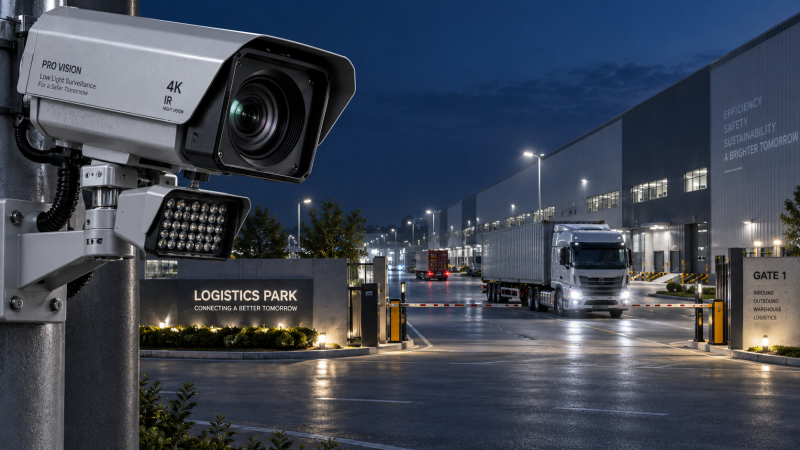
Yes. Cutting-edge optical technology for surveillance can improve low-light monitoring when it increases the usable signal captured during an exposure short enough to preserve movement. Larger effective sensor area, efficient light collection, spectrally matched lenses, and controlled illumination all contribute. The improvement becomes meaningful when a moving face, vehicle, or object retains the detail needed for the intended task. A brighter image alone does not establish better surveillance performance.
The central limitation is the available photon budget. Electronic gain makes a weak signal brighter but also amplifies noise. Longer exposure collects more light while increasing motion blur. Processing can suppress visible noise, yet it cannot reliably reconstruct identifying detail that the optics and sensor never captured. Strong nighttime performance starts with sufficient light reaching the sensor, then preserves that information through processing, compression, and recording.
Minimum illumination specifications leave the hardest questions unanswered
A minimum illumination value has little comparative value without its test conditions. Exposure duration, lens aperture, gain, image mode, and the criterion for an acceptable picture all influence the result. A camera showing a recognizable stationary scene at very low illuminance might produce blurred faces as soon as someone crosses the frame.
Illuminance measured in lux also describes light through the sensitivity of human vision. It does not fully characterize the radiation available to a camera, particularly when near-infrared illumination is present. Two scenes with the same lux reading can deliver different sensor signals because their spectra differ. Under infrared lighting, irradiance at the relevant wavelength and the complete camera response are more informative than a visible-light reading alone.
Exposure time therefore needs to accompany any claim about low-light performance. Acceptable duration depends on subject speed, distance, viewing angle, and image scale. Movement across the image creates more obvious blur than movement toward the camera. A wide overview can appear sharp while a tighter view reveals smeared facial features under the same exposure settings.
Detection, recognition, and identification require different levels of evidence. A silhouette can establish that someone entered an area without supporting identity. Likewise, a visible vehicle does not guarantee a readable registration plate. Performance criteria should name the required detail and the location where it must remain usable, rather than treating general scene visibility as the acceptance threshold.
Sensor sensitivity must be evaluated with the lens
Backside-illuminated sensor designs improve light collection by placing more of the photosensitive structure in the incoming light path. Larger pixels can collect more photons at a given exposure and image-plane illumination, although usable performance also depends on quantum efficiency, read noise, and pixel architecture. Sensor format and resolution must be considered together: a larger sensor with substantially more pixels does not automatically provide larger pixels.
Reducing resolution can improve the signal available per output pixel through binning or downsampling, but it also changes spatial detail. The relevant question is whether the resulting image still resolves the feature of interest at the required distance. Pixel count alone cannot answer that question because lens sharpness, focus accuracy, motion, and compression affect the information preserved in those pixels.
A wider lens aperture admits more light, but its nominal f-number does not describe every optical loss. Actual transmission depends on lens elements, coatings, and wavelength. A lens optimized for visible light can transmit near-infrared radiation differently, so its daytime performance is insufficient evidence for an infrared surveillance installation.
Opening the aperture also narrows depth of field. A face near the camera may be sharp while another farther along the same entrance path is soft. Edge sharpness and aberrations can become more apparent at wide apertures, depending on the lens design. Testing should include the frame edges and the full working distance, especially when analytics operate outside the center of the image.
Day-to-night focus shift deserves separate attention. Visible and infrared light can focus at different image planes. An infrared-corrected lens reduces this problem across its specified spectral range, but correct installation and focus remain necessary. A camera that looks excellent before sunset can lose fine detail after its infrared-cut filter moves and infrared illumination becomes dominant.
Choosing between color, infrared, and thermal evidence
Color footage supports distinctions such as clothing color and vehicle appearance. Preserving trustworthy color requires adequate visible light and a suitable spectral distribution. Under narrow or uneven lighting, automatic white balance cannot recover wavelengths absent from the scene. Noise reduction and gain can further distort weak color signals, making an apparently colorful image unreliable for descriptive evidence.
Near-infrared illumination supplies light without requiring the same visible brightness at the scene. It suits many monitoring tasks, but material reflectance changes with wavelength. Dark fabric in daylight can appear bright under infrared, and printed markings can lose contrast. Infrared images should therefore be assessed for the actual target features, without assuming they will preserve daytime appearance.
The choice between common near-infrared wavelengths involves a trade-off. Longer-wavelength illumination can reduce the visible glow associated with some emitters, while many silicon sensors have lower sensitivity there. Matching emitter output to sensor response and lens transmission is essential; electrical power consumption does not establish how much useful signal reaches the camera.
Thermal and visible cameras can complement each other when detection and identification have different requirements. Their images need geometric alignment if detections are transferred between channels. Different viewpoints create parallax, particularly for nearby subjects, so an overlay that aligns at one distance can misalign elsewhere. Thermal detection should be validated against background temperature changes and occlusion, rather than assumed to remain constant throughout the night.
Illumination geometry often determines the usable range
An illuminator’s stated range is conditional on beam shape, target reflectance, exposure settings, and the required image quality. A narrow beam concentrates light but leaves the edges of a wide camera view poorly illuminated. A broad beam distributes available output across a larger area, reducing illumination at distant targets. Camera field of view and illuminator coverage need to agree at the working distance.
Nearby surfaces can dominate exposure. A pale wall, reflective sign, or close foreground object returns strong light while the subject remains dark. Automatic exposure then reduces brightness across the frame, obscuring the area that matters. Exposure regions and highlight controls can help, although they cannot compensate for insufficient illumination at the target.
Integrated infrared emitters introduce particular installation problems. Dust, water droplets, scratches, and internal reflections on a dome can scatter light back into the lens. Spider webs close to the camera produce bright obstructions that are disproportionately prominent at night. Separate illumination can reduce direct backscatter, provided its position does not create harsh shadows across faces or other required features.
Rain and fog add a similar challenge over distance. Increasing light directed along the viewing axis can brighten suspended droplets and reduce contrast. Moving the source away from the lens changes the scattering geometry, but the benefit depends on beam direction and weather severity. More emitter output is therefore an incomplete response to poor nighttime visibility.
Processing can preserve evidence or make it disappear
Temporal noise reduction combines information across frames. It works well in stationary regions, yet moving subjects can develop trails or lose fine texture when motion estimation fails. Spatial filtering presents another trade-off: smooth walls look cleaner while small lettering and facial detail soften. A visually pleasing live image can conceal a loss of task-relevant information.
AI enhancement requires the same scrutiny. Models can improve perceived clarity, but reconstructed texture is not necessarily a faithful observation. For evidentiary use, recording arrangements should retain the original captured stream where available and document enhancement settings. The enhanced view should remain distinguishable from the source footage.
High dynamic range processing also interacts with motion. When a system combines exposures taken at different times, moving objects can produce ghosting or mismatched edges. Headlights and illuminated entrances are useful test conditions because they combine dark regions, bright sources, and movement. A wide dynamic range specification alone does not establish how well the camera handles that combination.
Finally, the recorded stream matters. Fine nighttime noise consumes compression capacity; stronger compression can erase texture or create unstable blocks around motion. Validation must use exported footage at deployment settings, since a high-quality local preview does not establish the quality available for later review.
A meaningful trial controls the variables that change the answer
A comparative trial needs equivalent framing, target distance, movement, and scene lighting. Automatic exposure settings should be recorded, including shutter limits and gain behavior. Otherwise, one camera can appear more sensitive simply because it uses a longer exposure. Where internal settings are unavailable, observed motion blur and recorded image behavior become especially important evidence.
Useful trial conditions include:
- A moving subject crossing both the center and the edge of the field of view, with pauses at different distances to separate motion blur from focus limitations.
- Bright headlights or an illuminated doorway behind the subject. This exposes highlight clipping, exposure recovery behavior, and loss of detail in darker regions.
- A transition from visible lighting to infrared operation, allowing assessment of focus shift and temporary changes in image quality.
- Wet surfaces and representative reflective materials, where these occur at the intended site. Their nighttime appearance can differ sharply from a dry daytime inspection.
Recorded outcomes should distinguish missed detections, false alerts, and insufficient identification detail. These are separate failures. An analytics model might detect a heavily blurred person correctly while the footage remains unsuitable for identification. Conversely, a sharp image can still trigger incorrect alerts because the model has not been validated against infrared appearance, shadows, or insects near the lens.
Acceptance criteria should specify the task, target area, allowed motion, lighting conditions, and recording configuration. If conformity with an imaging or safety standard is claimed, the applicable edition, test method, operating mode, and scope of evidence need to be identifiable. Illumination safety assessment must match the installed emitter arrangement and exposure conditions; image quality testing does not establish optical safety.
The strongest evidence of improvement is repeatable preservation of required detail under representative nighttime conditions. A system that resolves moving subjects only after extending exposure beyond the motion limit has reached a physical constraint. At that point, changes to illumination, optics, camera placement, or the required viewing distance offer a more credible path than further gain or enhancement.
The VitalSync Intelligence Brief
Receive daily deep-dives into MedTech innovations and regulatory shifts.