
Security
How smart construction sites management reduces safety risks
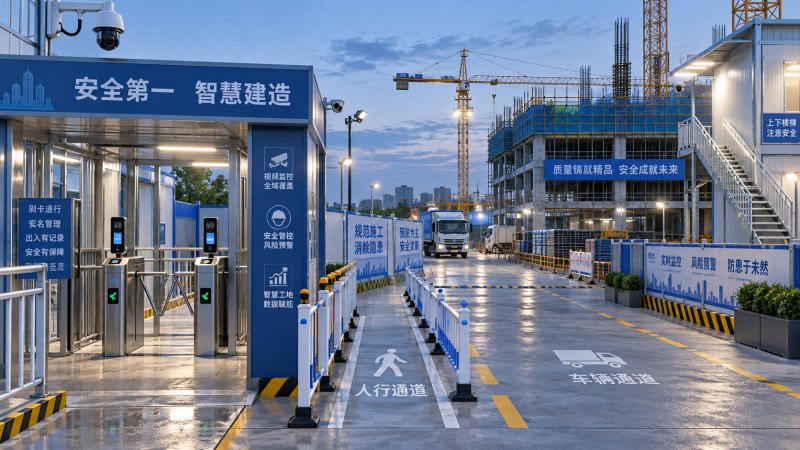
A delivery is due, a concrete pour is scheduled, and several subcontractor crews arrive within the same morning. At the gate, one worker’s induction record cannot be confirmed, a vehicle is waiting near a pedestrian route, and a dimly lit stairwell has become a shortcut between work zones. None of these conditions is unusual on its own. Together, they create the kind of gap in control where a near miss can become an injury.
Smart construction sites management reduces safety risks by making changing site conditions visible, traceable, and actionable before work continues. It does not remove the need for competent supervision or safe work planning. Instead, it connects controls that are often managed separately—site access, surveillance, lighting, equipment status, inspections, alerts, and records—so that safety decisions are based on current conditions rather than delayed reports or assumptions.
Why traditional site controls lose effectiveness during active work
Construction safety systems often begin with sound procedures: inductions, toolbox talks, permit controls, inspection forms, exclusion zones, and supervisor walk-throughs. The difficulty is that the site changes faster than many paper-based or disconnected processes can capture. A route that was safe at the morning briefing may be blocked by stored materials at noon. A restricted area may become accessible after a temporary barrier is moved. A worker may enter a new work zone after a shift change without the responsible supervisor knowing.
This is where risk develops. The issue is not simply a lack of information; it is a lack of timely, usable information at the point where a decision must be made. A safety manager may eventually receive an incident report, while the site team needed a warning when the unsafe condition first appeared.
Smart construction sites management addresses this timing problem. It creates a shared operational view that helps site personnel answer practical questions quickly:
- Who is currently on site, and are they authorized for the work area?
- Is a high-risk zone occupied when it should be isolated?
- Have temporary routes, gates, barriers, or lighting conditions changed?
- Has an inspection been completed, and can the finding be verified?
- Which alerts require immediate intervention rather than later review?
The value comes from linking these questions to a clear response process. An alert without ownership, escalation, and follow-up can create noise rather than safety improvement.
Start with the safety failures that are hardest to see
Not every risk needs advanced technology. A straightforward housekeeping issue may be corrected during a routine walk-through. Digital management is most useful where conditions change frequently, where multiple work groups overlap, or where visual supervision is limited by distance, elevation, low light, restricted access, or shift patterns.
Unauthorized entry and weak visitor control
Entry points are a common weak point because they combine workers, delivery personnel, visitors, and changing contractor teams. Manual sign-in methods may confirm that someone arrived, but they do not reliably show whether that person remains on site, has completed the required induction, or is permitted to enter a particular zone.
Digital access control can connect identity verification with induction status, approved work periods, and zone permissions. This is especially relevant around lifting areas, energized work locations, confined spaces, excavation boundaries, and plant operating zones. The purpose is not to treat access as a security-only task. It is to prevent someone from entering a hazardous environment without the required briefing, authorization, or protective controls.
Access rules should reflect actual operations. A system that blocks a qualified worker because a roster was not updated may encourage informal workarounds. The access process therefore needs a defined method for temporary approvals, emergency entry, and rapid correction of inaccurate records.
Vehicle and pedestrian conflict
Vehicle movement is one of the most persistent site risks because routes change as work progresses. A delivery vehicle may reverse near a temporary walkway, or mobile equipment may use a route that was previously reserved for pedestrians. Painted markings and posted signs remain important, but they are not always enough when visibility is poor or the site layout has changed.
Management systems can support safer separation by recording approved routes, identifying controlled gates, monitoring relevant camera views, and issuing notices when traffic arrangements change. In higher-risk areas, proximity alerts or controlled access points may help reduce uncontrolled interaction. These controls should support, not replace, a properly designed traffic management plan with designated routes, speed limits, banksman procedures, loading controls, and clear responsibilities.
Hazards hidden by poor illumination
Lighting is often treated as a comfort issue until an incident reveals its safety role. Uneven illumination can conceal trip hazards, obscure edge protection, reduce the visibility of signs, and make it harder for operators or spotters to judge movement. Temporary lighting can also fail silently after cables are moved, power is interrupted, or fixtures are damaged.
An intelligent lighting approach gives site teams a better way to manage this risk. Lighting schedules can match shift activity, selected areas can receive attention when work continues after daylight, and faults can be reported for inspection. Cameras placed in low-light areas require suitable optical conditions as well; poor images reduce the practical value of surveillance precisely where reliable visibility is needed.
Lighting decisions should be verified on the ground. A system may show that a fixture is powered, but this does not prove that the task surface, stair tread, access route, or exclusion boundary is adequately lit. Supervisors still need to assess glare, shadows, temporary obstructions, and the direction from which workers approach a hazard.
Turn monitoring into a response loop
Installing cameras, sensors, access readers, or digital forms does not automatically reduce risk. The critical difference is whether information moves through a response loop: detect, assess, assign, correct, verify, and record. Without this loop, teams may collect footage and notifications but fail to address recurring unsafe conditions.
- Define the event that matters. Start with observable events tied to known site risks, such as entry into a restricted zone, a blocked emergency route, a missing barrier, after-hours access, equipment movement in a controlled area, or a lighting fault in an active walkway.
- Set a realistic first response. Each event needs an owner. A gate-access exception may go to site administration, while a barrier breach may require the area supervisor or temporary works coordinator. Critical events need a route for immediate escalation.
- Confirm the condition before closing it. A digital ticket should not be closed simply because someone acknowledged it. Closure should show what was checked, what was corrected, and whether work was stopped, redirected, or permitted to continue.
- Review repeated signals. One alert may reflect a local error. Repeated alerts at the same location may show a poor route design, inadequate signage, unclear work sequencing, or a control that workers cannot realistically follow.
- Adjust the control, not just the record. The corrective action may be physical, procedural, or both: reposition a gate, change a delivery window, improve lighting, relocate material storage, update a permit boundary, or revise the work-zone layout.
This process is particularly useful for quality and safety functions because it separates evidence from assumption. A manager can see whether a required control was checked, whether a defect recurred, and whether the corrective action was verified. That does not make every record flawless, but it makes missing follow-up easier to identify.
Use surveillance as a verification tool, not passive observation
Video surveillance can support safety management when camera placement is based on operational questions. A camera aimed only at a broad overview of the site may be useful after an event but may not help confirm whether an access route is clear, whether a barrier remains in place, or whether a delivery zone is being used as intended.
Camera position, field of view, lighting conditions, image retention, and maintenance all affect whether surveillance can support a real decision. A camera that cannot capture the relevant boundary, or produces unusable images during low-light work, should not be treated as a reliable control. The same applies to analytics: automated detection can help focus attention, but it requires defined operating conditions and human review for events that may lead to intervention.
Privacy and workforce communication also matter. Monitoring should have a defined safety purpose, limited access to recordings, clear retention rules, and procedures consistent with applicable workplace and data-protection requirements. When teams understand what is monitored and why, the system is less likely to be seen as a substitute for fair supervision.
Connect digital inspections to work planning
Digital inspection tools are most effective when they are tied to the work sequence rather than used as a separate administrative task. For example, an excavation inspection should be linked to the conditions that determine whether entry is permitted. A temporary electrical inspection should connect to the equipment and areas affected. A lifting-area check should confirm that the planned exclusion zone can actually be maintained during the lift.
Forms should capture enough detail to support action, not merely prove that a form was completed. Useful fields include location, condition observed, responsible party, immediate control applied, photo or video evidence where appropriate, target completion time, and verification status. Free-text notes remain important because unexpected hazards do not always fit preset options.
A poor digital form can create false confidence. Long forms completed at the end of a shift, copied responses, or mandatory fields unrelated to the task can hide the issues that require attention. Keep critical checks visible, make escalation easy, and review whether reported findings are actually being closed at the work face.
Decide where smart controls should be introduced first
Trying to digitize every process at once can overwhelm site teams and make adoption uneven. A better starting point is to identify the point where a loss of control would have the most serious consequence or where manual oversight is repeatedly delayed.
Priority is often justified where several factors occur together: high worker movement, changing boundaries, interface with mobile plant, low-light operations, restricted access, or repeated deficiencies in inspection records. An active loading zone may deserve earlier attention than a stable storage area. A frequently altered temporary access route may need better monitoring before a permanently built corridor does.
Before selecting a tool, clarify the decision it must support. “Improve visibility” is too broad. “Confirm that only authorized personnel enter the excavation zone during active work” is specific enough to define access rules, monitoring coverage, responsible roles, and response timing. This prevents technology from being installed because it appears modern while leaving the original safety problem unchanged.
Measures that show whether management is improving control
Safety performance should not be judged only by the number of alerts generated. A high alert count may indicate an overly sensitive system, a genuine increase in unsafe conditions, or a site team that is finally seeing problems that were previously invisible. The useful question is whether the process produces earlier correction and fewer repeated control failures.
Review patterns such as unresolved alerts, repeated access exceptions, recurring blocked routes, inspection findings reopened after closure, lighting faults during active shifts, and the time between detection and verified correction. These indicators help identify where procedures are not matching site reality. They also help distinguish a one-off lapse from a system weakness that needs redesign.
Smart construction sites management works best when it strengthens the daily discipline already required for safe construction: clear ownership, visible boundaries, current information, timely intervention, and verified closure. Technology can make those controls easier to sustain across a complex site, but its safety value depends on the decisions and actions that follow each signal.
The VitalSync Intelligence Brief
Receive daily deep-dives into MedTech innovations and regulatory shifts.