
Security
Shenzhen Expo Highlights Multi-Protocol Compliance
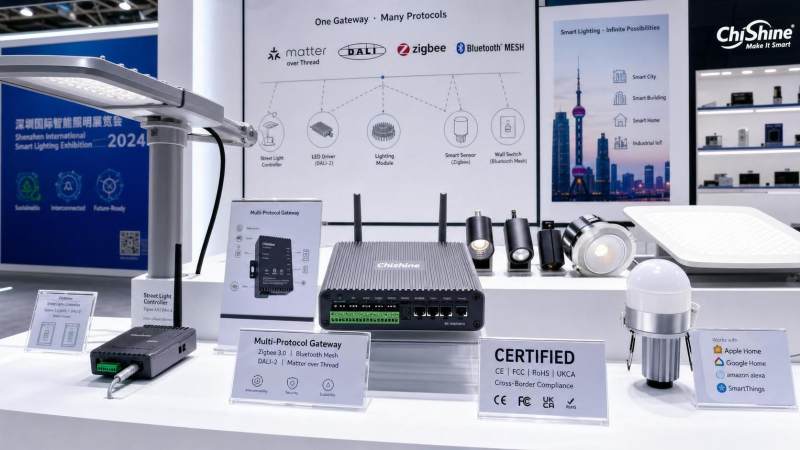
On June 24, 2026, the 28th Shenzhen International Smart Lighting Expo opened with a new focus on global protocol interoperability, placing Matter 1.3 over Thread and DALI-2x multi-protocol integration at the center of discussion. The development matters not only as a product and system showcase, but also as a compliance signal for lighting manufacturers, gateway developers, export suppliers, testing providers, project integrators, and public infrastructure buyers, because the event summary and the newly released white paper point directly to updated RF coexistence testing expectations tied to CE RED in the EU, FCC Part 15 in the United States, and SASO IECEE in Saudi Arabia for multi-protocol devices.
What Was Confirmed at the Shenzhen Event
The event took place on June 24, 2026 as the 28th Shenzhen International Smart Lighting Expo (SSL EXPO 2026). According to the provided summary, the exhibition introduced a dedicated “global protocol interoperability” theme pavilion for the first time. Its core technical presentation centered on a dual-stack gateway approach combining Matter 1.3 over Thread with DALI-2x, while also enabling Zigbee, Bluetooth Mesh, and KNX devices to connect into smart street lighting and security pole platforms.
The same summary states that Huawei, Tuya, and LTECH jointly released a white paper on cross-border smart lighting protocols. The document, as described in the input, clarifies new RF coexistence testing requirements for multi-protocol devices under EU CE RED, U.S. FCC Part 15, and Saudi SASO IECEE.
Why the Compliance Signal Matters Across the Supply Chain
For device makers, protocol integration now links more directly to certification readiness
Analysis shows that manufacturers of smart lighting controllers, gateways, and connected node devices may be affected first, because adding Matter 1.3 over Thread, DALI-2x, Zigbee, Bluetooth Mesh, or KNX into one platform is no longer only a technical architecture issue. It also changes how RF coexistence, technical documentation, and market-entry certification may need to be prepared for products intended for the EU, U.S., or Saudi markets.
For exporters and channel suppliers, market access risk may shift earlier in the delivery cycle
From an industry perspective, export-oriented suppliers and distributors may need to pay closer attention to whether multi-protocol product claims are matched by supporting test evidence and certification materials. The practical impact may appear in quotation review, contract confirmation, shipment planning, and acceptance documentation, especially where buyers expect products to satisfy CE RED, FCC Part 15, or SASO IECEE requirements for integrated wireless functions.
For project integrators and public-infrastructure buyers, interoperability claims may face stricter scrutiny
Observably, integrators working on smart street lighting or security pole platforms could face tighter specification checks when selecting gateways and edge devices that claim unified access for Zigbee, Bluetooth Mesh, KNX, and other protocols. The relevant business effect may show up in tender specifications, technical bid alignment, acceptance criteria, and post-delivery traceability, particularly when one platform is expected to connect devices based on multiple communication stacks.
For laboratories and compliance service providers, testing scope may become more complex
What deserves closer attention is that testing and certification service providers may need to review whether existing workflows sufficiently address coexistence verification for devices combining several wireless or control protocols. The event summary does not provide procedural details, but it does indicate that certification-related service work may increasingly depend on how multi-protocol device behavior is documented and evaluated for target markets.
What Companies Should Track From Here
Review whether product files match multi-protocol claims
Analysis shows that companies selling gateways, controllers, or integrated smart lighting devices should examine whether declarations, technical files, test reports, and product descriptions consistently reflect the actual protocol combinations being marketed. Where product positioning involves unified platform access, inconsistency between marketing language and compliance files could become a practical risk.
Watch how certification language is interpreted in actual execution
It is more appropriate to understand the white paper announcement as a strong execution signal rather than a complete description of every certification pathway. Companies should therefore continue tracking how RF coexistence expectations are expressed in formal certification practice, including whether the wording used in product submissions, test requests, and conformity materials needs adjustment for multi-protocol equipment.
Check procurement and supplier qualification documents earlier
For procurement teams and supply-chain managers, the more immediate issue may be document readiness before order confirmation. If buyers or project owners begin to require clearer evidence for interoperability and RF coexistence in tender or vendor qualification files, delays could arise not at design stage, but at approval, acceptance, or delivery stage.
Prepare for after-sales and traceability questions in export markets
From an industry perspective, after-sales service teams and exporters should also be alert to how multi-protocol products are described in warranty, maintenance, and issue-tracing records. Where one deployed device interacts with several protocol environments, troubleshooting and compliance traceability may become more documentation-dependent, even if the underlying product function remains unchanged.
How This Should Be Read at This Stage
Observably, this development is best read as an execution-oriented market signal tied to compliance and cross-border delivery, rather than as a standalone technology announcement. The combination of a dedicated interoperability pavilion and a white paper referencing CE RED, FCC Part 15, and SASO IECEE suggests that protocol convergence is increasingly being discussed together with certification expectations.
At the same time, analysis shows that the current input does not provide full official implementation details, testing procedures, or enforcement timelines. For that reason, the industry should avoid treating the event alone as proof of a finalized compliance framework. What deserves closer attention is how this signal is later reflected in certification practice, tender language, buyer requirements, and market feedback.
A Practical Reading for the Lighting Market
In practical terms, the Shenzhen event indicates that interoperability in smart lighting is becoming more closely tied to market-access preparation, especially for products intended for cross-border deployment. The immediate significance is not that all rules have definitively changed at once, but that protocol integration, certification preparation, and export documentation may need to be managed together more carefully.
It is more appropriate to understand this development as a clear compliance-related signal with commercial implications, while still recognizing that further observation is needed on execution details, certification interpretation, procurement adoption, and enterprise response.
Basis of This Article and What Still Needs Verification
This article is generated from the user-provided news title, event date, and event summary. Typical source categories for developments of this kind may include official event announcements, regulatory publications, trade or customs authorities, industry association releases, standardization documents, certification-related materials, and reporting by established industry media. No specific official source link was provided in the input, so the underlying official references still require ongoing verification.
Further observation is still needed on detailed policy or certification wording, actual testing interpretation, changes in tender documents, buyer-side compliance requirements, industry feedback, and how enterprises implement related documentation and delivery adjustments in practice.
The VitalSync Intelligence Brief
Receive daily deep-dives into MedTech innovations and regulatory shifts.