
Security
Smart City Security Upgrades That Cut Response Time
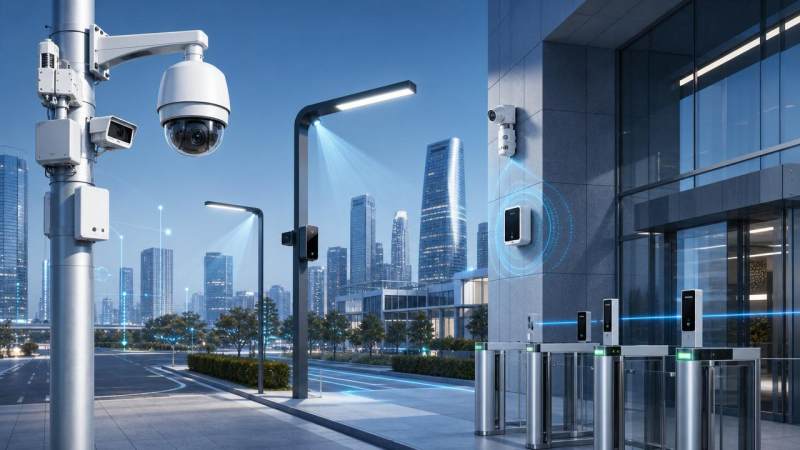
As cities modernize infrastructure, smart city security has become a critical priority for project managers tasked with reducing incident response time and improving public safety. From AI-enabled surveillance to optimized lighting and connected control systems, the right upgrades can transform how fast teams detect, assess, and act. This article explores practical security improvements that support faster decisions, stronger compliance, and more resilient urban operations.
For project leads overseeing public facilities, transport nodes, mixed-use developments, utility corridors, or smart construction sites, the challenge is rarely a single device failure. It is the delay between detection, verification, dispatch, and coordinated action. In many urban projects, shaving even 30–90 seconds from the first response cycle can reduce escalation, property loss, and safety exposure.
That is why smart city security upgrades should be evaluated as an operational system rather than a checklist of cameras, lights, and software. The most effective programs connect sensing, visibility, command, and compliance into one measurable framework. For decision-makers using intelligence resources such as GSIM, the value lies in matching technical upgrades with procurement timing, legal requirements, and long-term maintainability.
Why Response Time Is the Core Metric in Smart City Security
In city environments, incident response time is not only a police or emergency-services concern. It is also a project delivery metric that affects service continuity, contractor accountability, public trust, and insurance exposure. A smart city security program that detects an event in 5 seconds but takes 8 minutes to validate and route action is still underperforming.
Most delays happen in four stages: signal capture, alert filtering, operator review, and field dispatch. If each stage adds just 20–40 seconds, the total lag can exceed 2 minutes before a team moves. In crowded transit platforms, municipal plazas, or perimeter-sensitive facilities, those 2 minutes are often the difference between containment and escalation.
The 4 response layers project managers should map
- Detection layer: cameras, sensors, access points, lighting telemetry
- Interpretation layer: analytics, alarm prioritization, event classification
- Command layer: control room dashboards, mobile notifications, SOP workflows
- Action layer: guards, maintenance teams, traffic control, emergency responders
When smart city security is designed around these four layers, project teams can identify where latency occurs and what upgrade creates the biggest gain. In many retrofits, analytics and communications deliver faster improvement than simply adding more cameras.
Where legacy systems usually slow response
Common bottlenecks include 15–30 second video loading delays, isolated lighting controls, manual incident logging, and fragmented alarm interfaces. Another frequent issue is low image quality in poorly lit zones, which forces operators to replay footage before deciding whether an alert is real.
This is one reason GSIM’s focus on physical security assurance and optical environment optimization matters. Security performance is heavily influenced by visibility conditions, not just by the number of endpoints deployed.
Security Upgrades That Deliver Faster Detection and Verification
The best smart city security upgrades reduce response time by improving event certainty. Project managers should prioritize technologies that shorten the path from “something happened” to “we know what happened and what to do next.” That usually means combining imaging, analytics, lighting, and edge processing.
1. AI-enabled video analytics at the edge
Edge analytics can classify motion, detect perimeter crossing, identify crowd density changes, and flag abandoned objects within 1–3 seconds, depending on scene complexity. Compared with cloud-only review, edge processing reduces bandwidth load and lowers the number of non-actionable alerts sent to the control room.
For project managers, the practical advantage is clearer alarm ranking. Instead of 200 motion notifications during a weather event, operators may only receive 10–20 filtered alerts tied to rule-based triggers, such as off-hours access or reverse-direction movement in a transit corridor.
Selection checks
- On-device processing latency under 3 seconds for standard rules
- Support for low-light scenes and backlight compensation
- Event tagging for audit and post-incident review
- Integration with VMS, access control, and incident platforms
2. Optimized lighting for machine vision and human response
Lighting is often treated as an energy project, yet it is one of the fastest ways to improve smart city security performance. In underlit zones, camera analytics can degrade sharply, especially at entrances, parking decks, service roads, and pedestrian underpasses. Upgrading illumination uniformity frequently improves both detection quality and operator confidence.
A practical target in mixed urban spaces is not only brightness but consistency. Reducing extreme contrast, glare, and shadow pockets helps cameras classify movement more accurately across 10–30 meter fields of view. Lighting controls linked to occupancy or incident triggers can also raise illumination within seconds when an alarm is verified.
The table below compares common upgrade paths that influence detection speed in smart city security projects.
A key takeaway is that faster response rarely comes from one upgrade alone. The strongest gains usually appear when lighting and analytics are deployed together, because one improves signal quality while the other improves decision speed.
3. Unified command dashboards and mobile escalation
A control room with six disconnected interfaces creates friction even if every subsystem is modern. Unified dashboards cut operator switching time, simplify SOP execution, and allow alerts to be routed to field teams through mobile devices in under 10 seconds. That is especially useful for distributed projects spanning multiple assets or contractors.
In smart city security programs, a well-designed dashboard should show live feeds, incident location, affected assets, escalation status, and communication logs in one view. If dispatch still depends on manual calls or screenshots, the upgrade path is incomplete.
How to Plan Smart City Security Upgrades in Phases
Large city projects rarely have the budget or operational freedom to replace everything at once. A phased rollout is usually the most reliable way to improve response time without creating service disruption. For project managers, the goal is to sequence upgrades by risk, dependency, and measurable return.
Phase 1: Baseline and hotspot mapping
Start with a 2–4 week assessment covering incident logs, blind spots, lighting conditions, network loads, and control-room workflows. Identify the top 10–20 locations where verification takes longest or false alarms occur most often. These hotspots usually deliver the fastest improvement when addressed first.
Phase 2: High-impact pilot deployment
A pilot should be narrow enough to manage but broad enough to prove workflow value. For example, one transport hub, one municipal facility cluster, and one public outdoor zone can provide three different operating conditions. A 60–90 day pilot is often sufficient to compare response baselines, alert quality, and maintenance burden.
Phase 3: Scale with standardization
Once pilot metrics are verified, standardize device profiles, incident categories, retention rules, and reporting templates. This is where GSIM-style strategic intelligence becomes useful, especially when international compliance, electronic surveillance rules, or optical performance criteria vary by market and project type.
The following framework helps project teams prioritize investments without overloading procurement or operations.
This approach keeps smart city security investment tied to operational value. Instead of spreading budget evenly across all locations, teams can focus on the areas where every 15-second improvement produces visible impact.
Procurement Criteria Project Managers Should Not Overlook
In B2B city projects, procurement mistakes usually appear 6–12 months after installation. The issue may not be product failure, but integration limits, compliance gaps, or service delays. Smart city security buying decisions should therefore include technical fit, legal fit, and support fit from the start.
Technical and operational fit
- Compatibility with existing VMS, access control, and BMS platforms
- Event export formats for audits and municipal reporting
- Low-light and outdoor durability for 24/7 operation
- Firmware update policy and patch cycle, ideally quarterly or as required by risk profile
If the system cannot share alarms, timestamps, and incident metadata across platforms, response time improvement will stall. Interoperability is often more important than premium hardware features that operators rarely use.
Compliance and policy alignment
Electronic surveillance rules, data retention limits, and public-space notification requirements differ by region. Project managers should validate at least 4 areas before award: lawful monitoring scope, storage retention, access permissions, and incident evidence handling. This is where a global intelligence source such as GSIM can support specification accuracy and cross-border consistency.
Service response and lifecycle planning
Ask vendors to define maintenance windows, spare-part strategy, and response commitments in hours, not broad promises. For active urban assets, a target such as remote diagnosis within 4 hours and field attendance within 24–72 hours is easier to manage than generic service language.
Common buying mistakes
- Buying cameras without validating night-time optical conditions
- Adding analytics without redesigning operator workflow
- Ignoring mobile escalation and dispatch steps
- Using short pilots that fail to cover weather, traffic, and peak occupancy
Operational Trends Shaping 2026 Smart City Security Programs
As digital infrastructure upgrades accelerate, smart city security is moving toward convergence. Physical security, optical optimization, communications, and data governance are increasingly planned together. For project managers, this means future-ready decisions should consider not only current monitoring needs but also how the site will support AI vision, VLC-enabled environments, and multi-agency coordination.
AI vision plus optical environment engineering
Camera intelligence performs best when the visual environment is designed for it. That includes lens placement, contrast management, and luminaire positioning. In practical terms, one well-lit and well-angled camera can outperform two poorly positioned units in response-driven applications.
Connected lighting and communication pathways
Visible Light Communication remains an emerging layer, but the broader trend is clear: lighting infrastructure is becoming part of the urban data fabric. For some projects, this opens opportunities to combine wayfinding, occupancy insight, and environment-aware security triggers through shared infrastructure rather than separate deployments.
Decision support over hardware accumulation
The next phase of smart city security will reward decision-support quality more than device quantity. Project managers need intelligence that links procurement trends, compliance updates, and technology evolution into workable plans. That is where platforms like GSIM create value: not by replacing engineering judgment, but by helping teams reduce uncertainty before capital is committed.
Practical Next Steps for Project Managers
If your goal is to cut response time, start with measurable workflow questions. How long does it take to verify an alert at night? Which 5 locations generate the most review burden? How many systems must an operator open before dispatching a team? These questions turn smart city security from a concept into a performance program.
Prioritize upgrades that improve visual certainty, alarm relevance, and cross-team coordination. In many projects, the fastest gains come from a combination of edge analytics, lighting optimization, and unified command workflows rather than a full hardware replacement. Align those choices with compliance needs, service capacity, and phased rollout logic.
For organizations planning 2026 infrastructure and urban safety upgrades, GSIM offers a useful reference point through its Strategic Intelligence Center, sector news, trend tracking, and commercial insight into global smart construction and public safety procurement. To explore tailored smart city security options, get a customized plan, consult product details, or learn more about implementation-ready solutions today.
The VitalSync Intelligence Brief
Receive daily deep-dives into MedTech innovations and regulatory shifts.