
Security
EU EN 62471:2026 Tightens LED Export Compliance
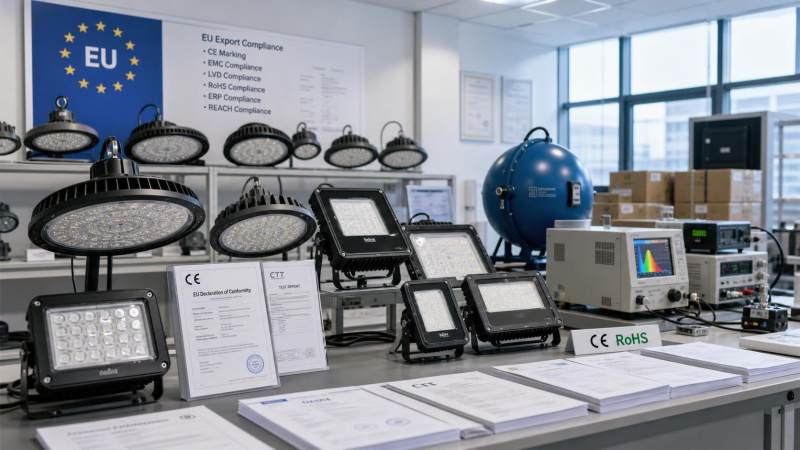
The publication of EN 62471:2026 in the Official Journal of the European Union on July 29, 2026, followed by its mandatory application from October 1, 2026, puts EU-bound LED industrial lighting under a more explicit compliance requirement. For exporters, manufacturers, buyers, and supply chain service providers handling products such as floodlights, high-bay lights, and industrial luminaires, the immediate issue is not only product eligibility for the EU market, but also how photobiological safety classification reports and supporting declarations will affect documentation flow, shipment timing, and commercial coordination.
What the revised standard now requires
According to the information provided, the revised EN 62471:2026 standard was published by the OJEU on July 29, 2026. From October 1, 2026, all LED industrial lighting products entering the EU market, including floodlights, high-bay lights, and industrial lighting fixtures, must obtain a photobiological safety classification report issued by a third-party laboratory.
The required report must cover hazard classifications including UV-A, Blue Light, and Radiation Hazard. The products must also be accompanied by a declaration of conformity. The revision directly affects the compliance route and delivery lead time of Chinese exporters shipping LED industrial lighting into the EU market.
Where the pressure is likely to appear across the supply chain
Export-facing manufacturers will face a stricter documentation gate
From an industry perspective, manufacturers supplying the EU market may be affected first because market entry now depends on having third-party photobiological safety classification documentation in place. The impact is likely to concentrate on pre-shipment compliance review, technical file preparation, and coordination between product teams and external laboratories.
What deserves closer attention is whether the relevant LED industrial lighting models intended for the EU are clearly identified early enough in the production and export process, so that testing and declaration materials do not become a last-minute bottleneck.
Trading companies and export intermediaries may need to recheck product readiness
For direct trading companies and export intermediaries, the requirement matters because they often sit between factories and EU buyers. Analysis shows that their risk is less about product design itself and more about incomplete documents, unclear test coverage, or shipment scheduling that assumes older compliance routines.
The business impact is likely to show up in quotation validity, order confirmation, and delivery commitments, especially where buyers expect conformity paperwork to be available together with shipment documents.
Laboratory scheduling and supply chain coordination become more time-sensitive
Supply chain service providers and compliance support firms may also be affected because the new requirement introduces a formal third-party testing step. Observably, once testing and classification reports become mandatory for all covered products entering the EU market, coordination across sampling, testing, document issuance, and shipment release becomes more sensitive to timing.
This does not by itself confirm a fixed delay pattern, but it does indicate that lead time management may become a more visible part of export execution.
EU buyers and project-side purchasers may tighten document review
For buyers, importers, and project procurement teams in the EU market, the change matters because conformity is tied not only to the product but also to the availability of supporting documentation. The practical impact may appear in supplier onboarding, order approval, and goods acceptance procedures.
What deserves closer attention is whether procurement communication starts to place more emphasis on photobiological safety classification status before shipment rather than after arrival.
What companies should focus on now
Separate confirmed requirements from internal assumptions
Companies should first anchor their internal response to the confirmed points only: the revised standard was published on July 29, 2026; mandatory implementation starts on October 1, 2026; covered LED industrial lighting products entering the EU market require a third-party photobiological safety classification report and a declaration of conformity. Internal teams should avoid extending this into unverified assumptions about additional obligations that are not stated in the provided information.
Map affected product categories against export plans
The named product scope includes floodlights, high-bay lights, and industrial lighting products. Analysis shows that companies with mixed product portfolios should pay attention to which SKUs are intended for the EU market and whether those models already have the required test pathway defined. This is a practical step because compliance work, order scheduling, and customer communication all depend on accurate product scope mapping.
Reassess document timing in relation to shipment commitments
The information provided already indicates an effect on compliance pathways and delivery cycles for Chinese exporters. In practice, this means businesses should examine whether third-party laboratory reports and declarations of conformity are being prepared early enough to support contracted dispatch dates. The point here is procedural rather than theoretical: shipment readiness may increasingly depend on document readiness.
Strengthen communication with suppliers, labs, and customers
What deserves closer attention is the handoff between factory, laboratory, exporter, and buyer. Companies involved in EU-bound shipments may need clearer responsibility lines for testing arrangements, report ownership, declaration preparation, and customer-facing document delivery. This is especially relevant where one party manufactures, another exports, and a third party manages compliance or logistics.
How this should be read at this stage
Analysis shows that this is more than a routine standards update for companies selling LED industrial lighting into the EU. The confirmed requirement creates an immediate compliance condition tied to market access, and the short interval between publication and mandatory implementation makes execution discipline a practical concern.
At the same time, it is more appropriate to understand this as both a near-term operational change and a longer-term regulatory signal. The near-term change is clear: covered products need third-party photobiological safety classification reports and declarations of conformity from October 1, 2026. The longer-term signal is that documentation depth and product safety classification may carry greater weight in export workflows for this segment. Some implementation details may still require continued observation, but the core compliance direction is already explicit in the provided information.
Why this update matters beyond a single filing step
The immediate industry significance lies in the fact that compliance is no longer only a background technical issue for EU-bound LED industrial lighting. It becomes a visible commercial and operational checkpoint that can affect export readiness, buyer communication, and delivery timing.
A neutral reading is that this development should currently be understood as a confirmed compliance change with direct execution consequences, rather than as a speculative policy signal. For the industry, the sensible approach is to treat it as an active requirement that merits close follow-up, especially where existing order pipelines, laboratory arrangements, and conformity documentation processes are still based on earlier routines.
Basis of this article and what still needs verification
This article is based on the user-provided news title, event date, and event summary regarding the publication and mandatory application of EN 62471:2026 for LED industrial lighting entering the EU market. The analysis above distinguishes between confirmed facts in the provided input and editorial observation about possible business impact.
For developments of this type, common source categories usually include official notices, corporate announcements, industry association updates, authoritative media coverage, and standard-setting documents. No specific official source link was provided in the input, so the exact official link still requires ongoing verification. Continued attention should be given to any further official wording, market-side implementation practices, and how affected companies adjust testing, conformity documentation, and shipment scheduling in response.
The VitalSync Intelligence Brief
Receive daily deep-dives into MedTech innovations and regulatory shifts.