
Security
EU RAPEX Alert Pulls Chinese LED High-Bay Lights
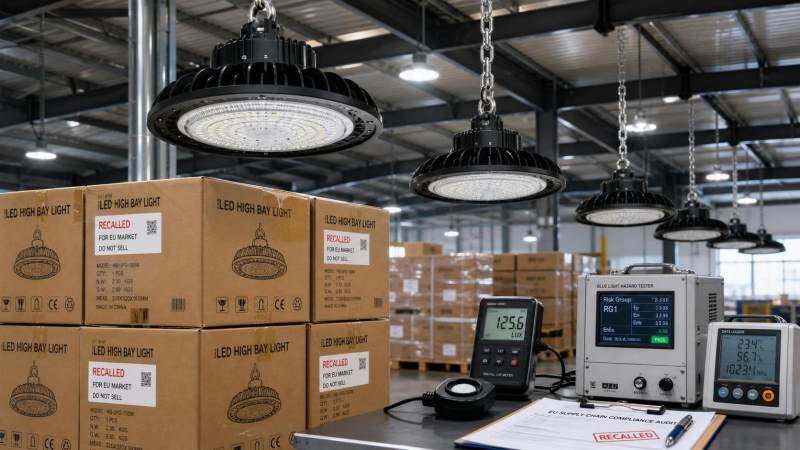
On June 16, 2026, an EU RAPEX notification signaled a concrete compliance risk for Chinese LED high-bay industrial lighting entering or circulating in the European market. The notice links market recall action not only to a blue light hazard result under EN IEC 62471:2026, but also to a testing and enforcement focus on transient LB spikes caused by constant-current driver fluctuation. For exporters, importers, buyers, testing parties, and supply-chain managers, the development is worth close attention because it points to a more practical shift in how product safety risk may be assessed in delivery, acceptance, and post-market control.
What the June 16 RAPEX notice confirmed
According to the information provided, RAPEX published notification 2026/week24, reference A12/0624/26, on June 16, 2026. The notification was jointly submitted by Germany, the Netherlands, and Sweden and covered 12 batches of Chinese-made LED high-bay industrial lights.
The products were reported as non-compliant because retinal blue light hazard exceeded the RG2 limit under EN IEC 62471:2026 full-mode testing. The notice also stated that market recall measures had been initiated.
The summary further made clear that the issue was not limited to a static labeled value. It specifically pointed to instantaneous LB increases associated with constant-current driver fluctuation.
Why this matters across the supply chain
Export shipments face a narrower margin for technical assumptions
From an industry perspective, exporters and trading companies may be affected first because the notice connects product risk to actual test behavior under full-mode assessment rather than to nominal specifications alone. What deserves closer attention is whether shipment readiness, technical files, and product declarations are still being prepared around static performance descriptions while enforcement attention may be moving toward operating-state variation.
For export transactions, the practical impact may appear in pre-shipment review, product selection, contract confirmation, and customer acceptance discussions. Companies involved in EU-bound deliveries should closely watch whether buyers, distributors, or authorities begin requesting more explicit evidence tied to EN IEC 62471:2026 test conditions and hazard evaluation results.
Manufacturing and sourcing teams may need deeper review of driver consistency
Analysis shows that manufacturers and procurement teams are likely to focus more closely on the driver section of the product, because the notification explicitly linked non-compliance to constant-current fluctuation and resulting instantaneous LB elevation. This means compliance review may no longer be limited to lamp labeling, optical design, or a single static reading.
In operational terms, the affected business links may include component sourcing, supplier qualification, design verification, incoming inspection, and production consistency checks. For companies buying finished luminaires or key electronic assemblies from upstream partners, it becomes more important to verify whether technical documentation and test evidence adequately reflect real operating behavior under the cited standard.
Importers, distributors, and project buyers may tighten acceptance documentation
Importers, channel operators, and project-side buyers may also feel the effect because a recall action changes the risk profile of products already in circulation or under procurement review. Observably, the issue is not only whether a product can be placed on the market, but also whether documentation is sufficient to support ongoing sales, project acceptance, and after-sales response if safety questions arise.
For these market participants, key points to monitor may include product test reports, technical files, batch traceability records, procurement specifications, and any customer-side wording that references EN IEC 62471:2026 or blue light hazard limits. Where procurement documents are updated later, the commercial and delivery implications could extend to product substitution, revalidation, or acceptance delays.
Testing and certification-related services may see more emphasis on mode-based verification
Testing service providers and certification-related parties may also need to pay attention because the notice explicitly referenced full-mode testing and transient behavior. It is more appropriate to understand this as a signal that evaluation focus may be broadening from nameplate parameters to operating-condition performance.
That does not by itself confirm a universal enforcement pattern across all products or markets. However, it does suggest that technical communication, report interpretation, and client advisory work may increasingly need to address how testing mode and driver behavior affect compliance conclusions.
What companies should watch now
Recheck whether existing compliance files match the cited test logic
Analysis shows that companies dealing in LED high-bay industrial lights should revisit whether current compliance materials align with the EN IEC 62471:2026 full-mode basis referenced in the notice. If technical files, declarations, or customer-facing materials rely mainly on static nominal values, that gap may become a practical issue in customer review or regulatory inquiry.
Pay attention to driver-related evidence, not only optical labeling
What deserves closer attention is the notification's explicit reference to instantaneous LB rise caused by constant-current fluctuation. For manufacturers, brand owners, and sourcing teams, this means the compliance discussion may increasingly require evidence tied to driver stability, operating-state performance, and batch consistency, rather than only fixture-level descriptions or catalog claims.
Prepare for possible changes in buyer language and tender requirements
Observably, even where no new formal procurement rule has yet been provided in the input, companies should watch whether customers, distributors, or project owners begin revising technical specifications, acceptance clauses, or supporting document requests. The event does not confirm that such revisions have already occurred, but it creates a credible reason to monitor contract and tender wording more closely.
Strengthen traceability and recall-response readiness
Because recall action has already been mentioned in the notice, export-oriented businesses and distribution partners may need to review how quickly they can identify affected batches, retrieve technical records, and respond to after-sales or regulatory questions. This is a practical compliance issue tied to delivery and post-market control, not only to initial certification or test approval.
How to read the regulatory signal
From an industry perspective, this development is better read as an enforcement signal tied to an identified testing basis and a concrete product-risk mechanism, rather than as a broad policy rewrite on its own. The notable point is that the notice connects non-compliance to transient LB behavior under full-mode testing, which may influence how safety performance is examined in practice.
At the same time, it is still necessary to observe how far this approach is reflected in subsequent official wording, buyer-side technical requirements, certification practice, and market feedback. The input does not establish a wider pattern beyond the reported notification, so broader conclusions should remain cautious.
What this means for the market at this stage
At this stage, the event is most appropriately understood as a real and actionable compliance warning for LED high-bay industrial lighting connected to the EU market. It highlights that blue light hazard assessment may become more sensitive to actual operating behavior and not just static declared values.
For industry participants, the rational takeaway is not to assume an across-the-board rule change beyond the provided facts, but to treat the notice as a concrete reminder to review testing assumptions, driver-related technical control, documentation readiness, and post-market response capability.
Basis of this article and items that still need verification
This article is generated based on the user-provided news title, event date, and event summary. The concrete official source link was not provided in the input, so the underlying notice text and any subsequent official clarifications still need continued verification.
For this type of event, relevant source categories typically include official regulatory notices, market surveillance releases, trade or customs authority information, industry association updates, standards organization documents, and reporting by established professional media. Further observation is still needed on later policy detail, certification interpretation, tender-document changes, market feedback, and how companies implement compliance responses in practice.
The VitalSync Intelligence Brief
Receive daily deep-dives into MedTech innovations and regulatory shifts.