
Security
UL 1598C Draft Raises LED Industrial Lighting Bar
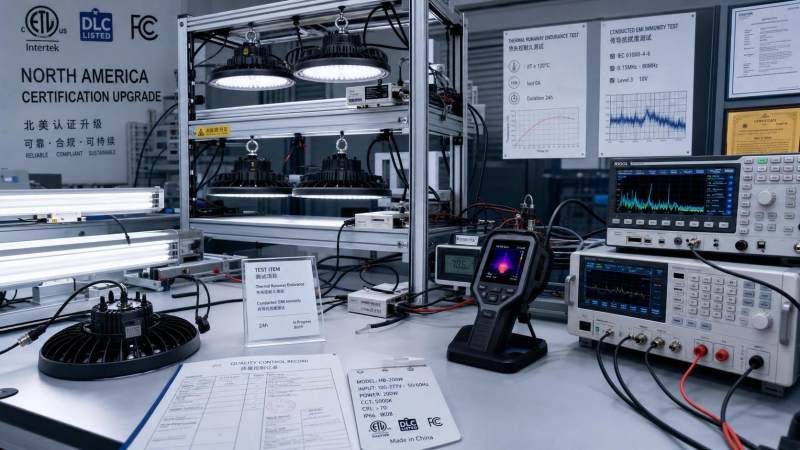
On June 23, 2026, UL published a draft third edition of UL 1598C for LED industrial lighting safety, with mandatory implementation planned for Q1 2027. The proposed revision introduces two new test requirements focused on accelerated thermal runaway verification for LED modules and conducted EMI immunity in the 150 kHz to 30 MHz range, making this a rule change that deserves close attention from exporters, manufacturers, testing teams, buyers, and certification-related service providers involved in supplying industrial luminaires to the North American market.
What the draft standard changes
According to the information provided, UL released the draft third edition of UL 1598C on June 23, 2026. The draft concerns the safety standard for LED industrial lighting products and is planned to become mandatory in Q1 2027.
The revision adds two key tests. One is accelerated aging verification for LED module thermal runaway, described as an extension of IEC 62368-1 Annex G. The other is conducted EMI immunity testing in the 150 kHz–30 MHz band at IEC 61000-4-6 Level 3.
The provided summary also states that this revision is expected to significantly raise the certification threshold and development cycle for Chinese industrial lighting products exported to the North American market.
Where the pressure may appear first
Product development and manufacturing schedules
From an industry perspective, manufacturers of LED industrial luminaires may feel the impact first in product design verification and development timing. The addition of thermal runaway and conducted EMI immunity tests means that compliance review is no longer limited to existing safety assumptions; it now extends to whether current module design, material selection, and electrical integration can pass the proposed new test path. What deserves closer attention is the risk that product launch plans and model transition schedules may need to account for longer validation work.
Export certification and market access preparation
For export-oriented suppliers, especially those targeting North America, the main issue is not only whether certification will still be obtainable, but also whether the certification path becomes more demanding in terms of preparation sequence and technical documentation. Analysis shows that once a draft standard signals a near-term mandatory date, certification planning, sample readiness, and report alignment become practical concerns for products that will be sold or tendered around the implementation window.
Testing, documentation, and buyer-side review
Testing service providers and compliance teams may need to prepare for closer scrutiny of test scope and supporting records. Buyers, importers, and procurement teams may also need to review whether existing technical specifications, qualification files, or supplier approval requirements remain aligned with the upcoming version of the standard. Observably, the change may affect not only laboratory work but also how product claims, bid materials, and delivery commitments are checked before shipment or project award.
What companies should watch now
Check certification timing against the Q1 2027 window
Analysis shows that companies with products intended for North America should pay attention to the planned mandatory timing in Q1 2027 and compare it with current certification, renewal, and model rollout schedules. Where project delivery spans the transition period, the key practical question is whether existing compliance planning remains sufficient under the draft direction.
Review technical files for the two added tests
What deserves closer attention is whether current technical documents are organized in a way that supports the two newly added test items. This includes internal design records, test preparation materials, and any product documentation that may later need to align with certification review or customer qualification requests. The provided information does not define detailed execution criteria, so this should be treated as an area for follow-up rather than as a settled compliance outcome.
Monitor procurement and supplier qualification impacts
For procurement and supply chain teams, the relevant issue is whether upstream components, module configurations, or supplier capabilities will need re-checking once the new test expectations are applied. It is more appropriate to understand this as an early warning for qualification and delivery planning, especially where product approval depends on external certification or customer-side technical acceptance.
Watch for changes in customer-facing documents
Exporters and sales teams should also watch whether tender files, buyer specifications, product declarations, and after-sales quality traceability documents begin to reflect the upcoming UL 1598C edition. Observably, even before mandatory enforcement begins, draft-stage rule changes can influence how customers frame compliance expectations during quotation, approval, or project onboarding.
How this signal should be read
Analysis shows that this update is more than a routine technical edit because it introduces two additional test dimensions tied directly to safety verification and electromagnetic immunity. At the same time, it is still more appropriate to understand the development as a rule signal that is moving toward implementation, rather than as a fully settled execution framework, because the input provided does not include detailed enforcement language, transition handling, or official interpretation beyond the planned Q1 2027 mandatory timeline.
From an industry perspective, the key value of this development lies in its timing: it gives manufacturers and exporters an early indication that compliance expectations for LED industrial luminaires supplied to North America are becoming more demanding. What deserves closer attention is how certification practice, buyer requirements, and project documentation may respond as the implementation date approaches.
Why continued tracking matters
Based on the information provided, the most balanced conclusion is that the UL 1598C draft third edition should be read as a meaningful compliance signal for the LED industrial lighting supply chain, especially for companies shipping to North America. The confirmed facts point to a higher certification threshold and a longer development path, but the exact market response and execution details still require observation.
It is more appropriate to understand this development not as a completed regulatory outcome, but as an important transition-stage update. For companies involved in export manufacturing, certification preparation, procurement, and delivery planning, the practical priority is to track how the draft moves toward mandatory use and how related compliance expectations are reflected in testing, documentation, and customer acceptance processes.
Basis of this article
This article is generated from the user-provided news title, event date, and event summary. Typical source types relevant to developments of this kind may include official announcements, regulator notices, standards organization documents, industry association releases, trade authority information, customs or market access updates, and reporting by authoritative industry media.
No specific official source link was provided in the input, so the exact official publication link still needs to be verified on an ongoing basis. Observably, the areas that still require continued tracking include detailed implementation language, certification interpretation, tender document changes, market feedback, and how companies execute against the planned Q1 2027 timeline.
The VitalSync Intelligence Brief
Receive daily deep-dives into MedTech innovations and regulatory shifts.