
Security
GCC States Tighten LED Road Light Entry Rules
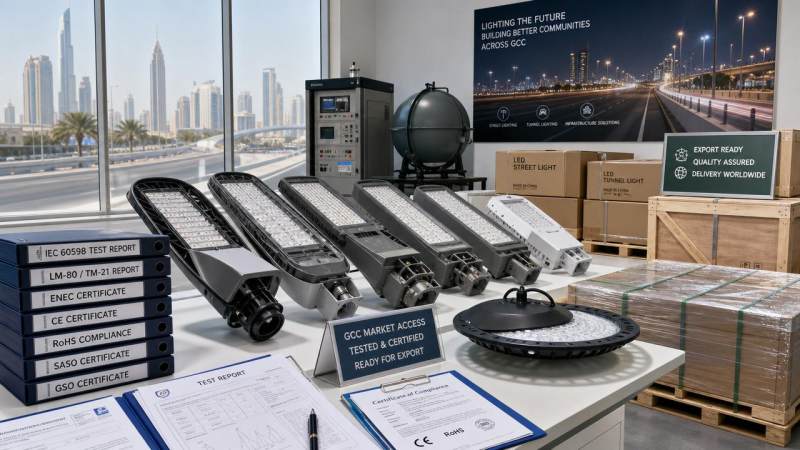
On October 1, 2026, a new market-access requirement takes effect across six GCC member states for imported LED road and tunnel lighting products. The change matters not only because it replaces reliance on standalone CQC or CE reports, but because it links product entry more directly to dual certification and test documentation, with likely consequences for exporters, certification planning, procurement timing, and delivery schedules.
What the new requirement confirms
According to the information provided, six Gulf Cooperation Council (GCC) countries, including Saudi Arabia, the United Arab Emirates, and Qatar, issued a joint notice on June 14, 2026. From October 1, 2026, all imported LED road and tunnel luminaires must meet both GCC certification under GSO 2530:2025 and IEC 62717 requirements related to lumen maintenance and lifetime testing.
The same information states that CQC or CE reports alone will no longer be accepted for these products. It also states that the new rule is expected to raise testing costs for Chinese exporters by about 35% and extend the average certification cycle to around 8 to 10 weeks.
Where the operational pressure is likely to appear
Export shipments face a tighter documentation threshold
From an industry perspective, direct exporters of LED road and tunnel lighting are likely to feel the change first at the compliance gate. The immediate issue is not only whether a product has been tested, but whether the report set matches the dual requirement now being recognized by the importing market. That means export teams need to pay closer attention to report combinations, submission timing, and whether existing files built around CQC or CE can still support active sales pipelines.
Manufacturers may need to reset certification and production sequencing
Analysis shows that manufacturers serving GCC-bound projects may need to re-sequence how they align testing, certification, and production release. If average certification lead times move to 8 to 10 weeks, production planning and shipment scheduling may need earlier locking of product specifications and test documentation. The effect is likely to be strongest where orders are tied to fixed delivery windows.
Procurement and project buyers may need earlier compliance checks
For buyers, distributors, and project-side procurement teams, the rule change may shift attention toward pre-award and pre-shipment compliance review. What deserves closer attention is whether bid documents, supplier submissions, and acceptance files are aligned with the new GCC plus IEC 62717 expectation, rather than relying on certificates that were previously treated as commercially sufficient.
Testing and certification service providers may see workflow changes
Certification-related firms and testing service providers are also likely to be affected because the rule narrows what documentation can support import access. Observably, this can increase the importance of scheduling, report completeness, and coordination between exporters and testing bodies, especially where shipments are planned close to the effective date.
What companies should review now
Check whether current report portfolios still match target-market access
Companies shipping to GCC markets should review whether current product files include both GCC certification under GSO 2530:2025 and IEC 62717 testing support for the affected LED road and tunnel luminaires. Where files are built mainly around CQC or CE, the practical question is whether they remain useful only as supporting documents rather than market-entry documents.
Reassess lead times in contracts and shipment plans
Because the provided information points to an average certification cycle of 8 to 10 weeks, exporters and supply-chain teams should pay attention to how certification timing interacts with contract milestones, factory booking, and shipment commitments. This is not yet proof of a uniform market outcome, but it is a clear signal that delivery planning may need more buffer.
Review bid documents and technical files for compliance alignment
For products already being quoted or tendered, it is worth checking whether technical submissions, test references, and qualification files reflect the dual-standard requirement. Analysis shows that mismatches between tender documentation and import compliance files could become a practical bottleneck even before customs or project acceptance stages.
Continue monitoring how the rule is applied in practice
The provided information does not include detailed enforcement procedures, document templates, or market-specific interpretation notes. For that reason, companies should treat this as a confirmed rule change with implementation details still worth tracking, especially in relation to certification wording, acceptance practice, and any changes in procurement documents after the effective date.
Why this looks like an execution signal, not just a policy headline
Observably, this development is more than a general compliance reminder because it sets a specific effective date and defines a narrower acceptance basis for imported products. At the same time, it is more appropriate to understand this as a rule now entering execution rather than a fully settled end state, because the market impact will depend on how consistently certification bodies, buyers, and import-side reviewers apply the requirement in day-to-day transactions.
From an industry perspective, the most useful reading at this stage is that access to GCC road-lighting projects and shipments may depend more heavily on certification readiness than before. The practical issue is less about headline policy language and more about whether companies can align testing, paperwork, and order timing without disrupting delivery commitments.
How to read the change at this stage
This update is best understood as a concrete tightening of entry requirements for imported LED road and tunnel luminaires in six GCC markets. The confirmed facts already point to higher testing costs and longer certification timing for Chinese exporters, while the broader commercial impact still requires observation through actual implementation, procurement updates, and market feedback.
A neutral reading is that the rule has moved beyond discussion and into an actionable compliance condition, but not all operational consequences can yet be treated as settled. For companies active in this product segment, the immediate priority is to verify documentation pathways and scheduling assumptions rather than wait for shipment-stage problems to reveal gaps.
Basis of this article
This article is generated based on the user-provided news title, event date, and event summary. The content typically relates to source types such as official notices, regulator releases, customs or trade authority information, industry association updates, standard-setting documents, and reporting by established trade media.
No specific official source link was provided in the input, so the exact source document still requires further verification. What still needs continued observation includes implementation details, certification interpretation, changes in tender documentation, industry feedback, and how exporters and buyers adjust their execution practices after October 1, 2026.
The VitalSync Intelligence Brief
Receive daily deep-dives into MedTech innovations and regulatory shifts.