
Security
ASEAN Smart Security Energy Rules Take Effect Oct 2026
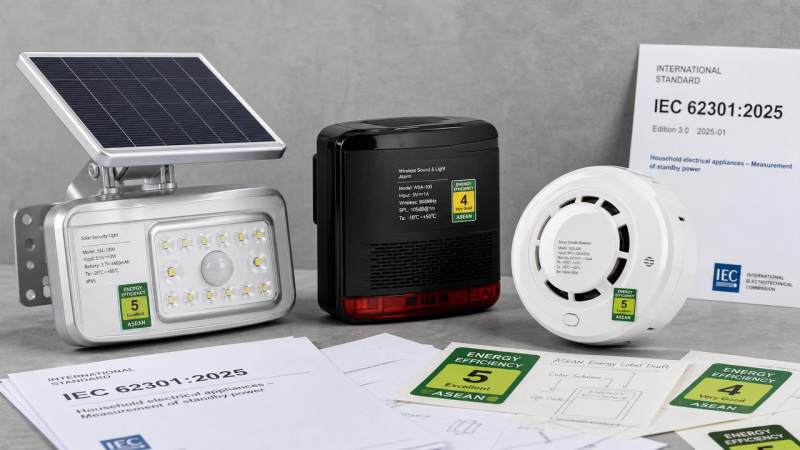
On 1 May 2026, Thailand’s TISI, Vietnam’s STAMEQ, and Indonesia’s BSN jointly launched the ASEAN Smart Security Equipment Energy Efficiency Mutual Recognition Framework, introducing new energy efficiency requirements for imported smart security devices—including smart smoke detectors, wireless audible-visual alarm units, and solar-powered security lights. Effective from 1 October 2026, all such products must comply with IEC 62301:2025 (standby power ≤0.5 W) and complete local energy label registration. This development directly affects Chinese exporters of personal protective equipment (PPE) and lighting products—and signals a new green market access pathway for certified suppliers.
Event Overview
On 1 May 2026, Thailand’s Institute of Standards and Industrial Research (TISI), Vietnam’s Standardization and Quality Assessment Agency (STAMEQ), and Indonesia’s National Standardization Agency (BSN) jointly published the ASEAN Smart Security Equipment Energy Efficiency Mutual Recognition Framework. The framework mandates that, starting 1 October 2026, all imported smart smoke detectors, wireless audible-visual alarm devices, and solar-powered security lights must meet the standby power limit of ≤0.5 W per IEC 62301:2025 and undergo mandatory local energy label registration. Chinese manufacturers holding GB/T 32029—2025 certification may use domestic test reports for expedited mutual recognition. For overseas importers, sourcing from pre-registered Chinese suppliers shortens customs clearance by 3–5 working days.
Which Subsectors Are Affected
Direct Exporters (Lighting & PPE Manufacturers)
Chinese enterprises exporting smart security lighting or integrated PPE systems containing wireless alarm components are directly subject to the new requirements. Compliance is mandatory for market access—not optional—even if the product has previously entered ASEAN markets without energy labeling. Impact manifests in testing obligations, documentation localization, and potential redesigns for standby power optimization.
Supply Chain & Component Suppliers
Suppliers of key subassemblies—such as low-power MCU modules, battery management ICs, or solar charge controllers used in compliant devices—face indirect but material demand shifts. Buyers may increasingly require component-level energy performance data aligned with IEC 62301:2025, especially for modules affecting system-level standby consumption. No new certification is mandated at the component level, but traceability and test report interoperability become more critical.
Distribution & Import Agents in ASEAN
Local importers and distributors handling smart security products must now verify both product compliance and supplier registration status before customs submission. Failure to confirm valid local label registration will delay clearance. The 3–5 day clearance advantage applies only when the Chinese manufacturer is already listed in the national energy label registries of Thailand, Vietnam, or Indonesia.
What Relevant Enterprises or Practitioners Should Focus On Now
Monitor official registry launch timelines per country
The framework is effective 1 October 2026, but national energy label registration portals have not yet opened publicly. Enterprises should track announcements from TISI, STAMEQ, and BSN—particularly regarding application procedures, required document formats, and accepted test report templates—to avoid last-minute submission rejections.
Prioritize verification of GB/T 32029—2025 alignment with IEC 62301:2025
While GB/T 32029—2025 enables fast-track recognition, it is not an identical standard to IEC 62301:2025. Companies should confirm whether their existing test reports cover all measurement conditions (e.g., network-connected idle states, multi-mode standby) specified in the IEC revision—especially where firmware behavior affects power draw.
Distinguish between policy signal and operational readiness
This framework reflects a coordinated regulatory intent—not yet full implementation infrastructure. As of May 2026, no public registry, fee schedule, or accredited lab list has been published by any of the three agencies. Businesses should treat current guidance as preparatory, not executable, until formal notice is issued.
Prepare technical documentation for local label registration in advance
Required materials are expected to include product photos, circuit schematics highlighting power paths, annotated test reports, and bilingual (English + local language) energy label artwork. Exporters should begin assembling these assets now—not after registration opens—to compress turnaround time.
Editorial Perspective / Industry Observation
Observably, this tripartite framework marks the first harmonized energy requirement across ASEAN for smart security hardware—not a standalone national rule, but a regional interoperability mechanism. Analysis shows it functions primarily as a market gatekeeping tool rather than a broad sustainability initiative: scope is narrowly defined (only three device categories), and enforcement hinges on label registration—not production audits or post-market surveillance. From an industry perspective, it is better understood as an early-stage regulatory signal: it confirms ASEAN’s intent to align with global energy efficiency norms for connected devices, but its real-world impact remains contingent on national rollout speed, enforcement consistency, and potential expansion to other IoT-enabled PPE or lighting categories.
Conclusion
This framework does not yet alter trade flows—but reshapes eligibility criteria for future ASEAN market access in a high-growth segment. Its significance lies not in immediate disruption, but in establishing a precedent for cross-border energy compliance in smart safety hardware. For now, it is more accurately interpreted as a structured preparation window than an enforcement deadline.
Information Sources
Main source: Joint announcement issued 1 May 2026 by Thailand’s TISI, Vietnam’s STAMEQ, and Indonesia’s BSN titled ASEAN Smart Security Equipment Energy Efficiency Mutual Recognition Framework. Note: National implementation details—including registration platform launch dates, fee structures, and accredited laboratory lists—remain pending and require ongoing monitoring.
The VitalSync Intelligence Brief
Receive daily deep-dives into MedTech innovations and regulatory shifts.