
Security
Brazil Tightens Traceability Rules for Solar Lighting
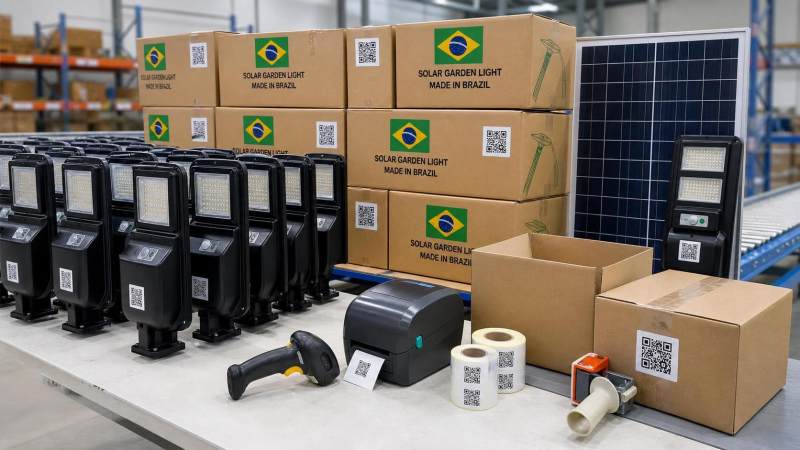
From October 1, 2026, imported solar lighting products entering Brazil will face a more specific traceability requirement under INMETRO Portaria 142/2026. The change centers on mandatory unique QR codes on both product packaging and the device itself, along with real-time synchronization to the SISCON compliance platform. For importers, manufacturers, certification-related service providers, distributors, and delivery teams handling the Brazil market, this is worth attention because it shifts compliance from a document-based checkpoint toward product-level and system-linked traceability.
What the New Rule Formally Requires
According to the information provided, INMETRO issued Portaria 142/2026 on July 10, 2026. The measure applies to imported solar lighting products and takes effect on October 1, 2026. Under the new rule, each product must carry a unique QR traceability code on both the packaging and the equipment itself, and the relevant information must be synchronized in real time to Brazil's national compliance supervision platform, SISCON. The new measure replaces INMETRO 141/2023 and is intended to strengthen full life-cycle traceability.
Where the Operational Pressure Is Likely to Appear
Import workflows move closer to product-level control
From an industry perspective, import-oriented trading companies are likely to be affected first because the rule is tied directly to imported solar lighting products. The practical impact is likely to appear in shipment preparation, packaging review, product marking, and compliance file coordination. What deserves closer attention is whether existing import routines, labeling steps, and pre-shipment checks are aligned with the requirement for a unique QR code on both packaging and the device.
Manufacturing and packaging stages face tighter execution demands
Analysis shows that manufacturers and processing partners serving the Brazil market may need to pay closer attention to how product marking is implemented in production and final packing. The rule, as provided, does not only concern external packaging; it also reaches the product body itself. That means the operational burden is likely to extend beyond paperwork into labeling consistency, traceability linkage, and release control before delivery.
Certification and compliance support work may become more detailed
For certification-related companies, testing support providers, and compliance coordinators, the change appears relevant because the rule links physical marking with a national supervision platform. Observably, this may affect document preparation, conformity review, and the consistency check between product identity and regulatory records. Even where execution details are not yet provided in the input, companies in this part of the chain should watch for how traceability information is expected to match product submissions and compliance records.
Distributors and after-sales channels may see stronger traceability expectations
Channel operators and after-sales teams may also need to monitor the change because a full life-cycle traceability approach can affect how products are identified after import and delivery. Analysis shows that product identification, complaint handling, and service record management could become more sensitive to whether QR-linked traceability information is complete and usable. This should be understood as an operational implication rather than a confirmed enforcement outcome, since the input does not provide detailed downstream procedures.
What Companies Should Review Now
Check whether Brazil-bound product marking is still based on the old rule set
Companies supplying imported solar lighting products to Brazil should review whether internal compliance procedures still reflect INMETRO 141/2023. Since Portaria 142/2026 replaces that earlier measure, any checklist, packaging specification, or shipment release step built around the previous requirement may need to be re-examined.
Review QR code placement and traceability consistency across documents and goods
What deserves closer attention is not only the existence of a QR code, but also whether the code is unique and consistently tied to the specific product and its packaging. In practice, businesses may need to review technical files, packaging artwork, product marking instructions, and internal traceability records to reduce the risk of mismatch across physical goods and compliance information.
Monitor how SISCON connectivity is reflected in execution requirements
The input confirms that real-time synchronization to SISCON is required, but it does not provide operational details on implementation. For that reason, companies should continue monitoring later official wording, execution guidance, or market-side compliance expectations that may clarify how data submission, timing, and record consistency are evaluated in practice.
Reassess delivery timing and handoff points in the supply chain
Observably, any rule that combines physical marking with platform synchronization can influence shipment readiness and delivery coordination. Importers, exporters, suppliers, and logistics-facing teams should therefore pay attention to whether compliance confirmation must be built earlier into packaging finalization, factory release, or pre-dispatch review for Brazil-bound orders.
How This Change Is Best Interpreted at This Stage
Analysis shows that this development is more than a routine administrative update because it replaces an earlier INMETRO measure and adds a clearer product traceability structure tied to both labeling and system reporting. At the same time, it is more appropriate to understand this as an implemented compliance signal with further execution details still worth watching, rather than as a fully transparent end-state with all market practices already settled. The rule change is confirmed; the exact operational interpretation across certification, shipment control, and downstream enforcement remains an area for continued observation based on later official communication and market response.
Why the Market Should Keep Watching
At this stage, the most rational reading is that Brazil is reinforcing traceability expectations for imported solar lighting products through a requirement that connects the physical product, its packaging, and a national compliance platform. For businesses already active in this trade flow, the main issue is not broad market speculation but whether existing compliance, labeling, and delivery arrangements are ready for the October 1, 2026 effective date. The development is best understood as a concrete rule change with immediate compliance relevance, while some aspects of execution still require close follow-up.
Basis of This Article
This article is based on the user-provided news title, event date, and event summary. The confirmed facts used here come from the provided description of INMETRO Portaria 142/2026, its July 10, 2026 issuance, its October 1, 2026 effective date, the QR traceability requirement for imported solar lighting products, the required real-time synchronization to SISCON, and the replacement of INMETRO 141/2023. For this type of development, commonly relevant source categories may include official regulatory notices, publications from supervisory authorities, customs or trade administration updates, industry association notices, standards-related documents, and reporting by authoritative trade media. A specific official source link was not provided in the input, so further verification remains necessary. What still needs continued observation includes detailed implementation wording, compliance interpretation in certification practice, possible changes in tender or procurement documentation, market feedback, and how companies execute the requirement in actual trade and delivery processes.
The VitalSync Intelligence Brief
Receive daily deep-dives into MedTech innovations and regulatory shifts.