
Security
China’s First Unenhanced Energy ABS Launched
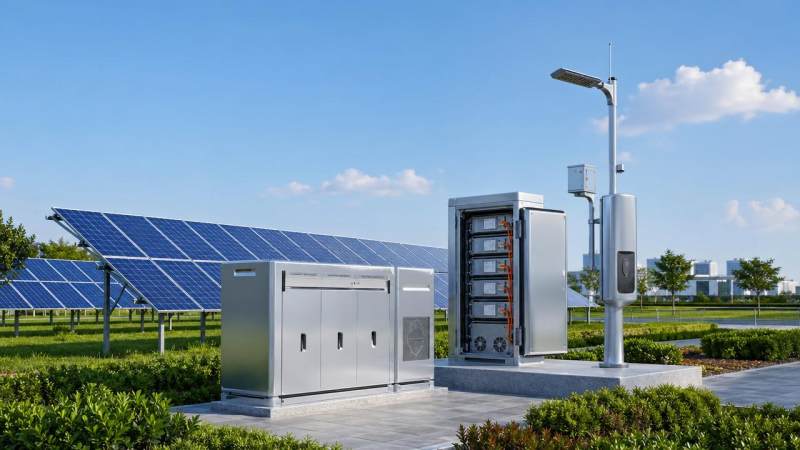
On April 29, 2026, State Grid Xiong’an Commercial Factoring Co., Ltd. successfully issued a RMB 902 million unenhanced asset-backed securities (ABS) on the Shanghai Stock Exchange — the first such transaction in China’s energy sector. The issuance marks a structural shift in financing for enterprises exporting solar lighting, smart nodes, and fire suppression systems — particularly those engaged in international EPC or PPP procurement — by offering project-level financial credibility without reliance on corporate credit or third-party guarantees.
Event Overview
On April 29, 2026, State Grid Xiong’an Commercial Factoring Co., Ltd. completed the issuance of a RMB 902 million unenhanced ABS on the Shanghai Stock Exchange. The underlying assets consist of receivables from distributed photovoltaic power stations, smart streetlight projects, and commercial & industrial energy storage safety systems. The transaction does not involve corporate credit enhancement or third-party guarantees; instead, it relies solely on project-level cash flows and alignment with internationally recognized ESG standards.
Industries Affected
Export-Oriented Green Safety Solution Providers
Companies supplying solar lighting, smart nodes (e.g., intelligent streetlight control units), and fire suppression systems to overseas markets are directly affected. Their ability to demonstrate project-level financing validation — rather than relying solely on parent company balance sheets — may improve bid competitiveness in international EPC or PPP tenders where financial credibility is assessed at the project level.
Domestic Project Developers & EPC Contractors
Firms developing distributed PV, smart infrastructure, or integrated energy safety systems in China may see increased demand for structured receivables documentation and standardized ESG reporting. Since the ABS structure anchors eligibility on verifiable project cash flows and ESG compliance, developers must ensure consistent revenue recognition, metering data integrity, and audit-ready sustainability disclosures.
Supply Chain Finance Service Providers
Commercial factoring firms, green finance platforms, and ABS arrangers face new benchmarking requirements. This transaction sets a precedent for evaluating energy-related receivables based on operational performance and ESG metrics — not issuer credit rating — potentially reshaping underwriting criteria and due diligence workflows for similar instruments.
What Enterprises and Practitioners Should Monitor and Act On
Track official guidance on ESG-aligned cash flow verification
Current ABS eligibility hinges on adherence to internationally accepted ESG standards. Enterprises should monitor upcoming technical guidelines from the Shanghai Stock Exchange or the Asset Management Association of China regarding how ESG compliance will be verified — e.g., whether third-party assurance of carbon reduction claims or energy yield data is required.
Prepare receivables documentation for project-level transparency
Exporters and project developers should begin standardizing contract terms, invoicing schedules, and performance data collection (e.g., energy generation logs, maintenance records, safety system uptime) to support future ABS-eligible asset pools. Early alignment with ISO 14064 or GRI reporting frameworks may reduce verification friction.
Distinguish between policy signal and near-term scalability
This is the first issuance — not yet a repeatable template. While it signals regulatory openness to project-level securitization in green energy, actual adoption depends on investor appetite, secondary market liquidity, and replication by non-State Grid-affiliated originators. Enterprises should treat this as a reference case, not an immediately deployable financing channel.
Assess implications for overseas tender submissions
International procurement entities may begin recognizing such ABS-backed project financing as evidence of financial viability. Exporters should proactively clarify with key clients (e.g., municipal utilities, development banks) whether inclusion of ABS issuance documentation strengthens bid evaluation — and if so, which elements (e.g., cash flow coverage ratio, ESG certification scope) carry weight.
Editorial Perspective / Industry Observation
Observably, this issuance functions primarily as a policy and market signal — not yet an established financing pathway. Analysis shows it validates the feasibility of decoupling energy infrastructure financing from corporate credit in China’s capital markets, but its scalability remains contingent on standardization of ESG-linked cash flow measurement and broader investor familiarity with unenhanced structures. From an industry perspective, it reflects growing institutional alignment between green infrastructure deployment and capital market innovation — yet real-world adoption will depend less on one-off success and more on replicability across diverse project types and ownership models.
Consequently, the market should view this not as an immediate alternative to traditional trade finance or export credit, but as an emerging indicator of how project-level financial transparency may evolve into a competitive differentiator — especially for Chinese exporters competing in climate-resilient infrastructure tenders globally.
Conclusion: This transaction is best understood as a structural experiment — one that introduces project-level financing credibility as a measurable, market-recognized attribute for Chinese green safety and smart energy exporters. Its broader significance lies not in volume or immediacy, but in redefining what constitutes financial trustworthiness in cross-border infrastructure procurement: shifting focus from balance-sheet strength to verifiable, ESG-integrated operational performance.
Information Source: Official announcement by State Grid Xiong’an Commercial Factoring Co., Ltd.; Shanghai Stock Exchange disclosure records dated April 29, 2026. Note: Ongoing observation is warranted for follow-up issuances, investor uptake, and potential regulatory refinements to ESG verification protocols.
The VitalSync Intelligence Brief
Receive daily deep-dives into MedTech innovations and regulatory shifts.