
Security
Saudi SASO Mandates SISCON for Solar Lighting
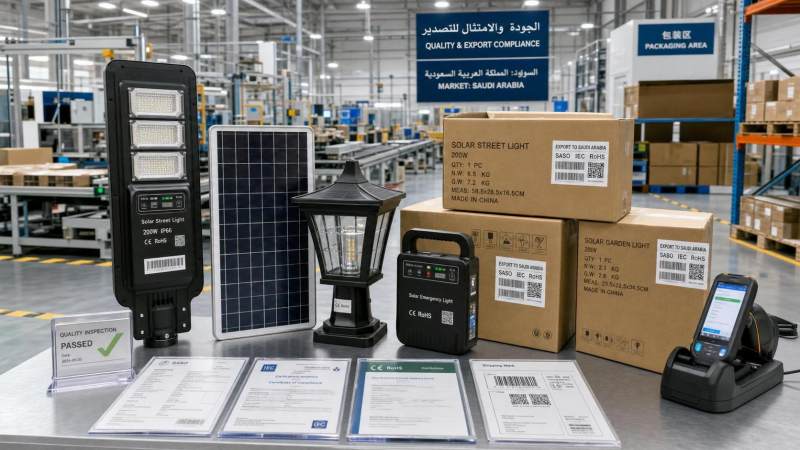
On July 12, 2026, the Saudi Standards, Metrology and Quality Organization (SASO) issued notice G/SPS/N/SAU/386, setting a new compliance condition for solar lighting products shipped to Saudi Arabia. From September 1, 2026, covered products including solar street lights, garden lights, and emergency lights must be equipped with a SASO-SISCON certification module and upload factory data in real time to the SISCON cloud platform. For manufacturers, exporters, importers, and compliance-related service providers, this is not just a documentation update: products that do not connect to the required system will not obtain a SASO CoC certificate, creating a direct customs clearance risk.
What the notice confirms
The confirmed facts are limited but operationally clear. SASO published notice G/SPS/N/SAU/386 on July 12, 2026. The notice states that, starting on September 1, 2026, all solar lighting products exported to Saudi Arabia must meet two conditions: first, they must have a pre-installed SASO-SISCON certification module; second, factory data must be uploaded in real time to the SISCON cloud platform. The product scope specifically includes solar street lights, garden lights, and emergency lights. The notice also makes the enforcement consequence explicit: products that are not connected to the system will not receive a SASO CoC certificate, which in turn can lead to customs clearance failure.
Where the immediate pressure will appear
Export and trading workflows face a hard compliance gate
From an industry perspective, direct exporters and trading companies are likely to feel the earliest impact because the new requirement is tied to the ability to obtain a SASO CoC certificate. The practical pressure point is no longer only product shipment, but whether the product and its factory-side data flow meet the new access condition before export. What deserves closer attention is how order acceptance, shipment timing, and document preparation are aligned with the September 1, 2026 effective date.
Manufacturing lines may need closer coordination with certification steps
For manufacturers of solar lighting products, the stated requirement shifts part of compliance into the production stage, since the certification module must be pre-installed and factory data must be uploaded in real time. Analysis shows that the affected business link is the handoff between production completion and export compliance readiness. Manufacturers should pay particular attention to whether the covered product categories in their portfolio fall within the stated scope and whether their factory processes can support the required data upload step.
Importers and buyers in Saudi Arabia may face delivery execution risk
Saudi-side importers, distributors, and project buyers may not control factory operations directly, but they could still be affected through delayed certification and customs clearance failure. Observably, the key issue for these participants is supplier readiness. In business terms, the main concern is whether outbound products can still move on schedule once the rule takes effect, especially for orders that are close to shipment around the implementation date.
Compliance and supply chain service providers will need to track rule execution closely
Service providers involved in certification support, shipment coordination, and customs-related documentation may also need to adjust their workflows. The reason is straightforward: the new rule links product configuration, factory data reporting, certification eligibility, and customs outcomes into one chain. What deserves closer attention is whether clients have fully identified affected SKUs and whether supporting documentation and process checkpoints reflect the new system-access requirement.
Practical issues companies should watch now
Clarify whether current products fall within the stated scope
The notice explicitly names solar street lights, garden lights, and emergency lights. Companies dealing in solar lighting should first verify whether their active export models for Saudi Arabia fall within these categories as described in the notice, because the operational consequence is tied directly to certification and customs clearance.
Check the production-stage readiness of module installation and data upload
Analysis shows that the central operational issue is not only having compliant paperwork, but also meeting the stated requirement for pre-installation of the SASO-SISCON certification module and real-time factory data upload. Businesses should therefore review whether these two steps are already reflected in production, inspection, and release procedures for Saudi-bound goods.
Review order timing against the September 1, 2026 enforcement date
What deserves closer attention is the timing gap between the notice date and the enforcement date. Companies handling near-term Saudi shipments should examine open orders, production schedules, and shipment windows to determine which goods may be exposed to the new requirement before export and customs clearance.
Keep customer and supplier communication tied to verifiable compliance points
Observably, this notice creates a need for more precise communication across the supply chain. Exporters, factories, and buyers should focus discussions on concrete items already stated in the notice: covered product categories, pre-installed certification modules, real-time factory data upload, and the certification consequence for non-compliant products. This helps separate confirmed obligations from assumptions that may still require clarification.
Why this should be read as an operational rule, not a symbolic notice
Analysis shows that this development already has a defined business consequence because SASO has linked system connection to CoC issuance and customs clearance outcomes. That makes it more than a policy signal in principle. At the same time, it is more appropriate to understand this as both an immediate compliance change and a continuing area for observation, because companies still need to monitor how the requirement is applied in day-to-day shipment and certification practice after the September 1, 2026 start date.
How the market should interpret this update
The most grounded reading of this notice is that Saudi market access for covered solar lighting products is becoming more dependent on traceability-linked compliance execution at the factory stage. The confirmed effect is clear: without SISCON connection under the stated requirement, a SASO CoC certificate will not be issued, and customs clearance may fail. Beyond that confirmed point, the broader industry significance should be viewed cautiously and practically. It is more appropriate to understand this update as a concrete near-term compliance requirement with longer-term signaling value for how market access controls may be implemented.
Basis of this article and points for continued verification
This article is based on the user-provided news title, event date, and event summary concerning SASO notice G/SPS/N/SAU/386 issued on July 12, 2026. For this type of industry update, relevant source categories typically include official notices, standard-organization documents, company announcements, industry association information, and authoritative media reporting. No specific official source link was provided in the input, so the exact official publication path still needs to be continuously verified. Follow-up attention should remain on any further official wording, implementation clarifications, and any practical interpretation affecting certification, shipment preparation, and customs clearance for covered solar lighting products.
The VitalSync Intelligence Brief
Receive daily deep-dives into MedTech innovations and regulatory shifts.