
Security
Vietnam Tightens Solar Street Light Entry Rules
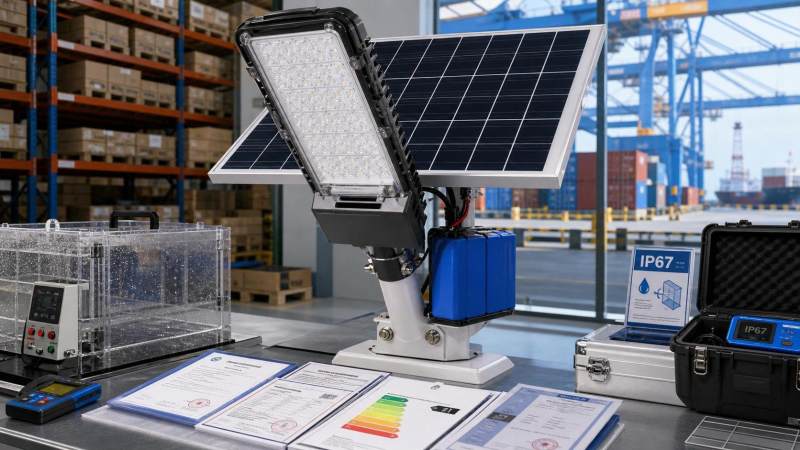
Vietnam’s mandatory implementation of QCVN 16:2026/BKHCN on October 1, 2026 turns compliance for imported solar street lights into a combined performance, durability, ingress-protection, and labeling requirement rather than a single technical check. For exporters, buyers, testing partners, and delivery teams, the immediate point of attention is that market access now depends on meeting the stated efficacy threshold, battery cycle-life requirement, IP67 third-party testing, and VEE energy labeling, while localized type testing through designated laboratories extends the certification timeline to 6–8 weeks.
What the new mandatory standard requires
The Ministry of Science and Technology of Vietnam (MOST) issued the national mandatory standard QCVN 16:2026/BKHCN on June 19, 2026. From October 1, 2026, all imported solar street lights must meet a minimum luminous efficacy of at least 120 lm/W and an internal lithium battery cycle life of at least 2,000 cycles.
The same products must also pass third-party IP67 testing for the complete luminaire and carry the Vietnam Energy Efficiency label, identified as VEE. For Chinese exporters, localized type testing must be completed through VINAQUATEST or the SGS Hanoi laboratory. The certification cycle is stated as 6–8 weeks.
Where the pressure shifts across the supply chain
Export programs now face a stricter market-entry sequence
Export-oriented suppliers are likely to be affected first because shipment readiness is no longer only about product availability. The rule change ties import access to both technical thresholds and local certification steps, which means sales planning, production release, and customs-facing documentation need to align with the new testing and labeling path.
From an industry perspective, what deserves closer attention is that compliance is attached to the imported finished product, not just to isolated components. That makes pre-shipment review of efficacy claims, battery specifications, IP67 test status, and labeling readiness more commercially relevant for exporters serving Vietnam.
Procurement and sourcing teams may need earlier technical screening
Buyers and sourcing teams may also feel the impact because product selection now has to account for explicit minimum performance and durability requirements before an order moves too far into execution. If a model cannot support the required luminous efficacy or battery cycle life, the issue may surface not at the quotation stage but during certification preparation, which can affect procurement timing and supplier confirmation.
Observably, this raises the importance of checking technical files, test arrangements, and supplier readiness earlier in the purchasing cycle, especially where delivery commitments depend on import clearance and local acceptance.
Testing and certification workflows become part of delivery risk
Certification-related service providers and delivery coordinators are likely to see the rule change reflected in scheduling pressure. The requirement to use VINAQUATEST or SGS Hanoi for localized type testing means the compliance path is more structured, while the stated 6–8 week cycle directly affects lead-time calculations.
For companies managing contracts or shipment windows, the practical issue is not only whether a product can comply, but whether testing, certification, and labeling can be completed within the commercial delivery plan. This is especially relevant where order release depends on a confirmed compliance timeline.
What companies should review now
Check whether current models match the stated thresholds
Companies supplying solar street lights to Vietnam should review whether the models intended for export can meet the minimum 120 lm/W efficacy requirement and the internal lithium battery cycle life threshold of 2,000 cycles. Where technical claims are close to the threshold, the compliance risk may be higher during localized testing.
Prepare technical files around complete-product verification
The requirement for third-party IP67 testing on the complete luminaire means documentation should be organized around the finished product rather than only around component-level claims. Companies should pay closer attention to how test reports, specification sheets, and product documentation align with the exact model intended for import and labeling.
Recalculate certification and shipment timing
Because the certification cycle is stated as 6–8 weeks, exporters, importers, and project buyers should reassess order sequencing, booking plans, and promised delivery dates. Analysis shows that timing risk may become a practical compliance issue even where the product itself is technically capable of meeting the new standard.
Follow implementation wording and market-facing documents closely
The input information confirms the mandatory standard, the effective date, the required thresholds, the IP67 testing condition, the VEE labeling requirement, and the named laboratories for localized type testing. It does not provide fuller enforcement detail beyond that. For that reason, companies should continue tracking how these requirements are reflected in certification practice, tender documents, buyer specifications, and import-side execution language.
Why this looks like an execution-stage signal
Analysis shows this development is more appropriately understood as an implemented market-entry requirement than as a broad policy direction without immediate effect, because a mandatory date, measurable thresholds, a labeling condition, and named localized testing channels are all already identified. At the same time, it is not yet a complete picture of market practice, since the input does not provide additional detail on enforcement interpretation beyond the stated requirements.
From an industry perspective, the most useful reading is that Vietnam is linking product access for imported solar street lights more tightly to verified efficiency, battery durability, environmental protection performance, and local certification procedure. That combination matters not only for compliance teams, but also for pricing, bid preparation, production scheduling, and shipment commitments.
How the market should read this development
At this stage, the event is best read as a concrete compliance change with direct implications for export preparation and delivery planning, rather than as a symbolic policy statement. The immediate significance lies in the fact that technical performance, third-party IP67 verification, VEE labeling, and localized type testing now sit on the same access path for imported solar street lights entering Vietnam.
A neutral industry conclusion is that companies with active or planned Vietnam business should treat this as an operational rule change that warrants prompt document review and timeline adjustment, while still watching for further clarification in execution practice and market feedback.
Basis of this article and points still worth verifying
This article is generated from the user-provided news title, event date, and event summary. The factual basis used here is limited to the provided information concerning QCVN 16:2026/BKHCN, its June 19, 2026 issuance by MOST, its mandatory implementation date of October 1, 2026, the stated product requirements, the VEE labeling condition, the named localized testing laboratories, and the 6–8 week certification cycle.
For this type of development, commonly relevant source categories may include official government notices, regulator publications, trade or customs authority updates, standard-setting documents, certification body communications, and reporting by authoritative industry media. A specific official source link was not provided in the input, so the exact source document path still requires follow-up verification. It also remains important to continue monitoring detailed implementation language, certification interpretation, tender document changes, industry feedback, and company-level execution results.
The VitalSync Intelligence Brief
Receive daily deep-dives into MedTech innovations and regulatory shifts.