
Security
How Precision Manufacturing Improves Optical Design Accuracy
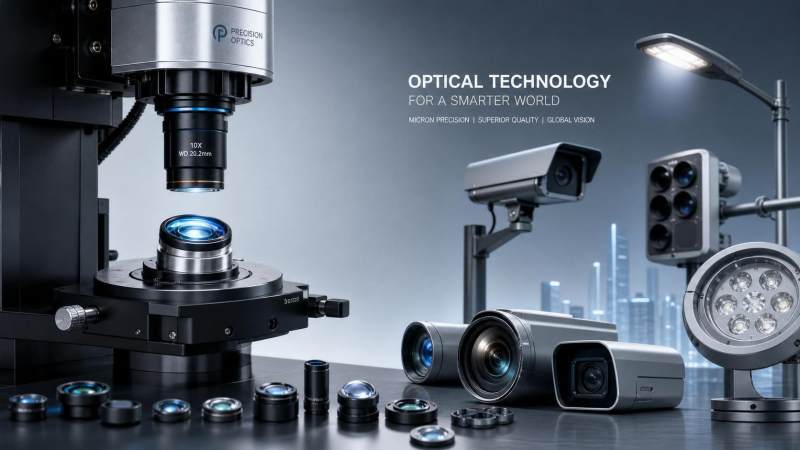
In security infrastructure and smart urban projects, optical performance is often judged at the point of use, not at the point of manufacture. Yet the two are tightly connected. How precision manufacturing improves optical design accuracy becomes clearer when lens geometry, surface finish, coating quality, and assembly tolerances are treated as project-level variables rather than isolated factory details.
That shift matters in 2026, when digital infrastructure upgrades, public safety modernization, and AI-enabled monitoring systems are expanding together. For platforms such as GSIM, which connect global compliance insight with optical technology intelligence, precision manufacturing for optical design is no longer a niche engineering topic. It is part of risk control, procurement logic, and long-term operational reliability.
Why optical accuracy begins on the manufacturing floor
Optical design defines how light should move through a system. Precision manufacturing determines how closely the final product matches that intent.
If the design calls for a precise focal length, low distortion, and stable beam distribution, those goals depend on micron-level execution. Small deviations change the result quickly.
In practice, precision manufacturing for optical design covers more than machining accuracy. It includes material consistency, polishing discipline, coating uniformity, alignment control, and repeatable assembly.
This is why two products built from the same drawing can perform differently in the field. The drawing captures intent. Manufacturing captures truth.
The tolerances that shape real-world performance
Optical systems fail gradually or suddenly depending on where tolerance errors appear. Some issues reduce image clarity. Others create compliance or coverage gaps.
Surface and form accuracy
Lens curvature must stay close to design values. Surface irregularities can introduce aberrations, scatter, and contrast loss, especially in long-range imaging or controlled illumination.
Coating consistency
Anti-reflective and protective coatings support transmission, glare control, and environmental durability. Uneven coatings can weaken low-light performance and increase maintenance risk.
Mechanical alignment
Even well-made components underperform when alignment drifts during assembly. Decentering, tilt, and spacing errors can affect field uniformity, detection range, and calibration stability.
Thermal and material behavior
A precise part at room temperature may shift under heat, vibration, or moisture. Material selection and manufacturing discipline must match the actual deployment environment.
Why the topic matters more in security and urban infrastructure
Security cameras, perimeter sensors, traffic systems, and smart lighting networks all depend on predictable optical behavior. When that behavior changes, the business impact is rarely minor.
A camera with unexpected edge distortion may reduce incident reconstruction quality. A lighting optic with uneven beam spread may leave dark zones in a transit corridor.
In cross-border projects, the concern extends beyond performance. Documentation, standards alignment, and repeatable quality also affect compliance reviews and acceptance testing.
This is where GSIM’s role becomes relevant. Its Strategic Intelligence Center links policy interpretation, optical technology trends, and procurement signals. That broader view helps teams evaluate precision manufacturing for optical design in a business context, not just a technical one.
Where precision manufacturing creates measurable value
The benefits are easiest to see when optical accuracy is tied to outcomes that can be tracked during deployment and operation.
The value is not limited to better optics. It also appears in fewer redesign cycles, clearer vendor comparison, and more predictable lifecycle costs.
Common scenarios where small errors become expensive
Precision manufacturing for optical design becomes especially important when systems are expected to work continuously and under mixed conditions.
- Long-distance observation, where minor aberrations weaken usable detail.
- Low-light surveillance, where transmission loss and flare reduce analytic confidence.
- Public lighting corridors, where beam inconsistency creates safety complaints.
- Construction and transport hubs, where vibration and dust test assembly stability.
- Cross-regional deployments, where documentation and repeatability affect approvals.
These cases share one feature. The cost of discovering optical weakness after installation is far higher than addressing manufacturing capability earlier.
How to evaluate suppliers and solutions more carefully
A useful evaluation process connects optical intent, manufacturing proof, and field conditions. Looking only at catalog performance is rarely enough.
Ask how tolerances are controlled
It helps to review machining capability, metrology methods, coating inspection, and alignment procedures. Repeatability matters more than isolated sample quality.
Check environmental fit
Precision manufacturing for optical design should match the final operating context. Heat, humidity, pollution, and vibration can reveal weak process control.
Compare manufacturing evidence with system claims
If a supplier promises high recognition accuracy or uniform illumination, there should be process data and test results that support the claim.
Include standards and policy visibility
For international projects, technical quality should be assessed together with applicable regulations. GSIM’s intelligence model is valuable here because procurement decisions are increasingly shaped by both performance and compliance.
A practical framework for better project decisions
A strong decision path usually begins with the optical task, then moves backward into manufacturing questions.
- Define the required optical outcome in measurable terms.
- Identify the tolerances most likely to change that outcome.
- Request evidence of process capability, not only finished samples.
- Test under realistic environmental and operational conditions.
- Review standards, documentation, and supply consistency together.
This approach reduces the gap between design ambition and installed performance. It also makes comparisons across vendors or solution packages more defensible.
What to watch next
The next wave of AI vision, VLC integration, and urban sensing will raise the bar further. Optical systems will be expected to deliver cleaner data, tighter beam control, and better interoperability.
That makes precision manufacturing for optical design a continuing strategic issue rather than a one-time specification item. The strongest results usually come from treating manufacturing quality as part of system governance.
A sensible next step is to map critical optical requirements against tolerance risk, supplier evidence, and compliance needs. With that structure in place, it becomes easier to judge which solutions are technically credible, operationally stable, and suitable for long-term deployment.
The VitalSync Intelligence Brief
Receive daily deep-dives into MedTech innovations and regulatory shifts.