
Security
Precision Manufacturing for Optical Components: Tolerance Matters
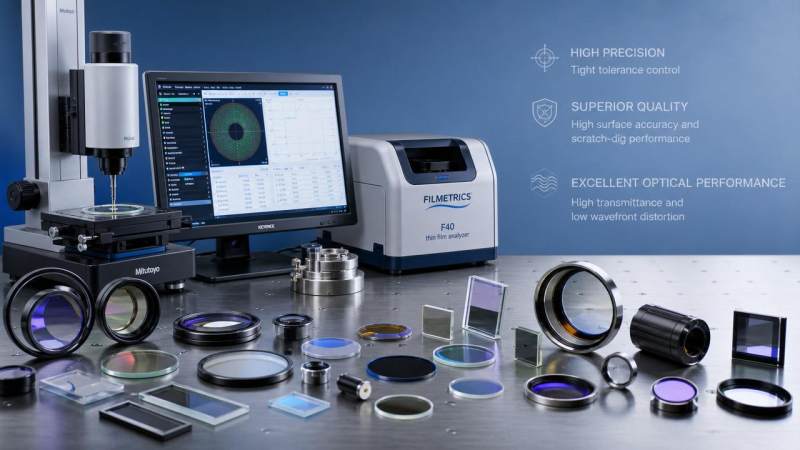
In security systems and optical environments, precision manufacturing for optical components is where performance, compliance, and reliability begin. For quality control teams and safety managers, even minor tolerance deviations can affect imaging accuracy, light transmission, and long-term system stability. As global infrastructure and urban safety standards rise, understanding tolerance is essential to making smarter sourcing, inspection, and deployment decisions.
Why Tolerance Is a Decision Issue, Not Just a Manufacturing Detail
When buyers evaluate optical parts, tolerance is often treated as a drawing requirement. In practice, it is a risk-control variable that shapes performance, maintenance cost, and compliance readiness.
For quality control personnel, tolerance determines whether a lens, cover glass, filter, or reflector will perform consistently across batches. For safety managers, it affects image clarity, sensor accuracy, and field reliability.
The core search intent behind precision manufacturing for optical components is practical. Readers want to know how tight tolerances influence system outcomes, what to inspect, and how to avoid hidden sourcing risks.
The most useful answer is straightforward: not every optical component needs the tightest tolerance, but every critical application needs the right tolerance linked to real operating conditions.
What Quality and Safety Teams Usually Need to Know First
Most target readers are not searching for abstract optical theory. They want a reliable way to judge whether a supplier’s manufacturing capability matches the demands of surveillance, sensing, illumination, or safety infrastructure.
The first concern is performance impact. If tolerance drifts, systems may suffer from blurred imaging, reduced light efficiency, alignment instability, color inconsistency, or shortened operational life.
The second concern is verification. Teams need to know which tolerances are measurable at incoming inspection, which require process certification, and which can only be validated through assembled system testing.
The third concern is cost versus necessity. Tightening every tolerance raises manufacturing expense, lead time, and rejection rates. Smart procurement depends on controlling the tolerances that matter most.
Which Optical Tolerances Matter Most in Real Applications
In precision manufacturing for optical components, tolerance is not one number. It includes dimensional, geometric, surface, material, and optical performance limits, each affecting the system differently.
Dimensional tolerance covers thickness, diameter, radius, and spacing. These values influence fit, assembly repeatability, and the optical path. Even small deviations can shift focus or create mounting stress.
Surface quality is equally important. Scratches, digs, waviness, and polishing defects may reduce transmission, increase scatter, and create image artifacts, especially in cameras used for monitoring or recognition.
Center thickness and wedge tolerance affect beam deviation and optical alignment. In surveillance optics or detection modules, these errors can degrade accuracy even when the component appears visually acceptable.
Coating tolerance is another major factor. Variation in coating thickness can alter reflectance, transmission, and spectral response, which directly impacts low-light performance, glare control, or sensor sensitivity.
Material consistency also matters. Refractive index variation, internal stress, bubbles, or inclusions can create unstable performance under temperature shifts, vibration, or continuous exposure to outdoor environments.
How Tolerance Directly Affects Security and Illumination Systems
For security imaging, optical tolerances influence resolution, contrast, field uniformity, and calibration stability. A lens system with weak tolerance control may pass bench inspection but fail under actual deployment conditions.
In facial recognition or license plate capture, focus accuracy and distortion control are critical. Small manufacturing variation can reduce recognition rates, especially at night or across wide temperature ranges.
For infrared or multispectral applications, tolerance becomes even more sensitive. Material accuracy, coating stability, and surface form strongly affect transmission behavior and measurement credibility.
In illumination systems, reflector geometry and lens precision govern beam shape, intensity distribution, and hotspot control. Poor tolerance may create uneven lighting that compromises safety, visibility, or sensor collaboration.
For integrated urban infrastructure, optical inconsistency across batches creates a hidden systems problem. Devices from the same project may perform differently, making maintenance, recalibration, and troubleshooting much harder.
How to Judge Whether a Supplier Truly Has Precision Manufacturing Capability
Many suppliers can quote tight numbers. Fewer can maintain them consistently across production volume. That is why capability evaluation should go beyond drawings and sample approval.
Start with process control evidence. Ask how the supplier controls grinding, polishing, coating, centering, bonding, and final inspection. Capability is stronger when tolerance is built into process flow, not sorted afterward.
Review measurement systems carefully. A credible supplier should explain how surface form, coating performance, dimensional accuracy, and cosmetic quality are measured, calibrated, and documented.
Batch consistency is often more important than one excellent prototype. Request historical data on yield, process capability, nonconformance trends, and lot-to-lot variation for similar optical components.
Also examine change control discipline. In security and safety applications, uncontrolled substitutions in glass type, coating source, adhesive, or polishing sequence can create silent performance drift.
Finally, look for application understanding. Suppliers with experience in surveillance, outdoor lighting, or sensing environments are usually better at linking tolerance to field conditions and failure modes.
What Incoming Inspection Should Prioritize
Quality control teams cannot inspect everything at maximum depth, especially under time and cost pressure. The better approach is to prioritize inspection items according to application risk and failure consequence.
Start with critical-to-function characteristics. These usually include clear aperture, surface quality, coating performance, thickness, centration, and transmitted wavefront or imaging-related indicators when relevant.
Check whether the inspection method matches the tolerance type. Visual checks are not enough for coating uniformity or subtle wedge error. Some requirements need interferometry, spectrophotometry, or precision metrology.
Sampling plans should reflect risk, not convenience. Components used in public safety cameras, perimeter monitoring, transportation systems, or optical signaling may justify tighter acceptance criteria than general commercial products.
It is also useful to track trend data rather than pass-fail results alone. Gradual drift in measured values often appears before formal nonconformance, giving teams time to intervene early.
How Safety Managers Can Translate Tolerance into Operational Risk
Safety managers are often responsible for uptime, incident readiness, and compliance outcomes rather than component specifications. Still, tolerance decisions directly affect those responsibilities.
If optical components are under-specified, systems may require frequent recalibration, produce unreliable images, or degrade faster in harsh environments. These issues increase operational burden and may weaken audit confidence.
If components are over-specified without need, projects absorb unnecessary cost and procurement complexity. The best decision is not the tightest tolerance, but the tolerance aligned with mission-critical performance.
A useful framework is to classify applications by consequence of failure. Evidence-grade imaging, public-space monitoring, transport corridors, and critical facilities usually deserve stricter tolerance governance than low-risk environments.
Managers should also consider environmental stress. Temperature cycling, humidity, dust, UV exposure, and vibration can amplify small optical errors, turning marginal components into field failures over time.
Common Sourcing Mistakes That Lead to Optical Performance Problems
One common mistake is buying to nominal dimensions while ignoring optical performance tolerances. Parts may fit mechanically yet fail to deliver the transmission, imaging, or alignment quality the system requires.
Another mistake is using cosmetic inspection as a substitute for functional verification. A component can look clean and still contain wedge error, refractive inconsistency, or coating variation that harms performance.
Teams also underestimate the risk of incomplete drawings. If tolerances are vague, suppliers may interpret them differently, leading to inconsistent manufacturing results and disputes during acceptance.
Price-driven sourcing without process visibility is another recurring issue. Low quotations may depend on weak process control, limited metrology, or loose batch management, which later becomes a quality problem.
Finally, organizations sometimes approve samples under ideal conditions but skip stress validation. A component that performs indoors may behave very differently in outdoor security or high-duty illumination use.
How to Set More Practical Tolerance Requirements
Better specifications begin with system function. Identify which optical characteristics affect detection accuracy, image usability, beam control, or environmental stability. Then assign tighter tolerances only to those points.
Cross-functional review helps. Quality teams, design engineers, sourcing staff, and safety stakeholders should align on what is critical, what is measurable, and what failure would mean in actual deployment.
Link every major tolerance to a reason. If a coating range is tight, define whether the driver is low-light transmission, laser compatibility, glare reduction, or spectral filtering. This improves supplier understanding.
It is also wise to define acceptance by both component and system level when necessary. Some errors are tolerable individually but become harmful when accumulated across multiple optical elements.
For long-cycle infrastructure projects, include traceability and requalification rules. This protects continuity when production lots, raw materials, or upstream processes change over time.
The Strategic Value of Precision Manufacturing for Optical Components
For organizations involved in safety infrastructure, precision manufacturing for optical components is not only a technical requirement. It supports dependable operations, procurement transparency, and stronger alignment with modern standards.
As global cities invest in digital monitoring, smart transport, and optical communication environments, decision-makers need more than hardware availability. They need confidence that components will perform predictably at scale.
This is where disciplined tolerance management becomes strategic. It reduces field uncertainty, supports lifecycle planning, and improves the credibility of security and illumination systems in regulated environments.
Platforms such as GSIM add value by connecting manufacturing considerations with compliance interpretation, technology trends, and project decision support. That broader context helps teams judge specifications more intelligently.
Conclusion: The Right Tolerance Protects Performance, Cost, and Trust
When evaluating precision manufacturing for optical components, the main question is not whether tighter tolerance is always better. The real question is whether tolerance is appropriate for the application’s risk and performance needs.
For quality control teams, that means verifying the few parameters that most strongly affect function. For safety managers, it means understanding how manufacturing variation can influence uptime, evidence quality, and system reliability.
The most resilient sourcing decisions come from linking tolerance to field use, inspection capability, supplier process control, and long-term operational goals. That is how organizations avoid both under-specification and wasteful over-specification.
In a market shaped by smarter infrastructure and higher accountability, tolerance truly matters. It is one of the clearest indicators of whether an optical component is ready for dependable real-world service.
The VitalSync Intelligence Brief
Receive daily deep-dives into MedTech innovations and regulatory shifts.