
Security
Security Insights: 5 Risks Reshaping Public Facility Protection
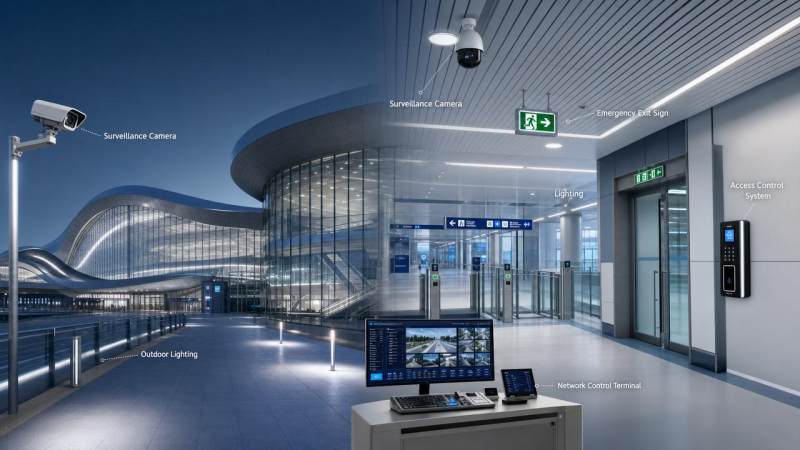
Public facilities now operate in a threat environment shaped by digital expansion, stricter regulation, and higher resilience expectations. These security insights show how protection is no longer limited to cameras, guards, and perimeter barriers. It now depends on governance, data integrity, lighting quality, interoperability, and response readiness across complex public environments.
For transport hubs, schools, civic buildings, hospitals, stadiums, and mixed-use infrastructure, the challenge is practical. Decision quality depends on seeing the right risks early. Strong security insights help connect physical security assurance with optical environment performance, producing safer, smarter, and more compliant public spaces.
Why a Checklist Approach Matters for Public Facility Protection
Threat conditions are changing faster than many public protection frameworks. New surveillance rules, connected devices, AI-enabled analysis, and aging infrastructure create overlapping risk layers. Without a checklist, critical control gaps often stay hidden until a failure, complaint, or incident exposes them.
A checklist structure turns broad security insights into repeatable action. It helps compare sites, standardize reviews, prioritize upgrades, and align security systems with lighting, compliance, maintenance, and emergency operations.
Core Checklist: 5 Risks Reshaping Public Facility Protection
- Audit surveillance governance across every device, retention rule, access log, and consent boundary to reduce legal exposure and improve accountability in daily public security operations.
- Verify cyber-physical integration between cameras, access control, alarms, networks, and cloud platforms to prevent one compromised system from weakening the full protection stack.
- Measure optical environment quality, including glare, shadow zones, color rendering, and night visibility, because poor illumination can undermine detection accuracy and response timing.
- Test resilience against crowd disruption, service outage, and emergency congestion by reviewing evacuation routes, backup power, communications continuity, and incident command coordination.
- Track supplier interoperability, lifecycle support, and standards alignment so future upgrades do not create vendor lock-in, maintenance delays, or blind spots in expanding facilities.
1. Surveillance Governance Is Now a Frontline Risk
Among current security insights, surveillance governance stands out because regulatory scrutiny is rising globally. Public facilities collect video, metadata, access records, and sometimes AI-generated alerts. If governance rules are unclear, the risk extends beyond fines. It can damage public trust and delay investigations.
Review who can access footage, how long data stays stored, where it travels, and whether AI review tools follow local compliance frameworks. Governance should be documented, not assumed. A strong policy reduces misuse, speeds audits, and creates defensible procedures during incidents.
2. Cyber-Physical Weaknesses Expand the Attack Surface
Modern public protection relies on connected systems. Cameras speak to analytics engines. Access readers connect to central control. Visitor management tools integrate with networks and identity records. These connections create efficiency, but they also widen the attack surface.
Useful security insights must therefore include cyber-physical mapping. Identify every bridge between operational technology and IT infrastructure. Segment networks, patch firmware, restrict remote access, and test fail-safe behavior. A secure door controller means little if a network compromise can disable it remotely.
3. Optical Environment Quality Directly Affects Security Outcomes
Many protection reviews still underweight the role of lighting. Yet optical conditions shape camera performance, human observation, facial visibility, and perceived safety. Poor contrast, excessive glare, and uneven brightness can create missed detections even when surveillance hardware is advanced.
This is where security insights must connect with illumination planning. Evaluate lux levels, transition zones, entry canopies, parking edges, corridors, and emergency routes. In public facilities, optical optimization supports both deterrence and accurate evidence capture. It also strengthens AI vision reliability in dynamic conditions.
4. Resilience Failures Often Begin with Operational Overload
Public facilities rarely fail from one isolated weakness. More often, disruption starts when routine pressure becomes operational overload. A power fluctuation, crowd surge, blocked exit, or radio failure can quickly weaken incident response across multiple teams.
Strong security insights require stress testing, not just specification review. Run scenarios for peak occupancy, weather disruption, transit delay, and simultaneous alarms. Confirm backup power duration, command handoff, and emergency communications. Resilience depends on how systems and people perform together under strain.
5. Vendor Lock-In and Standards Gaps Create Long-Term Exposure
A frequent but underestimated risk is technology dependence on closed ecosystems. Public facilities evolve over years, sometimes decades. If one supplier controls formats, maintenance pathways, and system compatibility, future expansion becomes slower and more expensive.
Practical security insights should include standards verification before procurement or retrofit. Check interoperability, API openness, firmware support, spare parts availability, and alignment with relevant security and lighting standards. Long-term protection improves when systems can adapt without total replacement.
How These Security Insights Apply Across Public Facility Scenarios
Transit Hubs and Mobility Corridors
Stations, terminals, and interchanges face constant movement, variable lighting, and frequent congestion. In these spaces, security insights should focus on crowd flow visibility, platform-edge observation, incident broadcast continuity, and surveillance governance for high-volume public monitoring.
Optical transitions are especially important near entrances, underground passages, and exterior loading areas. Detection quality often fails where brightness shifts abruptly between daylight and enclosed zones.
Healthcare and Civic Buildings
Hospitals and civic centers require open access without sacrificing protection. Security insights here should address visitor screening, sensitive zone access, after-hours monitoring, and privacy-compliant surveillance in public-facing yet regulated environments.
Lighting must support calm navigation, accurate identification, and emergency continuity. Resilience planning should also include elevator control, pharmacy storage, records access, and backup communications.
Education Campuses and Community Venues
Schools, libraries, sports halls, and event venues often combine open public access with vulnerable populations. Security insights should prioritize entry management, line-of-sight coverage, safeguarding zones, and emergency assembly routes.
These sites benefit from layered protection that balances visibility, ease of movement, and rapid communication. Overly intrusive systems can create resistance, while weak governance can expose sensitive records and incident footage.
Commonly Overlooked Risk Signals
Ignore maintenance drift at your own risk. Cameras, luminaires, access readers, and batteries often degrade gradually, making protection appear functional while actual performance drops below acceptable thresholds.
Overlook optical blind spots and incident reconstruction suffers. Entrances with backlight glare, reflective flooring, and poorly lit service alleys regularly reduce video usefulness during investigations.
Underestimate policy inconsistency and compliance gaps widen. One site may follow retention rules closely while another keeps informal practices, exposing the entire organization to avoidable governance risk.
Rely on procurement specifications alone and operational fit may fail. Security insights become valuable only when site conditions, workflows, and emergency behavior are tested in real use.
Practical Execution Recommendations
- Map every security and illumination asset by location, owner, firmware status, maintenance history, and standards reference.
- Run quarterly governance reviews covering retention, access permissions, audit trails, and third-party platform dependencies.
- Test camera performance under day, night, glare, and emergency lighting conditions rather than relying on datasheets.
- Simulate outage and crowd scenarios to verify resilience, communications continuity, and incident command clarity.
- Require interoperability evidence before upgrades so future expansion remains flexible and standards-based.
Conclusion and Next Action
The most valuable security insights do more than identify threats. They connect governance, infrastructure, lighting, resilience, and lifecycle planning into one protection framework. Public facility security is being reshaped by these five risks, and delayed action increases both operational and compliance exposure.
Start with a site-by-site checklist review, then rank gaps by safety impact, regulatory urgency, and upgrade feasibility. For organizations tracking global standards and emerging public safety trends, GSIM’s intelligence-led approach supports clearer decisions and stronger long-term protection outcomes.
The VitalSync Intelligence Brief
Receive daily deep-dives into MedTech innovations and regulatory shifts.