
Security
China Customs Tightens Export Inspection for Solar Lighting
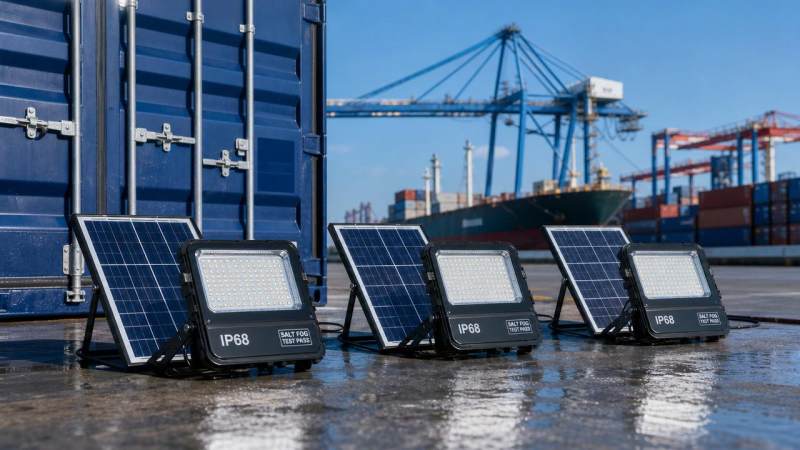
Effective May 26, 2026, Chinese customs authorities at Shenzhen, Ningbo, and Xiamen ports have implemented enhanced inspection requirements for photovoltaic-powered solar lighting products. The new measures specifically target outdoor and engineering-grade solar lighting exports, requiring dual certification—IP68 ingress protection and ≥1,000-hour neutral salt spray resistance—from accredited third-party laboratories. This development carries direct implications for exporters, component suppliers, manufacturers, and logistics providers serving global solar lighting markets.
Event Overview
Starting on May 26, 2026, customs authorities at the Shenzhen, Ningbo, and Xiamen export ports introduced mandatory dual-test verification for solar lighting products classified as ‘outdoor use’ or ‘engineering use’. All such shipments must be accompanied by a third-party test report confirming compliance with both IP68 protection rating and neutral salt spray resistance of at least 1,000 hours. Shipments failing to meet both criteria will be suspended from clearance and subjected to追溯 review (traceability investigation), resulting in average delays of 12–18 working days in delivery timelines.
Industries Affected
Direct Exporters (Trading Enterprises)
Exporters declaring solar lighting under outdoor or engineering categories are directly subject to the new requirement. Non-compliant consignments face immediate clearance suspension—not just rejection—and trigger traceability reviews across prior shipments, increasing administrative burden and shipment uncertainty.
Manufacturers (OEM/ODM Producers)
Manufacturers supplying outdoor-rated solar lighting to exporters must now ensure product design and material selection support both IP68 sealing integrity and long-term corrosion resistance. Production batches without pre-validated dual-test reports risk being held at port, disrupting order fulfillment even if previously certified for other markets.
Component & Material Suppliers
Suppliers of critical components—including enclosures, gaskets, PCB conformal coatings, and metal fasteners—face heightened scrutiny. Materials previously accepted for lower IP ratings or shorter salt spray durations (e.g., 48h or 500h) may no longer meet the updated threshold, prompting requalification needs.
Logistics & Customs Brokerage Firms
Customs brokers handling solar lighting declarations must verify test report validity before submission—including lab accreditation scope, test date, and explicit confirmation of both IP68 and ≥1,000h salt spray compliance. Inaccurate classification (e.g., mislabeling an outdoor unit as ‘indoor’) increases risk of post-clearance audit and penalties.
Key Considerations and Recommended Actions
Monitor official implementation guidance beyond initial notice
The current notice specifies three pilot ports and applies only to ‘outdoor/ engineering use’ declarations. However, analysis shows this may serve as a model for nationwide rollout. Stakeholders should track announcements from General Administration of Customs of China (GACC) and provincial customs offices for scope expansion—especially potential inclusion of additional ports or product subcategories (e.g., solar street lights vs. garden lights).
Verify classification accuracy and test report scope
Not all solar lighting products fall under the new requirement—only those declared under designated tariff or statistical codes linked to outdoor/engineering use. Exporters should cross-check HS code declarations against GACC’s latest commodity classification guidelines. Crucially, test reports must explicitly state both IP68 *and* ≥1,000h neutral salt spray results; reports citing either criterion alone—or referencing alternative standards (e.g., ASTM B117 vs. ISO 9227)—are insufficient.
Align procurement and production timelines with extended lead times
Third-party IP68 + 1,000h salt spray testing typically requires 3–5 weeks per sample batch. Combined with the 12–18 working day customs delay for non-compliant shipments, analysis shows lead time buffers must now extend by at least 4–6 weeks. Procurement teams should revise vendor agreements to require dual-certified components and adjust safety stock levels accordingly.
Prepare documentation for traceability review
Given the retrospective nature of the review process, companies should retain full technical dossiers—including design drawings, BOMs, material certifications, and historical test reports—for at least the past 12 months. Digital record-keeping systems should tag documents by product SKU and port of export to facilitate rapid response if selected for audit.
Editorial Perspective / Industry Observation
Observably, this measure is less a sudden regulatory shift and more a formalization of existing quality expectations—particularly for solar lighting deployed in coastal, high-humidity, or industrial environments where long-term reliability is mission-critical. From an industry perspective, it reflects growing alignment between Chinese export oversight and end-market requirements in the EU, Australia, and Middle East, where IP68 and extended corrosion resistance are increasingly specified in public tenders. That said, the dual-test mandate remains confined to three ports and specific use-case declarations as of May 2026; its broader adoption remains contingent on enforcement outcomes and stakeholder feedback. Current evidence suggests it functions primarily as a quality gate—not a trade barrier—but its operational impact on lead times and compliance overhead is already material.
This update signals a tightening of baseline quality expectations for solar lighting exports—not a ban, nor a tariff adjustment, but a procedural checkpoint with measurable execution consequences. For stakeholders, it is best understood not as an isolated policy change, but as part of a wider trend toward harmonized durability benchmarks in global solar hardware trade. Preparedness hinges less on reacting to the rule itself and more on integrating standardized environmental validation into product development and supply chain governance.
Source: Official notice issued by customs authorities at Shenzhen, Ningbo, and Xiamen ports, effective May 26, 2026. Scope and enforcement details confirmed via publicly available customs bulletin excerpts. Ongoing monitoring is recommended for potential extension to other ports or product classifications—no such expansion has been announced as of publication date.
The VitalSync Intelligence Brief
Receive daily deep-dives into MedTech innovations and regulatory shifts.