
Security
Middle East Launches 'SafeLight Gulf' Certification, Recognizes CQC-GS Mutual Certificates
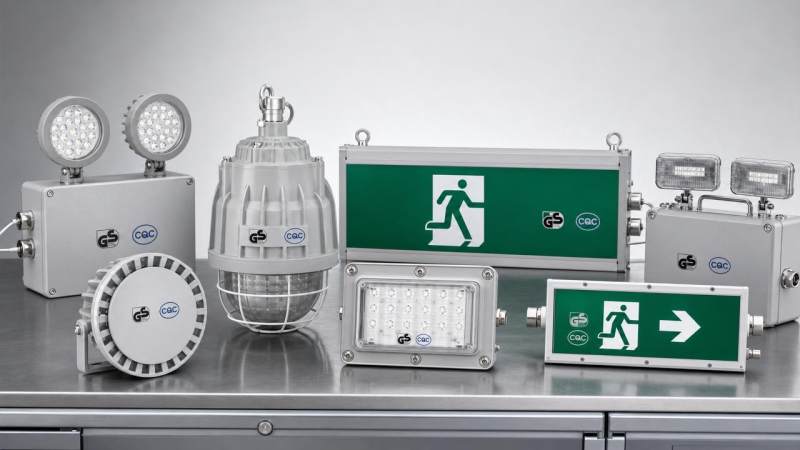
On May 25, 2026, Saudi Arabia’s SASO, the UAE’s ESMA, and Qatar Metrology jointly launched the regional ‘SafeLight Gulf’ certification program — a new conformity assessment framework for lighting safety in critical infrastructure. The initiative explicitly lists China’s CQC-issued GS mutual recognition certificates as among the first accepted equivalent documents. This development is particularly relevant for manufacturers and exporters of emergency lighting, explosion-proof luminaires, and fire evacuation signage systems targeting Gulf markets.
Event Overview
On May 25, 2026, the Saudi Standards, Metrology and Quality Organization (SASO), the Emirates Authority for Standardization and Metrology (ESMA), and Qatar Metrology announced the official launch of the ‘SafeLight Gulf’ certification scheme. The program covers emergency lighting, explosion-proof lighting, and fire evacuation indication systems. It confirms that GS mutual recognition certificates issued by China’s China Quality Certification Centre (CQC) are accepted as equivalent to local conformity requirements — effective immediately for the first cohort of recognized documents.
Industries Affected
Direct Exporters to Gulf Markets
Exporters supplying lighting products to Saudi Arabia, the UAE, or Qatar will face revised conformity expectations. Acceptance of CQC-GS certificates reduces duplication of testing and certification — potentially shortening market access timelines by over 60%, according to the announcement. However, this applies only to the specific product categories named: emergency lighting, explosion-proof luminaires, and fire evacuation signage systems.
Manufacturers Holding CQC-GS Certificates
Producers already certified under the CQC-GS mutual recognition arrangement may now use those certificates toward Gulf compliance — but only if their certified models fall within the three designated categories and meet all applicable technical and labeling requirements under SafeLight Gulf. No automatic grandfathering is confirmed; alignment with Gulf-specific standards (e.g., SASO IEC 60598-2-22 for emergency lighting) remains mandatory.
Third-Party Certification and Lab Service Providers
Certification bodies and testing laboratories supporting Chinese manufacturers must verify whether their current CQC-GS scope includes the exact product types and standards referenced in SafeLight Gulf. Those without coverage in emergency lighting or explosion-proof classifications may need to coordinate with accredited Gulf partners to validate test reports or issue supplementary declarations.
What Enterprises and Practitioners Should Monitor and Do Now
Track official implementation guidance from SASO, ESMA, and Qatar Metrology
The joint announcement confirms recognition in principle, but detailed procedures — including application workflows, validity periods, surveillance requirements, and transitional arrangements — have not yet been published. Stakeholders should monitor each authority’s official portals for technical circulars or FAQs expected in Q3 2026.
Verify product-category alignment before assuming eligibility
Recognition applies strictly to emergency lighting, explosion-proof luminaires, and fire evacuation signage systems. Products such as general-purpose LED fixtures, smart lighting controls, or architectural lighting are not covered. Companies should cross-check their CQC-GS certificate scope against the SafeLight Gulf product definitions before initiating submissions.
Distinguish between policy acceptance and operational readiness
While CQC-GS certificates are recognized as equivalent, local importers or local representatives may still require additional documentation (e.g., Arabic labeling, Gulf-specific risk assessments, or factory audit records). Recognition does not eliminate all local procedural steps — it replaces only the core safety certification requirement.
Prepare documentation packages proactively for early submissions
Companies planning near-term entries should compile technical files aligned with IEC-based Gulf standards (e.g., IEC 60598-1, IEC 60079 series), ensure traceability of GS-marked components, and confirm that their CQC-GS certificates include valid test reports for the relevant sub-clauses. Early coordination with Gulf-based conformity assessment bodies can help identify gaps ahead of formal applications.
Editorial Perspective / Industry Observation
Observably, this initiative signals a coordinated effort among Gulf standardization authorities to harmonize lighting safety requirements — not just a standalone certification rollout. Its immediate value lies in reducing redundant conformity assessments, but its longer-term significance depends on whether other Gulf Cooperation Council (GCC) members adopt SafeLight Gulf as a de facto regional benchmark. Analysis shows the inclusion of CQC-GS reflects growing technical alignment between Chinese and Gulf safety frameworks — though it remains limited in scope and does not imply broader regulatory convergence. From an industry perspective, this is best understood as an operational enabler for a narrow set of high-safety lighting products, rather than a structural shift in Gulf market access policy.
This is not yet a fully implemented regime: no official fee structure, no published application portal, and no confirmed timeline for third-party verification integration have been released. Current status is one of formal recognition — not full operational deployment.
Current more appropriate interpretation is that SafeLight Gulf represents a policy signal with near-term procedural utility for select exporters — not a completed regulatory framework.
Conclusion
The SafeLight Gulf certification launch marks a concrete step toward streamlined lighting safety compliance across key Gulf markets, with tangible time savings for eligible products. However, its practical impact remains constrained to three defined categories and contingent on forthcoming implementation details. For stakeholders, the priority is disciplined verification — not broad assumption — of equivalence, and close attention to official updates over the next 6–12 months.
Source Attribution
Primary sources: Official joint statement issued by SASO, ESMA, and Qatar Metrology on May 25, 2026. No additional background documents, technical annexes, or implementation roadmaps have been publicly released as of publication. Ongoing monitoring of SASO’s e-Services portal, ESMA’s Conformity Assessment Platform, and Qatar Metrology’s official notices is recommended for updates.
The VitalSync Intelligence Brief
Receive daily deep-dives into MedTech innovations and regulatory shifts.