
Security
Middle East Tightens Fire Electronics Import Certification
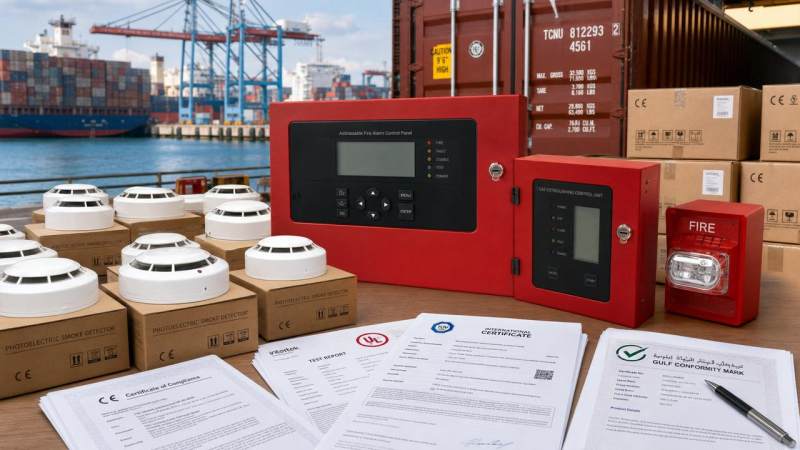
From June 1, 2026, the UAE ESMA, Saudi SASO and Qatar General Organization of Standardization began jointly enforcing a revised mandatory technical specification for fire electronic equipment imports. The change matters not only because it adds compliance requirements for products such as smoke detectors, intelligent fire alarm control panels and gas extinguishing control units, but also because products without updated certificates may be refused at the port. For exporters, importers, certification teams, procurement functions and delivery planners, this is a practical market-access issue rather than a routine standards update.
What the new requirement clearly changes
According to the provided information, the revised mandatory technical specification has been implemented from 2026-06-01 by the UAE ESMA, Saudi SASO and Qatar General Organization of Standardization.
The confirmed changes include new mandatory requirements covering:
- EMC immunity level: IEC 61000-4-3 Class B
- Environmental reliability: IEC 60068-2-14
- Mandatory local-language user interface requirements
The products explicitly mentioned in the provided information include smoke detectors, intelligent fire alarm controllers and gas extinguishing control units.
The same information also states that products that have not obtained the new-version certificate will be rejected at the port.
Where the pressure will appear along the business chain
Export shipments now face a stricter market-entry checkpoint
From an industry perspective, exporters and traders dealing in the covered fire electronic equipment may be affected first because the rule change is tied directly to import acceptance. The main pressure point is no longer only product readiness, but whether the shipment is backed by the updated certificate before customs-side entry takes place. What deserves closer attention is the link between certification status and shipment timing, since a non-compliant shipment may face immediate port refusal under the stated rule.
Manufacturers may need to revisit design and documentation alignment
Analysis shows that manufacturers of the listed product categories may need to pay closer attention to whether existing product configurations, test evidence and interface design align with the revised requirements. The newly stated EMC immunity level, environmental reliability requirement and local-language UI obligation point to a compliance review that may extend beyond labeling and into technical files, interface presentation and product validation records. Even where a product has been sold before, that does not automatically answer whether it fits the new certification basis.
Procurement and project delivery teams may need to reassess order release timing
For buyers, distributors and project procurement teams, the impact may appear in order confirmation, delivery commitments and model selection. Observably, if procurement plans still rely on products certified under an earlier basis, the risk shifts from price or lead time to admissibility at destination. Teams involved in scheduled deliveries should therefore pay attention to certificate version status, technical specification matching and document completeness before shipment release.
Testing and certification support functions may see tighter review demands
Certification service providers, compliance managers and testing-related teams may also be affected because the rule change creates a more specific verification burden. The practical issue is not only whether a product category is covered, but whether the evidence package corresponds to the newly required EMC, environmental and UI elements. In this context, document review, test report mapping and application preparation may become more time-sensitive for companies targeting these markets.
What companies should check now
Confirm whether the product falls within the newly affected scope
Companies should first verify whether their exported or sourced models include the product types explicitly mentioned in the provided information, such as smoke detectors, intelligent fire alarm control panels and gas extinguishing control units. Analysis shows that scope confirmation is the first practical step, because the compliance burden begins with whether the product is covered by the revised mandatory specification.
Review certification status against the revised technical basis
What deserves closer attention is whether current certificates, applications and supporting files correspond to the new-version requirements rather than to an earlier approval basis. Since the provided information states that products without the new certificate may be refused at the port, companies should pay attention to certificate version control, submission readiness and consistency across technical and trade documents.
Check technical files for EMC, environmental and UI consistency
Observably, the newly cited IEC 61000-4-3 Class B, IEC 60068-2-14 and local-language UI requirement mean that product teams should examine whether test materials, interface content and product documentation are aligned. This should be understood as a document-and-product consistency issue as much as a certification issue. If implementation details are not yet fully visible in the input, companies should treat this as an area requiring ongoing verification rather than assume a uniform enforcement method in every case.
Adjust shipment, procurement and delivery planning with compliance lead time in mind
Companies involved in export scheduling, local supply commitments or tender delivery should pay closer attention to the sequencing of certification, production release and shipment booking. It is more appropriate to understand this as a front-end compliance control issue: if the updated certificate is missing, downstream delivery arrangements may become ineffective regardless of product availability. Where contract or tender documents are involved, teams should also watch for any wording updates that mirror the revised requirements.
Why this looks more like an execution signal than a distant policy notice
Analysis shows that this development is better understood as an active enforcement signal rather than a preliminary policy discussion, because the provided information includes a clear implementation date and a clear consequence at the port for products lacking the new certificate. At the same time, it should not be overstated into a broader market conclusion beyond the stated facts. Observably, the next layer the industry still needs to watch is how certification interpretation, document review standards and buyer-side technical requirements are applied in practice after the rule takes effect.
How the market should read this update for now
At this stage, the event is most appropriately read as a concrete compliance threshold change for fire electronic equipment entering the specified Middle Eastern markets from June 1, 2026. The immediate significance lies in certification validity, technical alignment and shipment admissibility, not in abstract policy signaling. A neutral reading is that companies with exposure to these product categories should treat the update as already relevant to trade execution, while continuing to monitor how the requirements are reflected in certification practice, procurement documents and market feedback.
Basis of this article and what still needs verification
This article is generated based on the user-provided news title, event date and event summary. For this type of development, relevant source categories typically include official notices, releases from regulatory authorities, customs or trade administration updates, industry association communications, standard organization documents and reporting by authoritative trade media. No specific official source link was provided in the input, so the exact official publication path still requires further verification. What should continue to be monitored includes detailed implementation wording, certification interpretation, tender document updates, industry feedback and how companies execute against the revised requirements in practice.
The VitalSync Intelligence Brief
Receive daily deep-dives into MedTech innovations and regulatory shifts.