
Security
Saudi-UAE Tighten Fire Device Import Certification
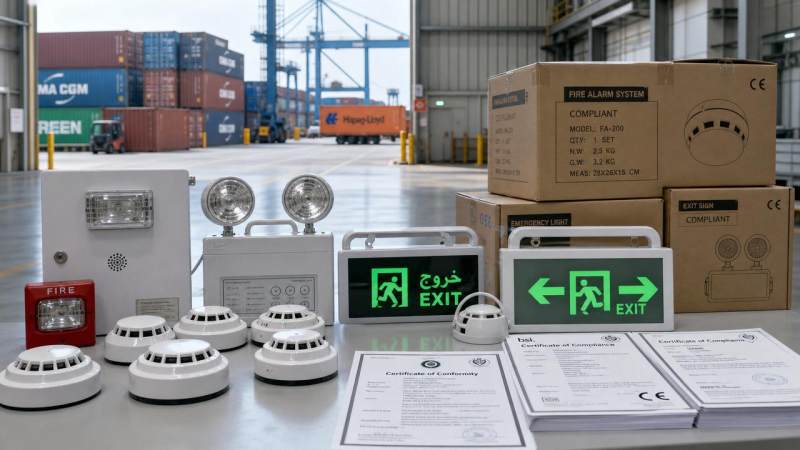
On June 1, 2026, Saudi Arabia’s SASO and the UAE’s NOMA jointly updated the import technical requirements for fire and emergency lighting electronic equipment, directly affecting imported smoke detectors, smart emergency lights, and evacuation indication systems. For manufacturers, exporters, importers, distributors, and project procurement teams serving the Middle East, this is not just a documentation update: it links dual certification, product interface localization, and port enforcement into the same compliance threshold, with non-compliant goods already being detained on site at Jebel Ali Port in Dubai and King Khalid Port in Riyadh from June onward.
What the updated import requirements now confirm
According to the information provided, the jointly updated technical specification for fire and emergency lighting electronic equipment took effect on June 1, 2026. The updated requirement applies to all imported smoke detectors, smart emergency lights, and evacuation indication systems.
The confirmed compliance conditions are twofold. First, the products must obtain both SASO IECEE CB transfer certification and NOMA EMIRATES Conformity Assessment. Second, the products must include a localized language user interface and a voice prompt function for power outage scenarios.
The enforcement aspect is also clear in the available information: products that do not meet the updated requirements have been subject to on-site detention since June at Jebel Ali Port in Dubai and King Khalid Port in Riyadh.
Where the pressure will be felt across the business chain
Export-facing manufacturers may face immediate design and certification adjustments
From an industry perspective, manufacturers producing smoke detection and emergency lighting electronics for Middle East-bound shipments are likely to feel the most direct impact. The reason is straightforward: compliance now concerns not only product certification, but also embedded product functions such as localized language UI and power-loss voice prompts. This means the affected business links are likely to include product configuration, firmware or interface preparation, model documentation, and export release readiness.
What deserves closer attention is whether the product version being shipped to Saudi Arabia and the UAE is aligned with the new import expectation, rather than assuming an existing certified version remains usable without modification.
Traders and importers face a higher risk at the customs and port stage
Analysis shows that direct trading companies and importers may be exposed to the most visible short-term disruption because the update is already tied to port detention. The practical impact is concentrated in shipment clearance, document completeness, and arrival scheduling. Where compliance is incomplete, the issue no longer remains a back-office certification gap; it can turn into a physical cargo delay.
For these market participants, the key change is that certification status and product-side functional conformity now have to be checked before shipment, not after arrival.
Distributors and project supply channels may see delivery uncertainty
For distributors, local channel operators, and firms supplying fire safety or emergency lighting systems into projects, the impact may emerge through delivery timing and product eligibility. If imported products are detained at port, downstream fulfillment, replacement planning, and customer coordination may all be affected.
Observably, the risk here is less about policy interpretation in the abstract and more about whether a sellable and deliverable stock unit can still move through the import chain without interruption.
Procurement and end-use project teams need to recheck product acceptance criteria
Buyers and end-use organizations procuring smoke detectors, smart emergency lights, or evacuation indication systems should also pay attention. Analysis shows that procurement review may need to look beyond general compliance claims and focus on whether the delivered product version actually matches the newly stated dual-certification and localization requirements.
The affected business link is therefore not only sourcing, but also technical acceptance, delivery planning, and communication with suppliers over compliant product versions.
Operational priorities companies should address now
Verify whether affected models already meet both certification tracks
Companies handling the covered product categories should first distinguish between products that have some form of existing market access documentation and products that specifically meet both SASO IECEE CB transfer certification and NOMA EMIRATES Conformity Assessment. Analysis shows this distinction matters because the updated requirement is framed as a dual threshold, not an either-or pathway.
Check whether localization functions are built into the shipped version
The update is not limited to formal certification. It also requires a localized language UI and a voice prompt function for power outages. What deserves closer attention is whether these functions are present in the exact hardware and software version prepared for import, and whether internal product descriptions, technical files, and shipment communication consistently reflect that version.
Review shipment timing against enforcement reality at key ports
Because the provided information states that non-compliant products have already been detained since June at Jebel Ali Port and King Khalid Port, companies should treat logistics planning and compliance review as linked tasks. For traders, importers, and supply chain service providers, this raises the importance of pre-shipment review, document alignment, and contingency planning for cargo already in transit or close to dispatch.
Keep supplier and customer communication tightly aligned
For businesses operating across multiple parties, practical execution may depend on whether suppliers, exporters, importers, and buyers are working from the same compliance checklist. Observably, a gap between sales claims, certification status, and actual product functionality could create disputes or delivery friction even before any formal rejection or detention is resolved.
Why this should be read as more than a routine paperwork update
Analysis shows that this development is better understood as a compliance tightening with immediate operational consequences, rather than as a distant regulatory signal. The reason is not only the introduction of dual certification, but also the explicit addition of localized interface and voice-prompt requirements, combined with reported on-site detention at named ports.
At the same time, it is more appropriate to understand this as an ongoing industry dynamic rather than a fully closed policy outcome. The currently confirmed facts establish the requirement and the enforcement action, but companies still need to keep watching how implementation is interpreted in day-to-day trade practice, especially across product versions, technical documentation, and shipment workflows.
How the market should read the latest move
In practical terms, this update signals that access to the Saudi and UAE import channels for certain fire and emergency lighting electronics is now more tightly connected to both formal certification and product-level localization features. For the industry, the significance lies less in headline policy change alone and more in the fact that non-compliance is already affecting cargo movement.
A neutral reading at this stage is that the development should be treated as an immediate compliance checkpoint and a longer-term signal of stricter import scrutiny for regulated electronic safety products in the region. It does not by itself confirm wider market outcomes, but it clearly raises the cost of assuming legacy certification and standard product configurations will remain sufficient.
Basis of this article and points for continued verification
This article is based on the user-provided news title, event date, and event summary concerning the June 1, 2026 update jointly issued by Saudi Arabia’s SASO and the UAE’s NOMA regarding import technical requirements for fire and emergency lighting electronic equipment.
For this type of development, source categories that are usually relevant include official regulatory notices, standards or technical specification documents, port enforcement notices, company compliance updates, industry association releases, and reporting by authoritative trade or industry media. A specific official source link was not provided in the input, so the exact official documentation should still be continuously verified.
Areas that warrant follow-up observation include any further official clarification on implementation, any refinements in document interpretation, and any additional enforcement signals affecting the covered product categories and shipment processes.
The VitalSync Intelligence Brief
Receive daily deep-dives into MedTech innovations and regulatory shifts.