
Security
CPSC Tightens Safety Helmet Impact Standards
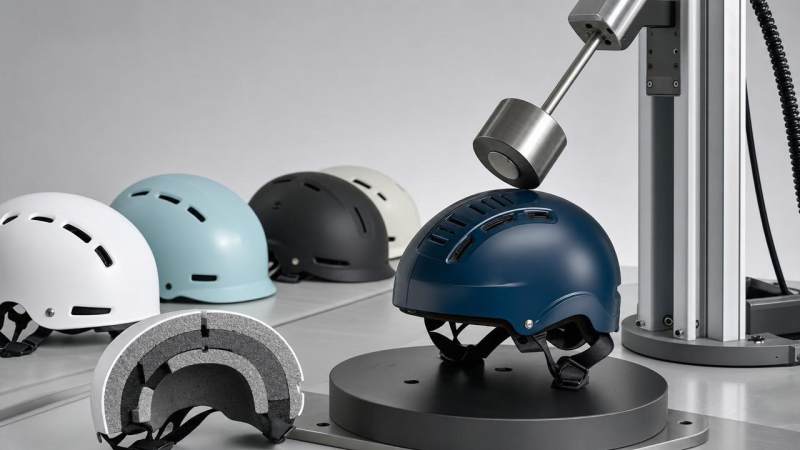
The U.S. Consumer Product Safety Commission (CPSC) issued an emergency revision to the personal protective equipment (PPE) safety helmet standard ASTM F1446-26 on May 20, 2026 — significantly raising impact absorption requirements and introducing new dynamic off-center testing. The update directly affects global manufacturers and exporters supplying the U.S. market, especially those in the occupational safety, construction, cycling, and industrial PPE sectors, due to the U.S.’s stringent enforcement posture and China’s dominant export share.
Event Overview
On May 20, 2026, the CPSC published the mandatory updated version of ASTM F1446-26. The revision tightens the vertical impact absorption performance threshold from ≤300g to ≤210g — a 30% reduction in allowable peak acceleration — and adds a new dynamic eccentric impact test. The rule takes effect immediately: all newly imported batches into the U.S. must comply. No grace period or phased implementation is provided. China remains the largest source country for safety helmets imported into the U.S., accounting for over 58% of total imports; consequently, numerous currently certified models face mandatory re-certification or structural redesign.
Industries Affected
Direct trading enterprises — Exporters and brand owners placing orders with overseas factories are affected because compliance is now tied to shipment date, not model certification date. Non-compliant shipments risk detention at U.S. ports, customs rejection, or mandatory recall. Contractual liability with U.S. importers may also trigger penalties or loss of shelf space, particularly among major retail and industrial distributors who require CPSC-aligned documentation prior to receipt.
Raw material procurement enterprises — Suppliers of shell polymers (e.g., ABS, PC, HDPE), energy-absorbing foams (EPS, EPP, multi-density PU), and suspension systems must adapt specifications to meet tighter energy dispersion demands. For example, foam density gradients and layering configurations previously acceptable under the ≤300g threshold may no longer pass the ≤210g requirement without reformulation or hybrid material integration. Procurement lead times and qualification cycles for new material lots are expected to lengthen.
Manufacturing enterprises — Factories producing safety helmets — especially those relying on legacy molds or fixed tooling — face immediate pressure to modify crown geometry, liner thickness distribution, and chinstrap anchorage points to pass both vertical and eccentric impact tests. Structural upgrades often require physical prototyping, third-party lab validation, and full re-testing per ASTM F1446-26 Annex A and B — increasing time-to-market by 6–10 weeks per model, on average.
Supply chain service enterprises — Testing laboratories, certification bodies (e.g., UL, SEI, Intertek), and regulatory consultants see surging demand for urgent re-evaluation services. However, lab capacity is constrained: only CPSC-recognized labs with calibrated eccentric impact rigs can issue valid reports, and current backlog exceeds eight weeks in North America and EU-accredited facilities serving Asian manufacturers. Logistics providers handling pre-shipment verification and documentation packaging must also adjust workflows to include updated test reports and declaration statements.
Key Considerations and Recommended Actions
Verify current model status against ASTM F1446-26 Annex A and B
Manufacturers and exporters should cross-check existing certifications — especially those issued before May 20, 2026 — against the revised test protocols. Older reports referencing ASTM F1446-23 or earlier versions do not satisfy the new requirements, even if labeled “compliant.” Re-testing is mandatory unless the original report explicitly covers the updated vertical threshold and includes documented eccentric impact results.
Assess mold/tooling flexibility for structural adjustments
Enterprises should audit whether existing production tooling allows for liner thickness variation (±1.5 mm), shell curvature modification, or dual-density foam integration without full retooling. Where tooling is inflexible, cost-benefit analysis of retrofitting versus new investment becomes urgent — especially for high-volume SKUs representing >15% of U.S.-bound shipments.
Engage CPSC-recognized labs early and confirm test scope coverage
Not all accredited labs perform the new dynamic eccentric impact test. Before scheduling, verify that the lab holds active CPSC recognition for both vertical impact (Section 7.3.1) and eccentric impact (Annex B) under F1446-26. Submit full technical dossiers — including material datasheets, assembly diagrams, and suspension system load paths — to avoid iterative re-submission delays.
Editorial Perspective / Industry Observation
Observably, this revision reflects CPSC’s strategic pivot toward outcome-based performance metrics rather than prescriptive design rules — a trend increasingly mirrored in EU EN 397:2012+A1:2019 updates and Canada’s recent CSA Z94.1-22 proposals. Analysis shows the 30% g-force reduction targets real-world injury data linked to rotational acceleration and localized skull deformation, not just linear impact. From an industry perspective, the absence of transition provisions suggests CPSC prioritizes rapid risk mitigation over supply chain adaptation — signaling heightened enforcement readiness across other PPE categories (e.g., eye protection, fall arrest systems) in H2 2026. Current more critical concern lies not in technical feasibility, but in harmonization gaps: ASTM F1446-26 does not yet align with ISO 10818 or GB 2811-2019 test methodologies, complicating dual-market product development.
Conclusion
This emergency revision marks more than a technical adjustment — it represents a recalibration of compliance expectations across the global PPE value chain. While technically achievable, the compressed timeline and lack of grandfathering place disproportionate pressure on mid-tier manufacturers reliant on standardized platforms. A rational interpretation is that the change accelerates industry consolidation: firms with agile R&D, embedded lab partnerships, and modular design systems will gain competitive advantage, while others face margin compression or market exit. Long-term, it reinforces that U.S. safety regulation is increasingly driven by biomechanical evidence — not consensus timelines.
Sources and Notes
U.S. CPSC Federal Register Notice Docket No. CPSC-2026-0042, published May 20, 2026; ASTM International Standard F1446-26 (approved April 15, 2026); CPSC Import Alert #66-01 (updated May 21, 2026). Note: CPSC has indicated potential follow-up rulemaking on labeling requirements and post-market surveillance protocols for ASTM F1446-26-compliant helmets — subject to stakeholder comment in Q3 2026. This item remains under active monitoring.
The VitalSync Intelligence Brief
Receive daily deep-dives into MedTech innovations and regulatory shifts.