
Security
PPE Export Prices Up 12.3% in Early June
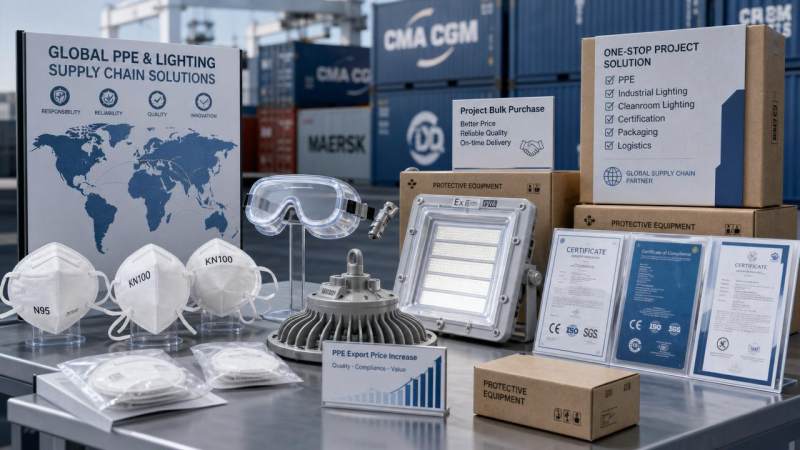
On 2026-06-01, the market signal worth watching was not only a rise in PPE export prices, but the compliance and trade factors behind it. According to the latest price index released by IFIA on June 4, China’s composite PPE export price index for the first week of June 2026 increased 12.3% year on year, with N95/KN100 respirators and anti-fog goggles rising 18.7%. The price movement was linked to higher filter-material certification costs following implementation of the EU’s EN 149:2024 update, together with higher marine insurance rates. For exporters, certification-related businesses, procurement teams, and cross-border project contractors, the issue is notable because the impact is already extending beyond PPE itself into bundled sourcing for industrial lighting products such as explosion-proof and cleanroom lighting.
What has been confirmed in the latest price reading
IFIA said in its PPE export price index released on June 4 that China’s overall PPE export price index in the first week of June 2026 was up 12.3% from a year earlier. Within that basket, N95/KN100-grade respirators and anti-fog goggles posted increases of 18.7%.
The summary provided indicates two direct drivers behind the increase: higher certification costs for filter materials after implementation of the EU EN 149:2024 revised standard, and higher marine insurance rates. The same summary states that this pricing trend has indirectly pushed up the price of combined procurement packages covering industrial lighting products, including explosion-proof lights and cleanroom lights, together with PPE, affecting budget allocation in cross-border EPC projects.
Where the pressure is likely to appear across the chain
Export quotations are becoming more compliance-sensitive
From an industry perspective, exporters handling respiratory protection and related eye protection products are likely to feel the impact first because the reported increase is tied in part to certification cost changes associated with EN 149:2024. In practice, this can affect quotation structure, validity periods, and supporting compliance documentation used in export transactions. What deserves closer attention is whether product documentation, certification references, and technical descriptions used in offers and shipment files remain aligned with the updated standard environment.
Bundled procurement for project supply is under budget pressure
Procurement teams and EPC contractors may be affected even when they are not buying PPE as a standalone category. The summary explicitly links PPE price increases to higher prices for bundled packages that also include industrial lighting such as explosion-proof and cleanroom lights. This means the pressure may appear during package budgeting, line-item allocation, supplier comparison, and technical-commercial balancing, especially where PPE and lighting are purchased together for industrial or controlled-environment use.
Certification and testing service providers may face higher review demands
Certification-related businesses and testing service institutions may see greater attention from clients seeking clarity on cost changes tied to EN 149:2024 implementation. The likely impact is less about volume assumptions and more about documentation review, report matching, and confirmation of applicable standard references. Analysis shows that where buyers or exporters are under cost pressure, scrutiny of certification scope, validity, and technical file consistency usually becomes more important in transaction execution.
Supply chain and delivery coordination may need tighter control
Higher marine insurance rates add a trade and logistics cost element to what might otherwise be treated as a product compliance issue. For supply chain service providers and delivery coordinators, the main area to watch is not only freight pricing, but also how insurance-related cost changes are reflected in contract terms, shipment planning, and total landed-cost calculations. This is particularly relevant where procurement packages combine multiple product categories and are budgeted as one project supply block.
What companies should monitor now
Check whether certification references match current tender and sales documents
Analysis shows that companies involved in respirators, goggles, or bundled industrial supply should review whether quotations, technical datasheets, test reports, and bid documents are using consistent standard references. Since the reported price increase is linked to EN 149:2024 implementation, any mismatch between product claims and supporting certification materials could become a practical issue during procurement review or project approval.
Reassess bundled purchasing assumptions for lighting plus PPE
For buyers of explosion-proof lights, cleanroom lights, and related PPE packages, it is worth revisiting how package pricing is structured. Observably, the issue is not limited to one product line; instead, bundled sourcing may transfer cost pressure from respiratory protection into adjacent project equipment budgets. Companies should therefore pay closer attention to package composition, substitution rules in tender files, and how suppliers separate product cost from certification- and logistics-related cost changes.
Watch trade documents and insurance-related cost allocation
Where marine insurance rates are part of the reported cause, exporters and buyers should monitor how insurance costs are reflected in shipping terms, commercial invoices, and overall contract pricing logic. The input does not provide execution details, so this should not be treated as a confirmed change in specific trade procedures. However, it is reasonable to monitor whether counterparties begin adjusting quotation validity, shipment arrangements, or cost-sharing language.
Prepare for closer review in cross-border EPC budgeting
The summary specifically mentions an effect on budget allocation in cross-border EPC projects. What deserves closer attention is whether procurement and project teams need to rebalance budget lines between PPE and industrial lighting within the same package. At this stage, the more practical response is to review assumptions in internal cost plans and supplier submissions rather than assume a uniform market outcome.
How this signal should be read at this stage
Analysis shows that this development is best understood as a combined compliance-and-trade cost signal rather than a standalone commodity price fluctuation. The role of EN 149:2024 implementation suggests that rule changes are already feeding into certification-related costs, while higher marine insurance rates show that logistics and trade risk pricing are amplifying the effect.
At the same time, it would be premature to treat this as a fully settled market pattern across all categories or projects. The information provided confirms a price move and identifies its stated causes, but it does not establish how every buyer, exporter, or certification body is executing adjustments. It is more appropriate to understand this as an active implementation signal that requires continued observation of procurement behavior, tender documentation, and market feedback.
Why the market should keep this in scope
The practical significance of this update lies in its spillover effect. A standards-driven increase in certification cost for PPE, combined with higher insurance costs in shipping, is no longer confined to respirators and goggles alone when project procurement is bundled. For companies operating across export, compliance, and industrial project supply, the main takeaway is not simply that prices rose, but that standards implementation and trade-cost changes are now interacting in ways that can alter package pricing and budget decisions.
From a neutral industry perspective, this is better read as a confirmed market signal with ongoing execution implications, rather than as a final outcome. Continued attention should focus on how certification practice, procurement documents, and project budgeting adapt to the cost pressures identified in the latest price index summary.
Basis of this article and points for further verification
This article is based on the user-provided news title, event date, and event summary. The summary cites an IFIA PPE export price index release dated June 4 and identifies EN 149:2024 implementation and higher marine insurance rates as the stated drivers behind the reported price movement. No specific official source link was provided in the input, so the official source link remains to be further verified.
For this type of development, source categories that are usually relevant include official notices, regulator releases, customs or trade authority information, industry association publications, standard-setting organization documents, and reporting by established industry media. Observably, the points still requiring follow-up are the detailed implementation approach around certification, any evolving interpretation of standard application, changes in tender or procurement documents, market feedback from affected sectors, and how companies are adjusting execution in practice.
The VitalSync Intelligence Brief
Receive daily deep-dives into MedTech innovations and regulatory shifts.