
Security
How Intelligent Surveillance Improves Safety at Transportation Hubs
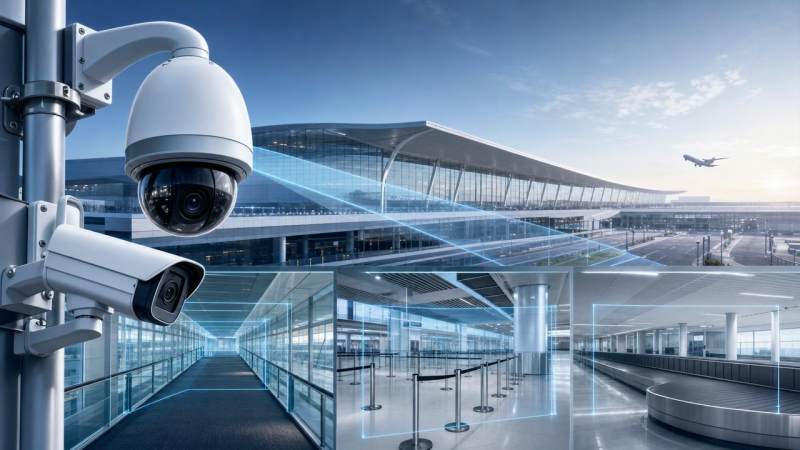
Transportation hubs are under pressure from every direction. Passenger volumes fluctuate sharply, compliance rules tighten, and public expectations for safety keep rising.
In that environment, intelligent surveillance for transportation hubs has moved beyond basic video recording. It now supports risk visibility, operational continuity, and faster coordination across terminals, stations, depots, and intermodal links.
The value is not limited to watching events as they happen. Strong systems help identify abnormal behavior, reduce response time, improve crowd flow, and create a more reliable basis for investment and governance decisions.
For organizations managing complex infrastructure, the real question is no longer whether surveillance matters. It is how intelligent surveillance for transportation hubs should be understood, evaluated, and applied in a rapidly changing security landscape.
Why transportation hubs require a different surveillance approach
Airports, rail stations, seaports, bus terminals, and logistics gateways share one challenge: they are open, crowded, and constantly moving.
Unlike enclosed facilities, these sites must handle public access, restricted zones, service corridors, retail activity, vehicle circulation, and emergency pathways at the same time.
That complexity creates blind spots for conventional monitoring. Static cameras and manual observation often struggle when congestion, low visibility, or multi-point incidents develop at once.
Intelligent surveillance for transportation hubs responds to this by turning visual data into operational insight. It combines imaging, analytics, alert logic, and environment-aware design.
Simple footage storage is no longer enough. Decision quality increasingly depends on whether systems can detect, classify, prioritize, and communicate what matters in real time.
What intelligent surveillance means in practice
In practical terms, intelligent surveillance for transportation hubs means more than AI cameras. It refers to a coordinated safety layer built around detection, interpretation, and response.
That usually includes video analytics for perimeter intrusion, queue build-up, unattended objects, wrong-way movement, restricted access attempts, and abnormal dwell time.
It also includes the optical conditions that shape image quality. Lighting uniformity, glare control, nighttime visibility, and weather resilience directly affect analytic performance.
This is one reason the market is paying closer attention to platforms that connect security assurance with optical environment optimization.
GSIM has become relevant in this context because it does not frame surveillance as isolated hardware. Its intelligence model connects standards, policies, optical technologies, and procurement signals.
That broader view matters when infrastructure operators must align safety upgrades with compliance rules, interoperability demands, and long-term urban modernization programs.
Why the topic is gaining urgency in 2026
The 2026 infrastructure cycle is accelerating digital transformation across public safety and mobility systems. Transportation hubs sit near the center of that shift.
Several forces are driving this momentum. Urban authorities want stronger resilience, operators need better incident visibility, and regulators expect more disciplined electronic surveillance governance.
At the same time, security threats are becoming less predictable. Risks now range from theft and trespassing to coordinated disruption, panic events, and infrastructure sabotage.
Another pressure point is public accountability. When an incident occurs, organizations are expected to reconstruct events quickly and show that procedures were informed by reliable data.
GSIM’s Strategic Intelligence Center reflects this shift. Its role in tracking surveillance compliance, AI vision trends, and VLC-related developments helps organizations interpret change before investing.
That kind of decision support is increasingly valuable because surveillance planning now involves legal, technical, and operational variables at the same time.
How safety outcomes improve on the ground
The strongest argument for intelligent surveillance for transportation hubs is practical performance. Better systems improve the speed and clarity of response before disruption expands.
Earlier threat detection
Analytics can flag unusual movement, perimeter breaches, abandoned baggage, or unauthorized entry before staff detect them through routine observation.
That time advantage matters in crowded environments, where small delays can turn manageable situations into broader safety incidents.
Smarter crowd management
Passenger surges are not only a service issue. They create safety risks around exits, platforms, checkpoints, curbside loading areas, and retail corridors.
Intelligent surveillance for transportation hubs can identify density changes, queue bottlenecks, and directional conflicts early enough for intervention.
Better multi-team coordination
Most incidents involve more than one team. Security, operations, maintenance, and emergency services need a common visual and situational reference.
Integrated systems make alerts easier to verify and escalate. That reduces confusion during fast-moving events.
Stronger post-incident learning
Recorded evidence becomes more useful when events are time-stamped, searchable, and linked to analytic triggers.
This supports compliance reviews, claims handling, training updates, and infrastructure redesign decisions.
Where intelligent surveillance creates the most value
Not every zone inside a transportation hub carries the same risk. The most effective programs prioritize locations where safety exposure and operational impact intersect.
This is where design discipline matters. Coverage should reflect operational priorities, not only camera quantity.
Key evaluation points before deployment
A useful system begins with the right questions. Technology selection without scenario analysis often leads to expensive blind spots.
- Map risk by zone, time window, and passenger behavior, not by building layout alone.
- Check how lighting conditions affect image integrity across day, night, weather, and reflective surfaces.
- Review compliance obligations for retention, privacy, cross-border data handling, and auditability.
- Test alert logic against operational workflows so staff are not overwhelmed by false positives.
- Confirm interoperability with access control, incident management, and public communication systems.
- Assess whether future upgrades may involve AI vision, edge processing, or VLC-enabled infrastructure.
This is another area where GSIM’s market and policy intelligence can help. Procurement decisions improve when technical choices are viewed against standards and trend signals.
A broader view of surveillance, lighting, and infrastructure readiness
One of the most overlooked issues in intelligent surveillance for transportation hubs is the relationship between security systems and the optical environment.
Poor illumination can weaken analytics, distort identification quality, and reduce operator confidence during critical moments.
That is why optical planning should be treated as part of safety architecture, not as a separate facilities concern.
GSIM’s positioning is useful here because it links physical security assurance with illumination optimization. That integrated perspective is increasingly aligned with smart infrastructure strategy.
As AI vision matures and VLC develops further, surveillance systems may become more context-aware, better connected, and more efficient in data exchange.
Organizations that plan with this convergence in mind are usually better prepared for future upgrades than those buying only for immediate gaps.
What to do next
A sensible next step is to review transportation risk through three lenses: operational pressure, compliance exposure, and optical conditions.
From there, compare whether current surveillance delivers only visibility or also usable intelligence.
If the answer is unclear, start with a site-specific assessment of high-friction zones, incident patterns, and response delays.
The most effective intelligent surveillance for transportation hubs is rarely defined by the newest device alone. It is defined by how well technology, policy, lighting, and operations work together.
That is also where informed intelligence platforms can add lasting value: not by replacing judgment, but by sharpening it before major safety decisions are made.
The VitalSync Intelligence Brief
Receive daily deep-dives into MedTech innovations and regulatory shifts.