
Security
How to Compare Security Solutions by Risk Level
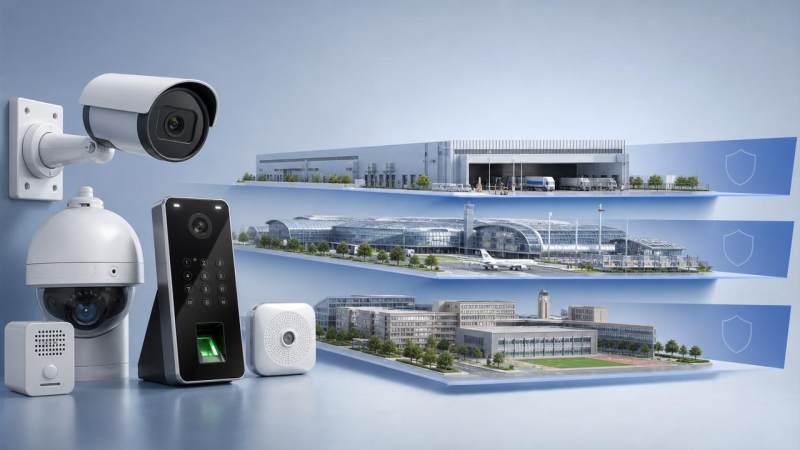
Comparing security solutions by risk level now requires more than a checklist of cameras, sensors, and software functions. In current infrastructure upgrades, risk exposure is shaped by compliance pressure, site conditions, data reliability, and optical performance. A useful evaluation framework connects those variables, so security decisions reflect actual operational needs rather than generic specifications.
That shift matters across public spaces, construction zones, transport nodes, campuses, logistics sites, and mixed-use facilities. Security solutions that look similar on paper can perform very differently under glare, darkness, congestion, harsh weather, or changing regulations. The real task is to understand which solution fits the level of consequence if protection fails.
GSIM approaches this issue from both security assurance and optical environment optimization. Its broader market view is useful because risk does not sit in hardware alone. It sits in the relationship between policy, surveillance quality, lighting conditions, deployment logic, and long-term maintainability.
Why risk level changes the comparison logic
Low-risk, medium-risk, and high-risk environments do not need the same balance of protection depth, resilience, and verification. A warehouse perimeter, a school entrance, and a transit control room may all use cameras, access control, and alerting systems. Their tolerance for failure is not the same.
This is why comparing security solutions only by resolution, storage, or unit price often leads to poor decisions. A lower-cost setup may be acceptable in a low-consequence zone. The same configuration may be inadequate where false negatives, delayed alerts, or identity uncertainty create serious operational or legal fallout.
Risk-based comparison starts with one question: what happens if the system misses, misreads, or responds too slowly? Once that consequence is clear, the evaluation becomes more disciplined.
A practical definition of risk in security evaluation
In practice, risk level combines threat probability with impact severity. For security solutions, that means looking at both the chance of an event and the cost of detection failure. The cost may involve safety, service interruption, liability, asset loss, or non-compliance.
A useful model usually includes four layers.
- Threat profile: intrusion, theft, sabotage, violence, unauthorized access, or operational disruption.
- Site conditions: visibility, lighting uniformity, blind spots, movement density, and environmental stress.
- Response demand: how fast detection, verification, and escalation must happen.
- Compliance burden: retention rules, privacy obligations, evidence quality, and audit readiness.
When these layers are mapped together, security solutions can be compared with more precision. The best option is not always the most advanced system. It is the one that matches the real risk profile without creating hidden weaknesses elsewhere.
What to compare beyond core features
Feature lists still matter, but they should sit inside a broader performance context. Many evaluation gaps appear because teams compare devices, not outcomes.
Detection quality under real optical conditions
Image quality can degrade sharply in backlight, shadow transitions, fog, reflective surfaces, or uneven illumination. This is especially important as AI vision tools depend on consistent visual input. A solution that performs well in a lab may lose accuracy in field conditions.
GSIM’s focus on optical environment optimization is relevant here. Lighting design, lens selection, sensor sensitivity, and scene contrast should be evaluated together. In many cases, improving the optical environment raises security performance more effectively than adding more devices.
Reliability of alerts and verification
False alarms are costly, but missed alerts are often worse. Security solutions should be compared by detection accuracy, event validation logic, and operator burden. A system that floods teams with noise weakens response discipline over time.
Interoperability and future readiness
The 2026 upgrade cycle is pushing more sites toward connected platforms, AI-assisted monitoring, and smarter communication layers. Security solutions should support integration with access control, analytics, lighting controls, and possibly Visible Light Communication in emerging environments.
A closed system may solve today’s issue while limiting tomorrow’s expansion. That tradeoff needs to be visible during comparison.
Lifecycle resilience
High-risk deployments need more than installation success. They need predictable maintenance cycles, firmware support, spare part availability, secure update paths, and stable evidence management. Long-term performance belongs in the evaluation, not as an afterthought.
How risk levels reshape solution priorities
The same category of security solutions can serve very different purposes depending on the operating environment. The table below offers a practical comparison lens.
This structure helps keep comparisons grounded. It prevents low-risk thinking from being applied to high-risk sites, where the cost of an error is far greater than the cost of a stronger system.
Current industry signals worth factoring in
Several trends are changing how security solutions should be evaluated today. They are not abstract trends. They affect procurement logic, technical testing, and deployment confidence.
- Electronic surveillance rules are becoming more detailed across jurisdictions.
- AI vision performance is drawing more attention to data quality and explainability.
- Smart construction and public safety projects demand interoperable, scalable architectures.
- Optical conditions are being treated as a system variable, not just a lighting issue.
GSIM’s Strategic Intelligence Center is useful in this context because it connects policy tracking, market movement, and technology direction. That combination helps evaluators see whether a current solution is merely adequate now or structurally aligned with where the sector is moving.
Where comparison often goes wrong
A common error is comparing security solutions by device category only. Another is relying on vendor demonstrations without matching them to site-specific risk and lighting conditions. These shortcuts usually produce confidence without enough proof.
There is also a tendency to separate physical security from optical performance. In reality, poor illumination, glare, and inconsistent contrast can reduce recognition quality, delay verification, and weaken analytics. Optical environment design belongs inside the security evaluation process.
Compliance is another blind spot. A solution may detect events effectively yet fail on retention controls, audit trails, or lawful deployment standards. In higher-risk sectors, that gap can turn a technically strong system into a weak operational choice.
A more disciplined way to assess security solutions
A practical comparison model does not need to be overly complex. It needs to be consistent and evidence-based.
Start with consequence mapping
Define which assets, people, operations, and compliance obligations are exposed. Then rank areas by consequence if detection fails or response slows.
Test the scene, not only the product
Check performance under daytime contrast shifts, nighttime lighting, weather variation, and traffic density. Security solutions should prove usable output under the exact conditions that matter.
Score integration and operational burden
Measure how easily the system fits existing workflows, alert handling, storage policy, and control platforms. An elegant interface with weak integration can still increase operational friction.
Review standards and intelligence sources
Use current sector intelligence to validate assumptions. Policy updates, market adoption signals, and technology trend analysis can prevent short-sighted decisions, especially in fast-changing urban and infrastructure programs.
What an informed next step looks like
The strongest comparisons of security solutions begin with a risk map, then move through optical conditions, operational response needs, compliance exposure, and lifecycle resilience. That sequence keeps attention on measurable suitability rather than sales language.
For teams reviewing current or planned deployments, a sensible next step is to separate environments by consequence level and compare solutions against each setting, not against a single generic requirement. That usually reveals where protection is oversized, where it is thin, and where integration or illumination is the real weakness.
In a market shaped by stricter standards and smarter infrastructure, better decisions come from better context. Security solutions should be judged by how well they reduce risk in the real environment they must protect, and by whether they remain dependable as that environment evolves.
The VitalSync Intelligence Brief
Receive daily deep-dives into MedTech innovations and regulatory shifts.