
Security
EU EN 62471:2026 Rule Triggers LED Re-Certification
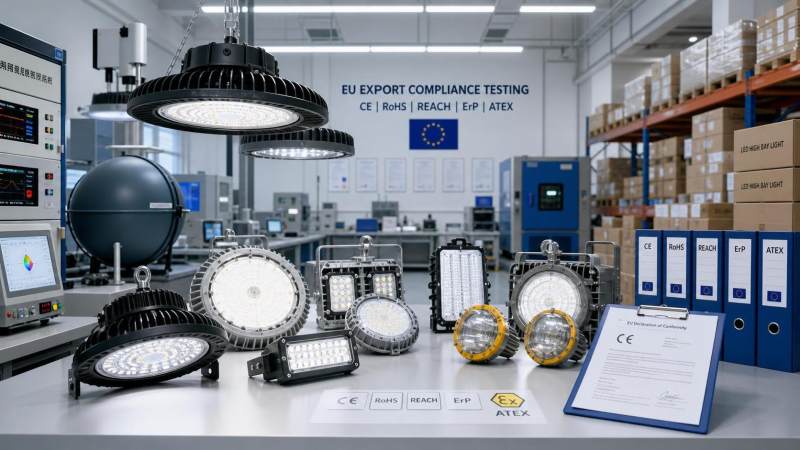
On July 28, 2026, a new compliance requirement took effect for LED industrial lighting entering the EU market. Following a notice published in the Official Journal of the European Union on July 27, EN 62471:2026 became mandatory for imported LED industrial lighting products from July 28, lowering the blue-light hazard classification threshold by 35% and adding transient radiation testing for pulsed LEDs. This is worth close attention because it directly affects certification, customs clearance, shipment timing, and technical documentation for exporters delivering industrial luminaires, high-bay lighting, and explosion-proof lighting products to the EU.
What the new mandatory standard changes
The confirmed change is that EN 62471:2026, described as a photobiological safety assessment standard, is now mandatory for all imported LED industrial lighting equipment from July 28, 2026. According to the provided information, the updated version reduces the blue-light hazard classification threshold by 35% and introduces new testing requirements for pulsed LED transient radiation. The same information also states that this change directly affects the compliance pathway for Chinese exporters shipping industrial lamps, high-bay lights, and explosion-proof lighting products to the EU, and that products without certification under the new version will be refused customs clearance.
Where the pressure is likely to appear first
Export shipments facing a changed compliance gate
From an industry perspective, exporters are likely to feel the impact first because the rule change is tied directly to market entry. The main pressure point is no longer only product design, but whether the product can still move through the certification and customs process under the new version of the standard. What deserves closer attention is the alignment between shipment schedules and the certification status of each affected model.
Manufacturers reviewing product testing and technical files
Analysis shows that manufacturers of industrial luminaires, high-bay fixtures, and explosion-proof lighting may need to focus on whether existing test coverage and technical files remain adequate under the revised blue-light threshold and the newly added pulsed LED transient radiation assessment. The operational impact is likely to fall on testing preparation, product documentation, and the supporting materials used for compliance review.
Certification and testing service providers under tighter timing demands
Observably, certification-related firms and testing service providers may become a critical link because the new rule creates an immediate need to reassess affected products against updated criteria. For these participants, the practical issue is not only technical interpretation but also document readiness, report validity, and the ability to support exporters whose deliveries depend on updated certification status.
EU buyers and supply-chain coordinators checking delivery risk
Buyers, import-side coordinators, and supply-chain service providers may also need to pay closer attention because customs refusal for non-certified products changes delivery certainty. The main concern is likely to be whether ordered products already meet the new mandatory standard and whether procurement files, product specifications, and shipping arrangements still match the current compliance requirement.
Practical points companies should now review
Check whether current certifications still support EU delivery
Analysis shows that companies involved in exports to the EU should first review whether products currently prepared for shipment are certified to EN 62471:2026 rather than relying on earlier certification assumptions. This matters most for product lines named in the provided information: industrial lamps, high-bay lights, and explosion-proof lighting products.
Re-examine test reports and technical documentation
What deserves closer attention is whether existing test reports and technical files clearly address the lowered blue-light hazard threshold and the new pulsed LED transient radiation requirement. The input does not provide detailed execution criteria, so this should be treated as a documentation and verification checkpoint rather than as a fully defined enforcement workflow.
Watch contract, procurement, and shipment timing
Observably, businesses may need to review delivery commitments, procurement plans, and supplier qualification checks where EU-bound LED industrial lighting is involved. Because the provided information states that non-certified products will be refused customs clearance, shipment timing and certification timing should be checked together rather than handled as separate steps.
Follow how the requirement is reflected in market documents
It is more appropriate to understand this stage as one in which companies should closely watch how the new requirement appears in certification reviews, bid specifications, procurement documents, and customer-side compliance requests. The input does not provide detailed wording from those downstream documents, so this remains an area for continued verification.
How this signal should be read at this stage
From an industry perspective, this should be read primarily as a rule already moving into execution rather than as a distant policy discussion. The mandatory date is stated, the affected product scope is identified in the provided information, and the consequence for products without updated certification is clearly linked to customs clearance. At the same time, analysis shows that the market still needs to observe how certification interpretation, supporting documents, and buyer-side implementation develop in practice, because those details are not fully described in the input.
What this means for the market now
The immediate significance of this development is that photobiological safety compliance for LED industrial lighting entering the EU can no longer be treated as a static certification issue. Based on the provided information, the more reasonable conclusion is that this is an active compliance transition with direct effects on export readiness, document review, and delivery planning. It is more appropriate to understand the update as an implemented market-entry requirement that also warrants continued observation on how execution details are applied across certification, procurement, and shipment workflows.
Basis of this article and points that still need verification
This article is based on the user-provided news title, event date, and event summary. For developments of this type, relevant source categories commonly include official notices, regulator publications, customs or trade authority information, industry association updates, standard-setting documents, and reporting by established trade media. A specific official source link was not provided in the input, so the exact source document and any later clarifications still need to be checked on an ongoing basis. Areas that remain worth monitoring include detailed enforcement language, certification interpretation, changes in bidding or procurement documents, industry feedback, and how affected companies implement the requirement in practice.
The VitalSync Intelligence Brief
Receive daily deep-dives into MedTech innovations and regulatory shifts.