
Security
EU Tightens LED Industrial Light Compliance from July 1
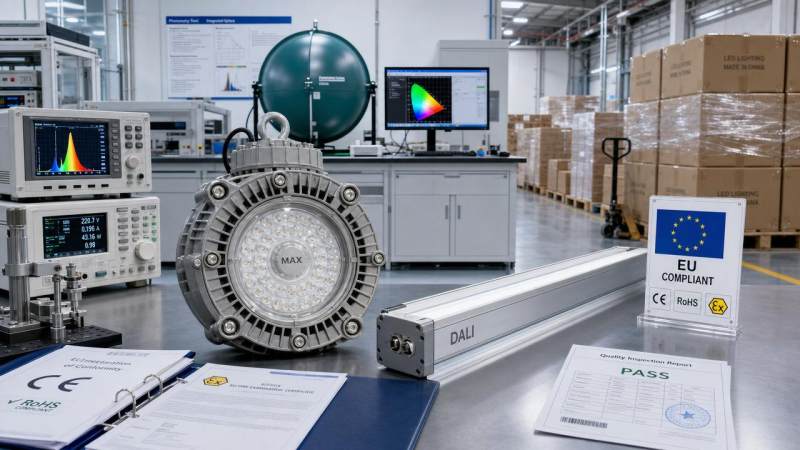
On June 12, 2026, the European Commission released Regulation (EU) 2026/1189, introducing new mandatory requirements for imported industrial lighting products entering the EU. The change covers Industrial Lights, including products such as MAX explosion-proof lights and DALI intelligent linear lights, and centers on luminous efficacy thresholds, standby power consumption, and photobiological safety classification. For exporters, certification service providers, buyers, and shipment planners, the update matters because it links technical compliance more directly to market access and customs clearance.
What the new requirement formally changes
The confirmed change is that Regulation (EU) 2026/1189 was issued by the European Commission on June 12, 2026, and will be mandatorily enforced from July 1. It applies to all industrial lighting products imported into the EU.
According to the provided information, the regulation adds compulsory requirements covering luminous efficacy thresholds, standby power consumption, and photobiological safety classification for Industrial Lights. The scope includes products such as MAX explosion-proof lights and DALI intelligent linear lights.
The same information states that products without CE-EMC plus EN 63414:2026 certification will be refused entry into the EU market.
Where the pressure is likely to appear first
Product design and manufacturing decisions
From an industry perspective, manufacturers and export-oriented producers are likely to feel the impact at the design stage first, because the new rule is tied to product performance and safety classification rather than only paperwork. What deserves closer attention is whether existing industrial lighting models can still align with the new luminous efficacy, standby power, and photobiological safety requirements without redesign, retesting, or specification adjustment.
Certification and testing workflows
Certification-related businesses and testing service providers may see pressure in review schedules and document preparation. Analysis shows that the rule change is not only a labeling matter but a gatekeeping condition for EU entry, which means technical files, test reports, and certification readiness become more closely connected to shipment timing and sales execution.
Export delivery and customs compliance
For exporters, trading companies, and supply chain service providers, the key exposure is in customs clearance and delivery planning. The confirmed refusal of entry for products lacking CE-EMC and EN 63414:2026 certification means that compliance status may affect whether goods can be shipped as planned, accepted at destination, and delivered without disruption.
Procurement and buyer-side screening
Buyers, importers, and procurement teams may need to pay closer attention to supplier qualification and document completeness. Observably, when access conditions become more explicit, purchasing decisions are more likely to depend on whether suppliers can provide certification support, technical evidence, and product documentation aligned with the new requirement.
What companies should review now
Check whether current product lines match the new compliance path
Companies dealing in Industrial Lights for the EU market should review whether existing models fall within the affected scope and whether present specifications, test status, and certification files are sufficient for the new requirements. This is especially relevant for products identified in the provided information, such as MAX explosion-proof lights and DALI intelligent linear lights.
Reassess certification timing against shipment schedules
Analysis shows that certification timing may become a practical business variable, not just a technical step. Exporters and project suppliers should therefore compare planned shipments, contract delivery dates, and ongoing certification work to reduce the risk of products reaching a customs stage without the required compliance basis.
Prepare technical and trade documents more carefully
What deserves closer attention is the consistency between product claims, testing records, certification materials, and trade documents. Where the input information does not provide detailed enforcement procedures, it is more appropriate to treat documentation readiness as a key area for continued checking rather than assume a settled practice already exists.
Watch for further execution language and market-side adoption
Because the provided information confirms the new rule and its market-access consequence but does not include detailed operational guidance, companies should keep watching for later official wording, certification interpretation, procurement document updates, and feedback from actual trade execution.
How this development is best understood at this stage
Analysis shows that this is more than a general policy signal. It is more appropriate to understand it as a landed compliance change tied directly to EU import eligibility for industrial lighting products. At the same time, the market still needs to observe how certification interpretation, document review practice, and buyer-side implementation will unfold in actual transactions.
From an industry perspective, the immediate significance is not only the addition of technical thresholds but the fact that compliance, certification, and customs access are now described as more tightly connected. That makes the rule relevant not only to engineering teams but also to export operations, procurement screening, and delivery planning.
What deserves continued attention in the coming period
At this stage, the event is best read as an enforceable rule change with practical implications for product access to the EU market. It does not yet, based on the provided information alone, support broader conclusions about market outcomes, procurement shifts, or long-term competitive effects.
A rational reading is that companies exposed to EU industrial lighting trade should prioritize compliance review, certification preparation, and shipment coordination, while continuing to monitor how the rule is applied in documentation, testing, and import control practice.
Basis of this article
This article is generated based on the user-provided news title, event date, and event summary. The factual basis used here is limited to the supplied information regarding Regulation (EU) 2026/1189, its release date, its stated scope, the added compliance requirements, and the stated consequence for products lacking CE-EMC plus EN 63414:2026 certification.
For developments of this kind, commonly relevant source types may include official announcements, regulator releases, customs or trade administration notices, industry association updates, standard-setting documents, and reporting by authoritative media. No specific official source link was provided in the input, so the exact source link remains to be further verified.
Observably, the areas that still require continued checking include detailed implementation language, certification interpretation, procurement document changes, industry feedback, and how affected companies execute compliance in practice.
The VitalSync Intelligence Brief
Receive daily deep-dives into MedTech innovations and regulatory shifts.