
Security
Glamox HVDC Lighting Order Speeds China Supply Chain
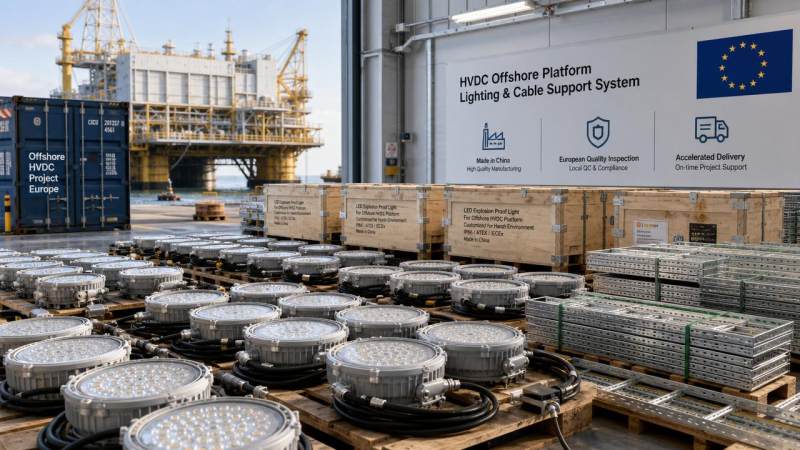
The time of the underlying event is not specified in the provided information, but the latest disclosure shows a large offshore HVDC platform lighting program has moved into volume delivery and is already signaling changes in how lead times, localized quality control, and component sourcing are being managed. For manufacturers, exporters, procurement teams, certification-related service providers, and delivery coordinators, the case is worth attention because it points less to a simple project update and more to an execution signal around supply-chain compliance, inspection localization, and the practical limits of shortened delivery cycles when some critical parts still rely on European distribution channels.
What has been confirmed in the current delivery phase
Norway-based Glamox confirmed on June 11 that the offshore high-voltage converter platform lighting project it is handling in Europe has entered the bulk delivery stage. The project involves more than 38,000 customized LED luminaires. About 65% of these products are manufactured by Chinese ODM suppliers and undergo localized quality inspection in the Netherlands. The current lead time has been reduced to eight weeks from the previous fourteen weeks. At the same time, some key chips used in explosion-proof lighting products still depend on secondary distribution channels in Europe, creating a risk of localized delivery fluctuation.
Why this matters across sourcing, trade, and delivery workflows
For ODM manufacturers, shortened lead time raises the compliance threshold in execution
From an industry perspective, the reduction from fourteen weeks to eight weeks changes the operational rhythm for Chinese ODM producers involved in customized industrial lighting. The likely impact is not only on factory scheduling, but also on specification alignment, production documentation, batch consistency, and cooperation with downstream inspection arrangements. What deserves closer attention is that faster delivery does not remove compliance requirements; instead, it can make technical file readiness, traceability records, and quality handover discipline more important in each shipment cycle.
For buyers and project procurement teams, localized inspection becomes a key control point
The confirmed use of localized quality inspection in the Netherlands suggests that quality acceptance is being managed closer to the delivery destination rather than relying only on factory-side release. Analysis shows this can affect procurement review, acceptance timing, non-conformity handling, and the way supply obligations are written into contracts or tender documents. Buyers and project-facing teams should therefore watch how inspection evidence, product conformity records, and delivery release documents are organized before and after shipment.
For exporters and supply-chain service providers, component dependency remains a practical trade risk
The remaining reliance on European secondary distribution for some critical explosion-proof lighting chips indicates that not every part of the supply chain has been compressed at the same speed. Observably, the main exposure here is not broad market disruption, but localized volatility in fulfillment planning. Exporters, logistics coordinators, and supplier management teams should pay attention to whether component availability, substitute approval procedures, and shipment sequencing create bottlenecks in otherwise accelerated projects.
Operational points companies should track now
Keep certification and technical records aligned with accelerated delivery
Analysis shows that when production shifts into bulk delivery with a shorter cycle, companies need to pay closer attention to whether technical documentation, inspection records, and product-level conformity materials can move at the same pace as manufacturing. This is especially relevant for customized offshore and explosion-proof lighting categories, where any mismatch between product configuration and supporting documents can slow acceptance even if physical production is on schedule.
Review procurement plans for components with uneven sourcing stability
What deserves closer attention is the continued dependence on European secondary distribution for certain key chips. Companies involved in sourcing and delivery should monitor whether this creates intermittent constraints in procurement timing, allocation visibility, or replacement approval. The available information does not confirm a wider shortage, so this should be treated as a risk point to track rather than an established disruption.
Prepare for stricter coordination between factory output and destination-side quality checks
The use of localized quality inspection in the Netherlands suggests that delivery control is not ending at production completion. Manufacturers, exporters, and service providers should therefore pay attention to handover documents, batch identification, inspection response time, and corrective action readiness. If project execution continues to favor destination-side verification, document completeness and traceability may become as important as manufacturing speed in protecting delivery commitments.
Watch tender and execution language for evolving compliance emphasis
It is more appropriate to understand this case as a practical signal that project delivery frameworks may place greater emphasis on inspection location, delivery certainty, and component-source transparency. Companies should closely read future tender files, customer technical requirements, and quality clauses for any change in wording around acceptance, localized checks, or critical-part sourcing expectations. The current information does not establish a new formal rule, but it does indicate an execution direction worth monitoring.
How this should be read at this stage
Observably, this update is more useful as an execution signal than as proof of a fully defined regulatory shift. The confirmed facts show a large project moving into scaled delivery with a substantial China-based manufacturing share, localized inspection in Europe, and a materially shorter lead time. Analysis shows the more important takeaway is how delivery discipline, trade coordination, and quality control are being tightened around real project schedules. Whether this develops into a broader rule change still depends on subsequent procurement language, certification practice, and market feedback.
A measured takeaway for the market
At this stage, the development is best understood as evidence that cross-border industrial lighting supply for offshore power applications is being executed under tighter timing and closer downstream quality control. It does not by itself prove a new formal policy framework, but it does highlight where companies may face practical pressure: compliance records, inspection readiness, sourcing resilience, and delivery sequencing. A rational reading is that the market should treat this as a concrete operational signal with possible wider implications, while continuing to watch how execution standards are reflected in later projects.
Basis of this article and what still needs verification
This article is generated from the user-provided news title, event timing field, and event summary. The specific official source link was not provided in the input, so the underlying disclosure still requires continued verification against the types of sources normally relevant to such cases, including official company announcements, regulator releases, trade or customs authority information, industry association updates, standards-related documents, tender materials, and reporting by authoritative industry media. Further observation is still needed on detailed execution language, certification practice, tender document changes, market feedback, and how participating companies manage delivery and quality coordination in follow-up stages.
The VitalSync Intelligence Brief
Receive daily deep-dives into MedTech innovations and regulatory shifts.