
Security
China Enforces New GB/T 39926-2026 for LED Industrial & Fire Safety Lighting
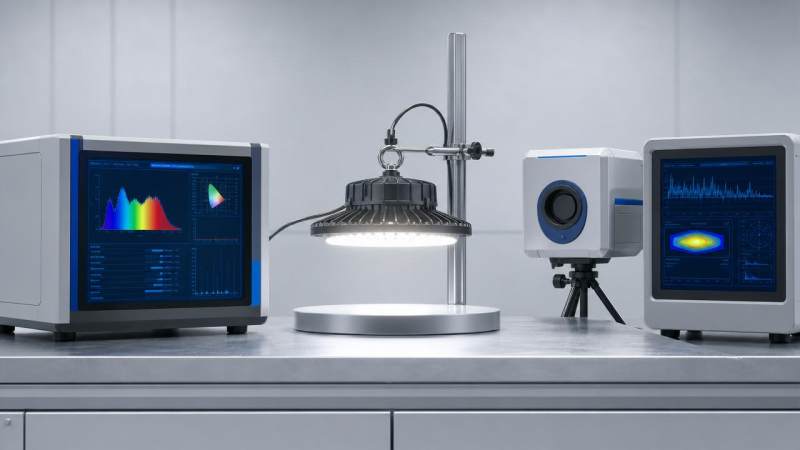
Starting 1 May 2026, China’s newly issued national standard GB/T 39926-2026 — Photobiological Safety Limits and Test Methods for LED Industrial Lighting Equipment — becomes mandatory for all export-bound LED industrial lights, emergency lighting units, and smoke detectors incorporating LED light sources. This development directly affects manufacturers, exporters, and supply chain stakeholders serving global markets — particularly those engaged in EU projects requiring EN 62471 compliance — and signals a tightening of photobiological safety requirements at the point of Chinese production.
Event Overview
According to an official announcement by China’s State Administration for Market Regulation, GB/T 39926-2026 enters into force on 1 May 2026. The standard mandates blue-light hazard classification (RG0) and retinal thermal hazard assessment for the specified product categories. It establishes mutual recognition foundations with IEC TR 62778:2020, though its test procedures are more stringent. Notably, overseas buyers using Chinese-made equipment in EU EN 62471–based projects must verify full compliance with all test items under the new Chinese standard.
Industries Affected
Direct Exporters & Trading Enterprises
Exporters of LED industrial lighting, emergency lighting, and LED-integrated smoke detectors face immediate compliance obligations. Non-compliant shipments risk customs rejection or post-import verification failures in destination markets — especially where EN 62471 conformity is contractually required. Documentation now requires explicit reference to GB/T 39926-2026 test reports, not just IEC-aligned results.
LED Lighting Manufacturers & OEMs
Manufacturers producing the affected product categories must revise internal quality control protocols to include RG0-level blue-light hazard testing and retinal thermal hazard evaluation per GB/T 39926-2026. Design changes — such as optical diffusion, driver current limiting, or lens material selection — may be necessary to meet the stricter pass criteria compared to prior voluntary benchmarks.
Fire Safety Equipment Integrators
Companies integrating LED light sources into smoke detectors or emergency exit signage must ensure that each LED module, including its driver and optics, undergoes system-level photobiological safety testing under the new standard — not just component-level certification. This extends responsibility beyond the lighting supplier to the final assembly entity.
Supply Chain & Certification Service Providers
Laboratories, third-party testing bodies, and certification consultants must validate their accreditation scope to cover GB/T 39926-2026’s specific measurement conditions (e.g., irradiance geometry, spectral weighting functions, exposure duration assumptions). Clients will increasingly request test reports explicitly referencing clause numbers and pass/fail outcomes per Annex A and B of the standard.
Key Focus Areas and Recommended Actions
Confirm alignment with official implementation guidance
Monitor updates from the Standardization Administration of China (SAC) and provincial market regulation bureaus regarding transitional arrangements, enforcement timelines for legacy stock, and accepted test report formats — as these details remain pending public clarification.
Prioritize high-risk product categories and export destinations
Focus initial compliance efforts on products destined for EU-based EN 62471–referenced tenders (e.g., public infrastructure, rail, healthcare facilities), where buyer-side verification is most likely and non-compliance carries highest contractual risk.
Distinguish between policy issuance and operational readiness
Recognize that while the standard takes effect on 1 May 2026, accredited testing capacity, lab turnaround times, and supplier lead times may lag; begin sample submissions and process validation no later than Q1 2026 to avoid bottlenecks.
Update technical documentation and procurement specifications
Revise bill-of-materials requirements, supplier quality agreements, and product datasheets to explicitly require GB/T 39926-2026 test reports — including measurement distance, angular field, and spectral irradiance data — rather than generic ‘IEC TR 62778 compliant’ statements.
Editorial Perspective / Industry Observation
Observably, this standard represents less a standalone regulatory shift and more a formalized convergence point between China’s domestic safety framework and international photobiological risk management expectations. Analysis shows that GB/T 39926-2026 does not introduce novel hazard thresholds but codifies and enforces existing best practices — with added rigor in test methodology and reporting granularity. From an industry perspective, it functions primarily as a signal of China’s intent to align export-grade product safety assurance with upstream design accountability. Current enforcement posture remains focused on documentation verification rather than pre-shipment physical inspection — meaning actual market impact hinges heavily on buyer-side due diligence and contractual enforcement, not just regulatory oversight.
Conclusion: GB/T 39926-2026 marks a procedural hardening of photobiological safety requirements for specific LED-based safety-critical lighting products exported from China. It is neither a technical revolution nor a sudden market barrier — rather, it formalizes expectations already emerging in high-stakes procurement environments. For affected stakeholders, the standard is better understood as a documentation and traceability requirement than a fundamental redesign mandate — provided testing infrastructure and supplier coordination are proactively aligned ahead of the 1 May 2026 deadline.
Source: Announcement by the State Administration for Market Regulation of the People’s Republic of China. Note: Implementation guidance documents, enforcement protocols, and laboratory accreditation updates remain pending official release and are subject to ongoing monitoring.
The VitalSync Intelligence Brief
Receive daily deep-dives into MedTech innovations and regulatory shifts.