
Security
Middle East Accelerates Solar Security Lighting Deployment; Chinese Integrated Light-Storage Streetlights Export Up 41%
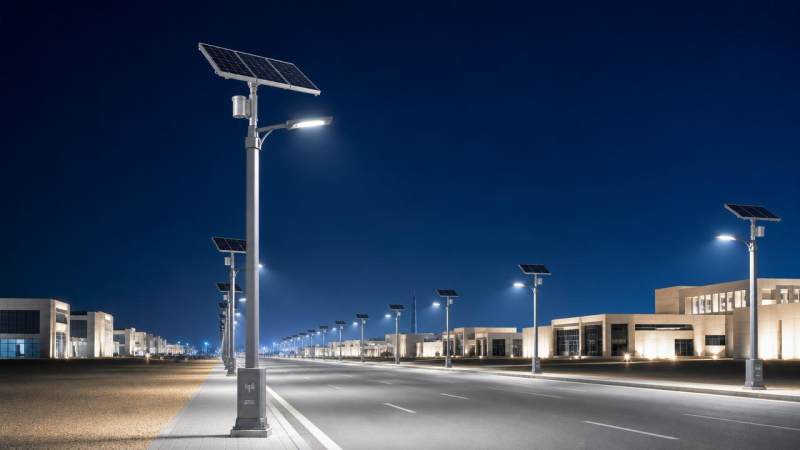
On May 15, 2026, the release of the 2026 Gulf Cities Resilient Infrastructure White Paper—jointly published by Saudi Arabia’s Public Investment Fund (PIF) and the UAE’s ADQ—confirmed that Saudi Arabia, the UAE, and Qatar have mandated off-grid solar-powered security lighting systems for new urban developments. These systems must integrate motion sensing, remote monitoring, and fire alarm interlocking functionality. The policy shift has directly driven a 41% year-on-year increase in Chinese exports of such solar streetlights to these three countries in Q1 2026, reaching USD 320 million—with dual-mode LoRaWAN + NB-IoT communication modules now accounting for 68% of exported units. This development is especially relevant for manufacturers of smart lighting hardware, IoT module suppliers, export-oriented OEM/ODM firms, and logistics providers specializing in energy infrastructure equipment.
Event Overview
On May 15, 2026, the 2026 Gulf Cities Resilient Infrastructure White Paper, co-published by Saudi PIF and UAE ADQ, stated that Saudi Arabia, the UAE, and Qatar have designated off-grid solar security lighting as a mandatory component for new city construction projects. The specification requires integration of motion detection, remote surveillance, and fire alarm联动 (interlocking). According to publicly reported trade data, Chinese exports of solar streetlights to these three countries totaled USD 320 million in Q1 2026, up 41% year-on-year. Among exported units, those equipped with LoRaWAN and NB-IoT dual-mode communication modules rose to 68% share.
Impact on Specific Industry Segments
Direct Export Trading Firms
These firms face immediate shifts in product compliance requirements and certification pathways. The mandate introduces functional and interoperability expectations beyond basic photovoltaic performance—e.g., standardized sensor output protocols and alarm interface logic. Impact manifests in longer pre-shipment verification cycles, increased technical documentation demands, and potential delays if legacy models lack certified fire alarm linkage capability.
Component & Module Suppliers (e.g., LoRaWAN/NB-IoT Module Makers)
Suppliers of wireless communication modules are seeing rising demand for dual-mode (LoRaWAN + NB-IoT) configurations tailored to Middle Eastern telecom infrastructure and regulatory testing regimes. The 68% adoption rate signals a structural shift—not just incremental growth—toward embedded, certified low-power wide-area network (LPWAN) solutions. Impact includes tighter lead-time pressure, need for regional type-approval support, and heightened scrutiny on firmware upgradability and over-the-air (OTA) update compatibility.
Lighting OEMs & System Integrators
OEMs supplying turnkey solar lighting systems must now align hardware architecture with multi-sensor fusion and alarm interlock logic. This affects bill-of-materials planning, firmware development timelines, and third-party verification scope (e.g., UL 1995 or EN 50131 certifications may become de facto prerequisites). Impact is most visible in R&D cycle extension and increased validation costs per SKU—especially where motion sensing and fire alarm interfaces require separate safety-grade isolation design.
Supply Chain & Logistics Service Providers
Providers handling cross-border shipment of solar lighting systems face new classification and documentation requirements. Off-grid systems with integrated sensors and alarm interfaces may trigger additional customs tariff codes (e.g., under HS 8543 for electrical apparatus with automatic control functions), affecting duty calculation and import clearance speed. Impact includes need for updated commodity coding training, deeper coordination with local import agents in target GCC markets, and proactive alignment with evolving GCC Standardization Organization (GSO) conformity assessment procedures.
What Relevant Companies or Practitioners Should Monitor and Act On
Track official technical annexes and implementation guidelines
The White Paper sets policy direction but does not yet publish detailed technical specifications. Analysis shows that full rollout will likely depend on forthcoming GSO or national standards documents—expected in late 2026 or early 2027. Exporters should monitor updates from Saudi SASO, UAE ESMA, and Qatari MOE for test method harmonization and certification timelines.
Focus on dual-mode communication module availability and regional certification status
Current 68% share reflects market preference—but not yet regulatory mandate. Observably, this share is rising due to interoperability advantages in heterogeneous GCC telecom environments. Companies should prioritize sourcing modules already certified under both LoRa Alliance and GSMA NB-IoT frameworks—and verify local network operator compatibility (e.g., Etisalat, STC, Ooredoo) before finalizing BOMs.
Distinguish between policy signal and procurement reality
While the White Paper declares mandatory deployment, actual tender documents for new city projects (e.g., NEOM, Masdar City Phase II, Lusail expansion) have not yet universally incorporated all specified features. From industry perspective, current tenders still vary widely in technical depth—some referencing only ‘solar-powered lighting’, others specifying full sensor+alarm integration. Companies should review live GCC public procurement portals—not just policy texts—to assess real-world enforcement pace.
Prepare for extended lead times and revised compliance workflows
Manufacturers should audit internal QA processes against anticipated GSO Type 5 (conformity marking) requirements for integrated security lighting. Current more suitable understanding is that fire alarm interlock functionality may require third-party functional safety assessment (e.g., IEC 61508 SIL1), which adds 6–8 weeks to certification timelines. Preemptive engagement with accredited labs in Dubai or Riyadh is advisable ahead of Q3 2026 tender waves.
Editorial Perspective / Industry Observation
This development is best understood as a strong policy signal—not yet a fully operationalized regulatory regime. Analysis shows it marks the formal institutionalization of solar lighting beyond energy efficiency into urban resilience infrastructure. It reflects a broader strategic pivot across Gulf states: away from standalone renewable energy deployment toward integrated, intelligent, and mission-critical applications. Observably, the emphasis on fire alarm interlocking suggests convergence between lighting systems and building management systems (BMS), implying future demand for standardized data models (e.g., BACnet/IP, MQTT over TLS). Industry should treat this as an inflection point—not just a procurement trend—because it redefines the functional scope and liability profile of solar lighting products in high-stakes infrastructure contexts.
Conclusion
Overall, the White Paper’s mandate signals a structural upgrade in the value proposition of solar streetlights in the Gulf—shifting from passive illumination to active security and resilience enablers. For industry participants, this means moving beyond photovoltaic yield optimization toward system-level interoperability, functional safety, and regulatory foresight. Currently, it is more accurate to interpret this as a directional catalyst than a near-term revenue driver—its primary impact lies in reshaping product development roadmaps, supply chain readiness, and technical compliance strategies over the next 12–24 months.
Information Sources
Main source: 2026 Gulf Cities Resilient Infrastructure White Paper, jointly published by Saudi Public Investment Fund (PIF) and UAE ADQ on May 15, 2026.
Note: Technical implementation guidelines, national standard references, and tender-level enforcement details remain pending publication and are subject to ongoing observation.
The VitalSync Intelligence Brief
Receive daily deep-dives into MedTech innovations and regulatory shifts.