
Security
Middle East Launches 'Smart Infrastructure 2030' Procurement
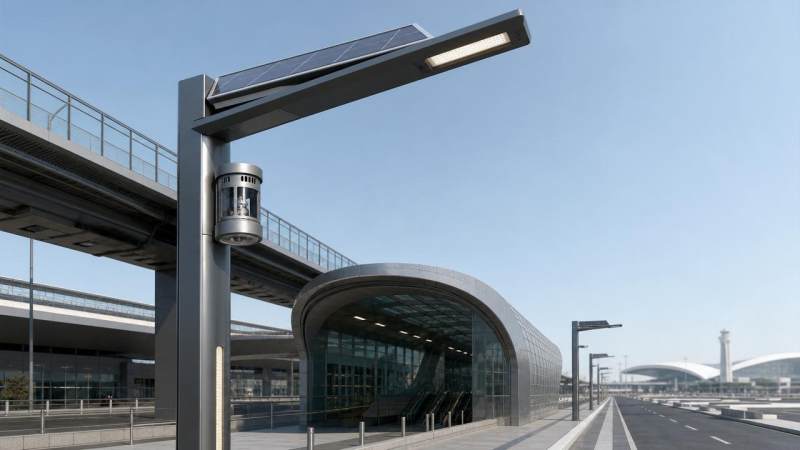
Three Gulf states — the UAE, Saudi Arabia, and Qatar — have jointly launched the first phase of the 'Smart Infrastructure 2030' procurement initiative, with centralized tendering scheduled for Q2 2026. This development signals material implications for global suppliers of integrated solar-powered lighting and fire suppression systems — particularly those serving transportation and urban development infrastructure. Companies active in EPC delivery, cybersecurity-compliant system integration, and Middle East–certified distribution channels should treat this as a structurally significant procurement signal.
Event Overview
The UAE, Saudi Arabia, and Qatar jointly announced the initiation of the 'Smart Infrastructure 2030' first-phase procurement. As confirmed in official statements, 12 large-scale projects will enter centralized tendering in Q2 2026. These projects cover airports, metro stations, and new city development zones. The scope explicitly requires integrated solutions combining solar-powered LED road lighting and dual-technology fire suppression systems (aerosol and fine water mist). Bidders must hold IEC 62443-3-3 cybersecurity certification and demonstrate compliance with both UL 1598 (luminaires) and UL 864 (fire alarm control units).
Industries Affected by Segment
Direct Trade Enterprises (Export-Oriented EPC Integrators)
These firms are directly impacted because the tender mandates end-to-end system integration — not component supply alone. The requirement for combined solar lighting + fire suppression functionality means standalone product exporters face disqualification unless embedded within an integrated EPC proposal. Impact manifests in bid eligibility criteria, project qualification timelines, and post-award service obligations (e.g., local commissioning, cybersecurity validation).
Channel Distribution Enterprises (Regional Distributors & Local Certification Agents)
Distributors without formal representation agreements covering IEC 62443-3-3 and UL dual-standard certification support cannot enable their supplier partners to meet tender prerequisites. The emphasis on ‘local certification agents’ in the announcement indicates that third-party conformity assessment capacity — not just brand presence — determines market access. Impact centers on commercial viability: distributors lacking accredited local testing or documentation support may be excluded from bid consortia.
Manufacturing Enterprises (Lighting & Fire Suppression OEMs)
OEMs producing only UL 1598– or UL 864–certified components — but not both — are indirectly affected. Since integration is mandatory, OEMs unable to co-certify subsystems under unified architecture risk marginalization. Impact is most visible in R&D alignment: future product roadmaps must accommodate interoperability testing across lighting control and fire alarm signaling protocols.
Supply Chain Service Providers (Certification, Testing & Localization Support Firms)
Third-party labs and certification consultants with verified IEC 62443-3-3 assessment capability — especially those recognized by Gulf Standardization Organization (GSO) or ESMA — face increased demand. The tender’s explicit reference to IEC 62443-3-3 (not just general IT security) implies granular technical validation is required, not self-declaration. Impact includes workload scaling and need for documented regional accreditation status.
What Relevant Enterprises or Practitioners Should Focus On
Monitor official tender documentation release timelines — not just the 2026 Q2 deadline
While Q2 2026 marks the centralized bidding window, pre-qualification phases, technical clarification deadlines, and local registration requirements often begin 6–12 months earlier. Enterprises should track announcements from each country’s procurement portals (e.g., UAE’s Etimad, Saudi’s NCEC, Qatar’s eTender) rather than relying solely on joint statements.
Prioritize verification of dual UL certification coverage — not just individual product listings
UL 1598 and UL 864 certifications must apply to the *integrated system*, not isolated components. Observably, many vendors hold one but not both — and some assume modular certification suffices. Current more accurate understanding is that system-level test reports validating communication integrity between lighting controllers and fire alarm interfaces will be required.
Distinguish between policy signal and operational readiness
The joint announcement confirms intent and framework, but does not yet specify budget allocation, award criteria weighting (e.g., cybersecurity vs. energy efficiency), or local content requirements. Analysis shows that while the signal is strong, actual bid preparation must wait for technical specifications — which historically follow intergovernmental coordination phases lasting 9–15 months after such declarations.
Engage certified local agents now — not during bid submission
Local certification agents require time to complete documentation review, site audits, and GSO/ESMA liaison. Enterprises lacking pre-established relationships with accredited agents in at least two of the three countries (UAE, KSA, Qatar) face high risk of missing pre-qualification windows. Pre-engagement allows alignment on labeling, Arabic-language manuals, and cyber-resilience evidence packages.
Editorial Perspective / Industry Observation
This initiative is best understood not as an immediate procurement event, but as a structural calibration of regional infrastructure procurement standards. Observably, the inclusion of IEC 62443-3-3 — a relatively recent industrial cybersecurity benchmark — alongside dual UL certification suggests Gulf states are converging toward harmonized, outcome-based system assurance, moving beyond legacy component-level compliance. Analysis shows this reflects broader Gulf regulatory trends: tighter integration of safety, sustainability, and cyber-resilience into public infrastructure contracts. It is less a short-term opportunity and more a long-term threshold — one that redefines minimum technical and procedural eligibility for participation in major Gulf infrastructure programs.
From an industry standpoint, the timing matters: Q2 2026 places planning cycles squarely in 2024–2025. That makes current activity — certification alignment, agent engagement, and interoperability testing — preparatory, not reactive. The announcement functions primarily as a formalized signal, not a finalized contract pipeline.
Conclusion
The 'Smart Infrastructure 2030' procurement launch represents a calibrated shift in Gulf infrastructure procurement standards — emphasizing integrated, certified, and cyber-resilient systems over discrete hardware supply. Its significance lies not in near-term revenue generation, but in its role as a binding technical benchmark for future Gulf infrastructure tenders. Enterprises should interpret it as a multi-year alignment milestone: preparation now affects eligibility later. A measured, certification-first response — rather than speculative bidding — remains the most operationally appropriate stance.
Source Attribution
Primary source: Joint statement issued by the UAE, Kingdom of Saudi Arabia, and State of Qatar on the 'Smart Infrastructure 2030' initiative.
Note: Tender specifications, budget details, and evaluation criteria remain unpublished and are subject to official release through national procurement platforms. These elements require ongoing monitoring.
The VitalSync Intelligence Brief
Receive daily deep-dives into MedTech innovations and regulatory shifts.