
Security
PPE Export Prices Rise as Respiratory Gear Leads
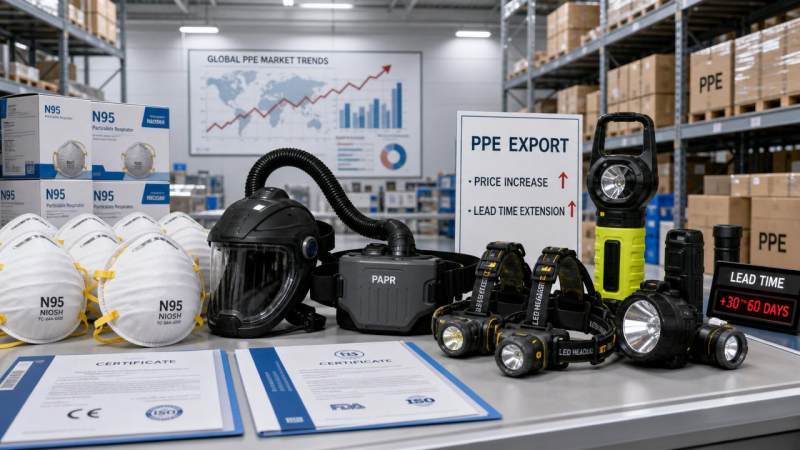
On June 1, 2026, the market signal worth watching is not only the rise in China’s PPE export prices, but also the way price pressure and certification timing are now affecting delivery in adjacent product categories. Based on the latest weekly monitoring released by the China Chamber of Commerce for Import and Export of Textiles, the increase is most visible in respiratory protection products, while delays in CE and FDA certification updates for some models are already extending lead times for cross-category PPE Gear-Safety Wear products such as safety headlamps and explosion-proof handheld lamps with integrated respiratory interfaces. For exporters, buyers, certification-related service providers, and procurement teams, this is relevant because it touches pricing, compliance timing, document readiness, and order execution at the same time.
What the latest weekly monitoring confirms
According to the Global PPE Export Price Monitoring Weekly Report released on June 7, 2026 by the China Chamber of Commerce for Import and Export of Textiles, China’s overall PPE export price index in the first week of June rose 12.3% year on year.
Within that same update, respiratory protection products, including N95/KN100 masks and powered air-purifying respirators, recorded a year-on-year increase of 18.6%.
The same information also indicates that higher prices, combined with delayed CE and FDA certification updates for some models, have already pushed delivery cycles for cross-category PPE Gear-Safety Wear orders to 8–10 weeks. The affected products include safety headlamps and explosion-proof handheld lamps that incorporate integrated respiratory interfaces.
Where the pressure is likely to appear first
Export order execution is becoming more sensitive
From an industry perspective, exporters may be affected first because price changes and certification timing directly influence quotation validity, delivery commitments, and shipment scheduling. What deserves closer attention is whether order documents, technical specifications, and certification status remain aligned when products involve both PPE and safety-lighting functions.
Procurement teams face a tighter coordination window
For procurement-side participants, the reported extension of lead times to 8–10 weeks matters because purchasing plans for integrated products may no longer be managed as routine accessory buying. Analysis shows that buyers of safety headlamps and explosion-proof handheld lamps with respiratory interfaces may need to pay closer attention to supplier certification status, model-specific document updates, and delivery sequencing before confirming replenishment or project procurement schedules.
Certification and testing-related service links may see more scrutiny
Certification-related enterprises and testing service institutions may also come under greater operational pressure, not because new rules were explicitly announced in the input, but because delayed CE and FDA certification updates are already affecting delivery. Observably, this makes the timing of compliance review, document renewal, and model matching more consequential for transaction execution.
Supply-chain service providers may need to adjust handoff expectations
For supply-chain coordinators and channel operators, the impact is likely to appear in handoff timing, order visibility, and customer communication. Where products fall into a PPE Gear-Safety Wear cross-category, businesses may need to monitor whether the latest certification documents and shipping preparations stay consistent with the product configuration being delivered.
What companies should watch in current transactions
Check whether certification updates match the exact model in shipment
Analysis shows that the practical issue is not certification in the abstract, but whether CE and FDA update status for some models is consistent with the exact integrated product being quoted, ordered, or shipped. Companies should therefore pay close attention to model-level documentation, especially where respiratory functions are built into safety lighting products.
Review lead-time commitments in contracts and procurement files
With reported delivery cycles already extending to 8–10 weeks for some cross-category orders, what deserves closer attention is whether internal procurement schedules, tender files, supply agreements, and customer delivery promises still reflect current execution conditions. This is particularly relevant where delivery timing is treated as a binding commercial term.
Keep technical and trade documentation synchronized
Observably, cross-category products create a higher risk of mismatch between product description, technical documentation, and compliance paperwork. Companies involved in export, sourcing, or distribution should therefore watch whether technical files, testing references, and shipment-related documents are being updated in step with the product model and certification status.
Monitor whether market signals turn into wider compliance friction
The input does not confirm a broader regulatory change beyond the reported certification-update delays and price movements. Even so, it is more appropriate to understand the current situation as a signal to monitor whether certification timing, procurement review, and customer acceptance requirements become tighter in actual order execution.
Why this matters beyond a price increase
Analysis shows that this development is not only about PPE becoming more expensive. It also highlights how pricing pressure and certification timing can interact to affect adjacent categories that combine protective and safety-use functions. For the industry, the more important takeaway is that compliance timing can become an operational bottleneck even when the immediate headline is a price index move.
It is more appropriate to understand this as an execution signal rather than a fully settled rule change. The facts provided already point to a real effect on delivery cycles, but the broader market response, including how buyers, suppliers, and certification-related parties adjust their practices, still requires continued observation.
How to read the current signal
From an industry perspective, the current update should be read as a practical warning that pricing, certification renewal timing, and delivery planning are becoming more tightly linked in certain PPE-related product lines. It does not by itself establish a new formal regulatory framework, but it does indicate that companies dealing in integrated respiratory-interface lighting products should not treat compliance and procurement as separate processes.
A rational reading is that this is an already visible market and execution change with compliance implications, while the full downstream effect on purchasing standards, tender wording, and customer acceptance practice still needs to be watched carefully.
Basis of this article and points still requiring verification
This article is generated from the user-provided title, event date, and event summary. The factual basis referenced here comes from the described weekly monitoring release by the China Chamber of Commerce for Import and Export of Textiles and the details provided in the input.
For events of this type, commonly relevant source categories may include official announcements, information published by regulatory authorities, customs or trade administration updates, industry association releases, standard-setting documents, and reporting by authoritative media. However, a specific official source link was not provided in the input, so continued verification is still needed.
What should continue to be monitored includes any further clarification on certification execution, model-specific compliance updates, changes in tender or procurement documentation, market feedback on delivery conditions, and how enterprises are adjusting actual order handling in response.
The VitalSync Intelligence Brief
Receive daily deep-dives into MedTech innovations and regulatory shifts.