
Security
How transport hub security requirements shape passenger access
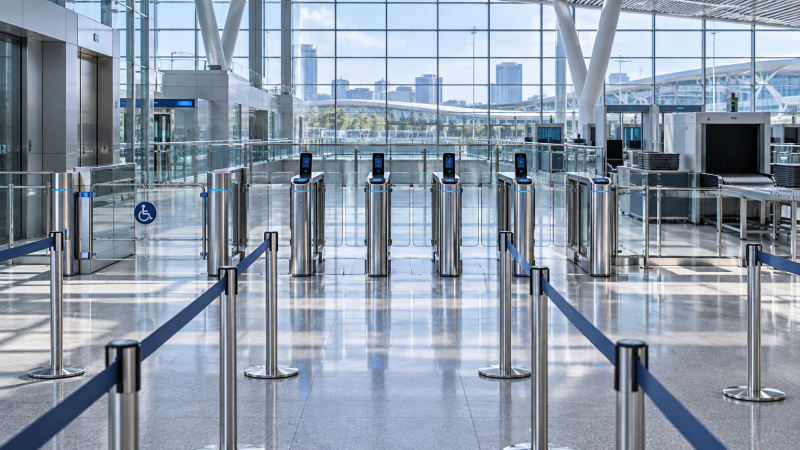
Transport hub security requirements shape passenger access by determining where entry is permitted, what must be verified at each boundary, and how people move when normal operations change. A workable layout places controls where they address a defined threat, provides enough space for the resulting queues, and preserves accessible routes and emergency escape. Adding gates or screening equipment without resolving these relationships creates congestion and leaves gaps around the controlled entrance.
The starting point is a map of passenger journeys and security boundaries. Each crossing needs a clear purpose: ticket validation, identity verification, prohibited-item screening, or protection of a restricted area. These functions require different equipment, staffing, and space. Combining them at one entrance is justified only when their operating rules and passenger flows remain compatible.
Define the boundary before selecting the equipment
A terminal entrance, a ticket barrier, and an airside checkpoint serve different purposes. Ticket validation establishes a travel entitlement; it does not establish that a person or bag has passed security screening. Likewise, an identity check does not automatically authorize access to every restricted area. The access plan must distinguish these decisions so that one successful transaction does not unintentionally unlock a more sensitive zone.
For every boundary, record the origin and destination zones, the evidence required for passage, the permitted direction of travel, and the response to an unsuccessful check. The same drawing should show adjacent retail entrances, lifts, stairs, service corridors, and doors used during maintenance. A controlled main entrance loses its purpose when an adjoining route crosses the same boundary without equivalent control.
Transfers deserve particular attention. A passenger arriving from another service may already have passed one form of control, but that status only remains useful if the route preserves the relevant separation and the destination recognizes it. Where recognition is absent, the transfer route needs space for another check. Assuming all connecting passengers can remain within a controlled zone often leads to late changes in corridors and waiting areas.
Queue space is part of the security design
A checkpoint's equipment rating does not describe the capacity of the complete passenger journey. Preparation, document presentation, bag handling, secondary inspection, and collection of belongings all affect how quickly a lane clears. A fast scanner provides little benefit when its downstream collection area remains occupied.
Capacity assessment needs arrival patterns over short intervals, especially around train arrivals, departure banks, event dispersal, and service disruption. An hourly average conceals the bursts that fill a concourse. The useful question is whether the available lanes and queue area absorb the expected surge while keeping crossing routes, entrances, and escape paths usable.
A simple planning relationship illustrates the pressure: when the arrival rate exceeds the processing rate, queue growth approximately equals that difference multiplied by the duration of the imbalance. This estimate is only a starting point. Lane interruptions, passenger groups, and variable inspection times require operational observations or simulation before the layout is accepted.
Queue storage must also reflect the people occupying it. Wheeled luggage, pushchairs, mobility aids, and family groups change the usable capacity of a holding area. Floor area divided by an assumed standing density is insufficient if the resulting arrangement prevents turning, overtaking, or access to an assistance point.
Secondary inspection needs its own space and a controlled return route. Moving a passenger aside should release the main lane without creating an opportunity to bypass the unfinished check. Where queue overflow is expected, the overflow area and its activation procedure belong in the design; relying on improvised barriers during a surge creates unpredictable circulation.
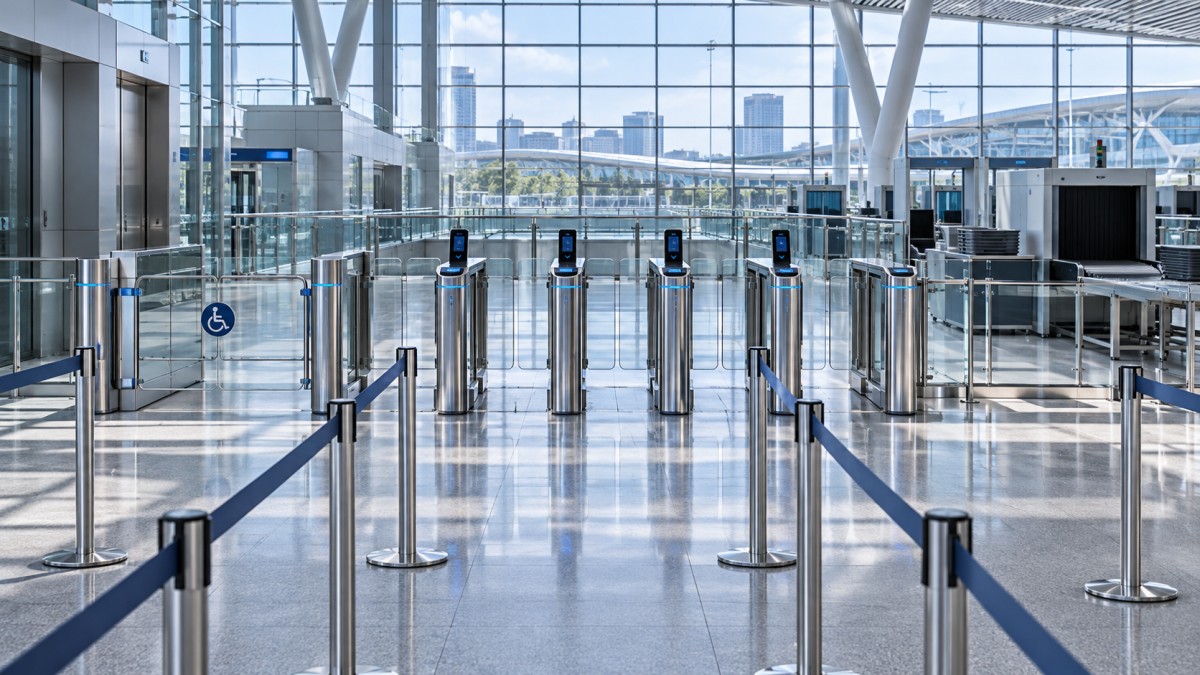
Accessible routes must preserve the same security boundary
An accessible gate should connect the same origin and destination zones as the adjacent standard lanes. A separate route through a remote service door introduces additional supervision, wayfinding, and boundary-control demands. If that route depends on assistance, the waiting position must remain visible and reachable without forcing a passenger to stand in the main flow.
Clear opening width is only one part of access. The approach angle, turning space, threshold, gate opening duration, reader position, and space beyond the gate determine whether passage works with a mobility aid or luggage. A wide gate placed immediately before a sharp turn can still create difficulty.
Screening procedures also need a defined alternative when the standard process cannot be used. The layout must accommodate that procedure with suitable privacy, supervision, and space for accompanying belongings. A temporary workaround established after installation often consumes circulation space that was assumed to be available.
Accessible gates used for pushchairs, large bags, or assisted groups need demand estimates that reflect those journeys. Treating them as rarely used exceptions understates their contribution to throughput. Their control logic also matters: an extended opening must support authorized passage while addressing following passengers who have not completed the required check.
Connect gate behavior to evacuation and disruption scenarios
Security seeks to restrict unauthorized movement; evacuation requires a usable path away from danger. The design must resolve this relationship for each door and barrier through an agreed fire and life-safety strategy. A single instruction to “unlock all gates” does not capture differences between public exits, restricted-area doors, and routes that cross security boundaries.
For each controlled opening, define its behavior during fire alarm activation, power loss, network failure, local emergency release, and an instruction to restrict entry. The relevant behavior includes opening direction, release mechanism, indication at the control position, and restoration after the event. Emergency egress must function as required even when the normal ticketing or access transaction is unavailable.
A security incident does not always call for the same movement as a fire. Restricting entry into an affected area while allowing occupants to leave requires different controls from directing evacuation through it. Commands therefore need an explicit scope, including which gates change state and which routes remain available.
Power recovery is another overlooked transition. A controller restarting after an outage must not unexpectedly close a barrier across people already passing through. Once an evacuation or uncontrolled opening has broken a protected boundary, normal operation also requires a defined method for restoring that boundary. Reclosing the gates alone does not establish the status of everyone remaining inside.
Make surveillance and lighting support access decisions
Camera coverage should follow the decisions made at the boundary. An overview image helps reveal queue growth or movement against the intended direction. Reviewing a disputed gate passage needs a view of the transaction and the people crossing. Those tasks require different framing, so a camera count or a coverage diagram alone cannot establish performance.
The scene changes substantially between an empty-terminal survey and a busy operating period. Passengers obscure one another, open gates interrupt sightlines, and temporary signs or retail fixtures block views. Camera positions need assessment with queues present and with the equipment in its operating positions.
Lighting must support both movement and image capture. A floor illuminance reading does not describe the light reaching faces near a reader. Bright exterior glazing behind an entrance creates backlighting; reflective floors and polished barriers introduce glare. Camera exposure settings that handle a bright doorway can leave nearby faces poorly resolved.
Verification should use the installed camera, lens, exposure configuration, and intended lighting scenes. Evening operation, daylight transitions, and reduced lighting modes expose weaknesses that a single daytime inspection misses. Where recorded video is intended to support an access investigation, the acceptance criteria should describe what the image must reveal under these conditions.
Surveillance also has an operational destination. An alert for reverse movement or suspected tailgating needs a defined response location and an available responder. Without that connection, detection produces an event record while the access problem continues. Recording, retention, and access permissions should follow the applicable governance requirements without unnecessarily collecting personal data throughout every public route.
Keep fare systems and security permissions distinct
Sharing infrastructure does not remove the need for separate permission rules. A valid ticket can authorize entry to a platform while a restricted corridor requires another credential. The software configuration must preserve these distinctions, including temporary permissions and any time or direction restrictions.
Failure behavior deserves the same attention as normal transactions. If a communications link fails, locally stored permissions may allow some gates to continue operating. That arrangement needs rules for expired credentials, event storage, and reconciliation after reconnection. A fallback that accepts every presented credential changes the boundary's protection and requires explicit justification.
Duplicate scans, unreadable tickets, and incomplete transactions should direct passengers to a resolution point without obstructing the next person. The route from that point back to the controlled entrance must be clear. Otherwise, exception handling becomes an informal bypass or repeatedly feeds people into the wrong queue.
Event timestamps across gates, video, and alarm systems need sufficient consistency to reconstruct a passage. This matters when determining whether a gate opened for a valid transaction, an emergency command, or a fault. Integration testing should demonstrate the full sequence, including the visible gate state and the information received at the control position.
Accept the passenger journey under realistic conditions
Commissioning becomes meaningful when it follows complete journeys through the finished space. Equipment functioning individually does not establish that signage, queues, access permissions, and exception handling work together. Trial scenarios should include:
- A concentrated passenger arrival while one processing lane is unavailable, with observation of queue spillback and crossing routes.
- Assisted passage through the accessible route, including a failed credential and return from the resolution point.
- Network loss during an active transaction. Gate behavior, local records, and recovery need to remain consistent with the agreed operating rules.
- An emergency release followed by restoration of the controlled boundary, including passengers and belongings still within the affected space.
Acceptance records should connect each scenario to observable outcomes: where people wait, whether routes remain usable, what state each gate enters, and what information reaches the control position. These records make faults reproducible and distinguish a hardware defect from an unsuitable operating procedure or layout.
Temporary works require the same scrutiny. Moving a queue, adding a retail enclosure, or closing a corridor changes approach angles, camera sightlines, and the available escape space. A revised passenger route should be assessed against the original boundary and flow assumptions before it opens, even when every installed device remains technically functional.
The VitalSync Intelligence Brief
Receive daily deep-dives into MedTech innovations and regulatory shifts.