
Security
China's AI Terminal Intelligence Grading Standard GB/Z 177—2026 Takes Effect
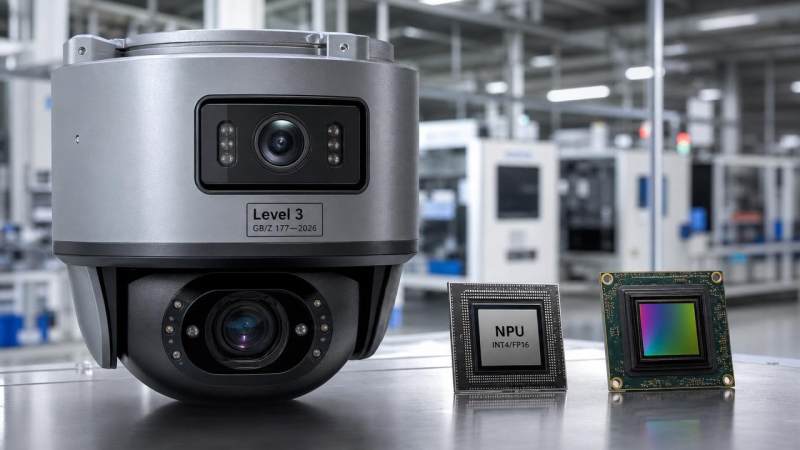
On May 15, 2026, China’s national guideline GB/Z 177—2026, Guidelines for Artificial Intelligence Terminal Intelligence Grading, officially entered into force. The standard introduces new AI capability compliance requirements for export-oriented intelligent security cameras and AI-driven industrial lighting controllers—marking the first time that AI vision analytics, edge inference latency, and on-device model update capability have been codified as mandatory evaluation criteria in China’s export regulatory framework. Its implementation directly impacts manufacturers, exporters, and supply chain actors engaged in the global trade of AI-integrated physical infrastructure.
Event Overview
The National Standardization Administration of China published GB/Z 177—2026 as a guidance document (not a mandatory standard per se, but referenced in customs, certification, and procurement protocols). It became effective on May 15, 2026. The document defines five intelligence grades (Level 0 to Level 4) based on functional capabilities including real-time visual scene understanding, sub-200ms local inference response under defined workloads, and secure, authenticated over-the-air model updates without cloud dependency. It explicitly applies to intelligent surveillance terminals and AI-enabled lighting control systems intended for export—particularly those targeting markets with overlapping AI governance regimes, such as the EU under its AI Act transition arrangements.
Industries Affected
Direct Export Enterprises: Exporters of smart security cameras and industrial lighting controllers must now declare AI capability grades in technical dossiers submitted to Chinese customs and third-party certification bodies (e.g., CCC-related AI annex assessments). Non-declaration—or misclassification—may delay export clearance or trigger post-shipment verification audits. Buyers in the EU are increasingly requesting alignment between GB/Z 177–2026 grading statements and CE+AI Act conformity declarations, especially where AI functions fall under ‘high-risk’ use cases.
Raw Material Procurement Enterprises: Suppliers of AI-acceleration chips (e.g., NPUs supporting INT4/FP16 mixed-precision inference), low-latency image sensors, and secure element modules face revised technical specification requests. Procurement teams now need to verify not only component performance (e.g., inference throughput) but also firmware-level support for standardized model update protocols—such as signed OTA frameworks compliant with GB/Z 177–2026 Annex B.
Manufacturing Enterprises: OEM/ODM producers must adapt production test flows to include standardized AI functionality validation: e.g., benchmarking inference latency across lighting control scenarios (motion-triggered dimming, occupancy-based zoning), verifying local model reload success rates, and logging AI vision accuracy metrics under varying ambient light conditions. These tests are now part of pre-shipment QA checklists referenced by certification labs.
Supply Chain Service Providers: Logistics and compliance service firms—including those offering export documentation, type testing coordination, and EU Authorized Representative services—must integrate GB/Z 177–2026 grading documentation into their service packages. Notably, some third-party labs have begun offering ‘Grade Verification Reports’ aligned with the standard’s Annex A test methodology—a service previously unavailable.
Key Focus Areas and Recommended Actions
Verify AI capability mapping against GB/Z 177–2026 grade definitions
Enterprises should conduct internal gap assessments using the official grading matrix (e.g., Level 2 requires ≥90% accuracy in person/vehicle classification under 10 lux illumination; Level 3 adds multi-object tracking continuity). Avoid self-declaring higher grades without validated test evidence—regulatory referencing is increasing in customs risk profiling.
Update technical documentation for dual-market alignment
For EU-bound shipments, align GB/Z 177–2026 capability statements with AI Act Annex III high-risk system documentation. Specifically, clarify whether AI functions constitute ‘safety components’ (e.g., lighting control during emergency egress), which triggers stricter conformity assessment pathways under both frameworks.
Engage certified labs early for Grade Verification Reports
Given limited lab capacity for standardized AI terminal testing—and growing buyer demand for verified grading—enterprises are advised to schedule verification cycles at least 8–10 weeks ahead of planned shipment dates. Labs accredited by CNAS under GB/Z 177–2026 scope are currently listed on the Standardization Administration’s public portal.
Editorial Perspective / Industry Observation
Observably, GB/Z 177–2026 is not merely a technical checklist—it signals China’s strategic move toward shaping de facto interoperability norms for edge-AI hardware in physical infrastructure domains. Unlike broad AI governance frameworks, this guideline focuses narrowly on measurable, verifiable device behaviors—making it operationally actionable for manufacturers. Analysis shows that its adoption rate among Tier-2 suppliers remains uneven: while leading camera OEMs have integrated grading into R&D roadmaps since 2025, many lighting controller makers still treat it as a ‘compliance overhead’ rather than a product differentiation lever. From an industry perspective, the standard’s true influence will be revealed not in immediate enforcement, but in how quickly international buyers begin citing it contractually—particularly in public tenders for smart city infrastructure.
Conclusion
The entry into force of GB/Z 177–2026 represents a calibrated step in the institutionalization of AI capability accountability at the device level. It does not replace existing safety or EMC standards—but layers AI-specific behavioral expectations onto them. For global supply chains, the more consequential implication is procedural: it normalizes the expectation that AI features in embedded systems must be characterized, tested, and declared—not just marketed. A rational interpretation is that this reflects converging global pressures to render AI tangible, auditable, and traceable in mission-critical physical environments.
Source Attribution
Official text published by the Standardization Administration of the People’s Republic of China (SAC), Document No. SAC/TC 28/SC 42-2026-001; effective May 15, 2026. Supporting interpretation notes issued by China Academy of Information and Communications Technology (CAICT), April 2026. Note: Mutual recognition status between GB/Z 177–2026 grading and EU AI Act conformity claims remains pending formal bilateral dialogue—this area warrants ongoing monitoring.
The VitalSync Intelligence Brief
Receive daily deep-dives into MedTech innovations and regulatory shifts.